
Pandora plans to build second factory


Play
PANDORA, one of the world's largest jewellery brands, is buying a land plot in northern Thailand in order to build its second factory in the country and globally, senior vice president Thomas Nyborg said.
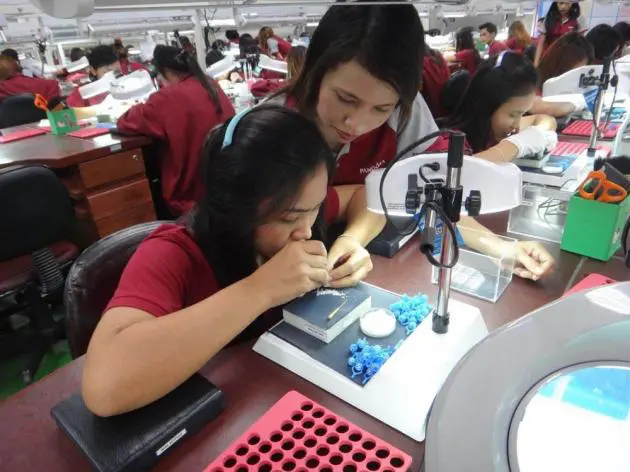
Pandora has been based at the Gemopolis Industrial Estate in Bangkok since 2003.
Nyborg, who heads the Denmark-headquartered company’s Thailand operations, said the new factory would serve Pandora’s rapid expansion and mitigate the risks associated with having a single manufacturing site.
He said Pandora made about 80 million pieces of jewellery a year, or nearly 2 million pieces weekly, in Thailand – more than 10 times the production rate of large Thai-owned jewellery companies such as Pranda Jewelry Plc.
Pandora’s number of employees had gone up from about 1,300 six years ago to more than 7,000 now.
He said many other jewellery companies had been affected by the fluctuating metal costs, but Pandora had weathered the storm due to its fully integrated operations – from design to manufacturing to retailing – and its professional management team.
Listed on the Nasdaq-OMX Copenhagen stock exchange, Pandora reported group revenue of 9 billion Danish krone (Bt49.5 billion) in 2013, a 32-per-cent EBITDA (earnings before interest, tax, depreciation, and amortisation) margin and a net profit of 2.22 billion Danish krones.
For 2014, it expects revenue of more than 11 billion Danish krones and an EBITDA margin of approximately 35 per cent.
The group currently employs more than 9,000 people worldwide.
Nyborg was quoted last June as saying Pandora was considering building a new factory outside Thailand due to fears of political unrest and natural disasters.
But in an exclusive interview with The Nation last week, he said the company was at the time worried about the possible cancellation of Board of Investment incentives offered to the jewellery industry, which did not happen.
“The issue is we’re happy here. Thailand is our good production base,” he said.
Nevertheless, Nyborg said Pandora would eventually have to build a new factory outside Thailand to get closer to its major markets.
Beginning in Europe, the Danish company has expanded its markets to cover the United States, its biggest market, and only started penetrating Asia about five years ago.
For the Thai market, it appointed Tanachira Retail as its exclusive distributor less than three years ago.
Pandora jewellery is sold in more than 80 markets through approximately 10,000 points of sale around the world, including estores and 1,200 concept outlets. Nyborg said the company was not affected by the recent increase of Thailand’s minimum daily wage of Bt300.
“Last year, our share of Thailand’s jewellery exports was over 5 per cent,” he said.
Gems and jewellery is Thailand’s fourth-largest export earner.
According to the Gem and Jewelry Institute of Thailand, between January and August the country exported gems and jewellery valued at Bt215.4 billion, up almost 8 per cent from a year ago. Gems and jewellery accounted for 4.5 per cent of the country’s total exports.
Nyborg said Pandora’s two biggest challenges were maintaining its high growth rate (it grew 30 per cent in 2013 and projects to expand by 25 per cent this year) and attracting key talent.
“We work very hard to professionalise our operations. But most people don’t know. When they think of jewellery companies, they tend to think of family-owned enterprises like those in Mahesak or Baan Mor,” he said.
“We’re a very modern company. We don’t compare ourselves to other jewellery firms, rather to automobile, electronics and fast-moving consumer-goods companies.”
Pandora was founded over 30 years ago by Danish goldsmith Per Enevoldsen, who now lives in Thailand.
The company started buy jewellery from Thailand in 1982 before setting up its own production base here.
