
'Marketers need to be aware of uniqueness of consumers'


Play
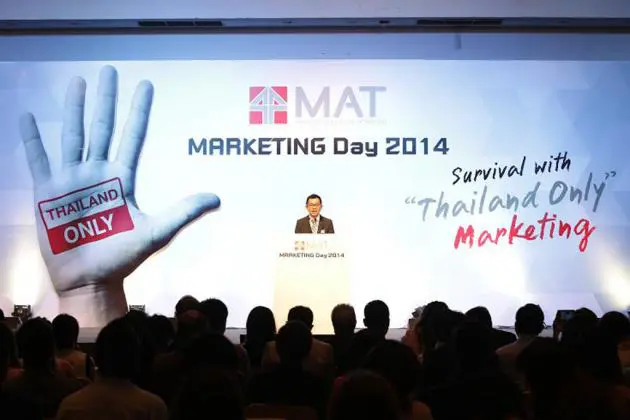
Amid the global trend of consumer behaviour being shaped by online media, local people are still showing their "Thailand only" values and lifestyles, and such uniqueness should be considered carefully by any marketer aspiring to succeed in this market.
Dangjaithawin Anantachai, managing director of Intage (Thailand) and president of the Thailand Marketing Research Association, said yesterday that global economic power would shift to Asia.
She was speaking at a seminar on “Survival with ‘Thailand Only’ Marketing” held by the Marketing Association of Thailand.
According to Goldman Sachs’ projection of the 20 largest economies in 2050, China will rank on top, followed by the United States and India. Thailand will sit at 18th.
“We are in the process of democratisation. Consumption will shift from the top of the pyramid to the bottom as a larger base of people will enjoy higher purchasing power. Marketing will also move from product-centric to people-centric,” she said.
Innovation will shift from intellectual property to wisdom of the crowd, and politics will transition from representative to participatory democracy.
Asian cultures share a key common uniqueness, as marked by a quest for modernity and information and communications technology, an orientation towards the community and family with discipline and a hierarchy, a tendency towards collectivism, and concern for status.
However, there are some differences among Asian consumers.
Those in Shanghai, for instance, are independent, dynamic and ambitious, while consumers in Delhi are striving but reserved. Education is a key to success for them. Consumers in Jakarta show self-content and strong individualism, but family is priority.
In Ho Chi Minh City, consumers are ambitious and status-seekers, while in Yangon, they are easy-going. Ambition, however, is a new fashion for them.
Consumers in Phnom Penh are ambitious but with an easy and slow pace. In Manila, consumers are contented and easy-going.
Consumers in Bangkok are easy and laid-back. They are attached to the five “S” values of saduak (convenience), sabai (comfort), sanuk (fun), smile and sathu (respect for things holy).
“Today consumers are no longer simple. They have lower brand loyalty, but search for instant alternatives. They have mindful living and vie for validation status. They are now in the hyper self-expression era,” Dangjaithawin said.
“Consumers are also shaping their time and expecting authenticity.”
The marketer’s role is to deepen the consumer’s experience in such a period of time as well as to be transparent and to humanise their brand. A company’s most important people are not in the boardroom but at every touch-point with consumers.
Pornthip Kongchun, head of marketing at Google Thailand, said more than 3 billion people around the world were Internet users.
Thailand has about 30 million Internet users, representing a 40-per-cent penetration rate. The rate is expected to jump to 50 per cent next year.
“There are 43 million smartphone users in Thailand. The smartphone is now the central device for the digital experience,” she said.
Online media enjoy the strongest share of voice among digital consumers. Thai consumers spend 23.5 hours per week on average on the Internet, while only 16.4 hours are for watching television, 3.2 hours for reading the newspaper and 2.8 hours for reading magazines.
Marketers should ensure their campaigns are shown across all digital devices, and to increase their focus on attracting viewer’s attention, as well as to embrace the video opportunity, Pornthip said.
Good storytelling will be an appropriate technique to turn watchers into consumers, she added.
Pornthip also said Thailand ranked fifth in the world in terms of YouTube viewership. In Asia, the Kingdom is behind only Japan, but ahead of Vietnam.
“Thailand consumes more than 1 billion views of YouTube a month, and about 40 per cent of them are via mobile phone,” she said.
Pavan Varma, global business manager of Facebook, said the company was quite committed to Thailand, one of the biggest opportunity markets in the world.
