
Baht-yuan exchange pact signed with China


Play
Stock market cooperation and other agreements also signed during Prayut's visit to Beijing
Thailand and China marked Prime Minister General Prayut Chan-o-cha’s official visit to the economic powerhouse by yesterday signing memoranda of understanding and agreements on currency exchange and stock-market cooperation.
The aim is to secure the flow of the yuan and ease access to the currency and capital transactions in the region.
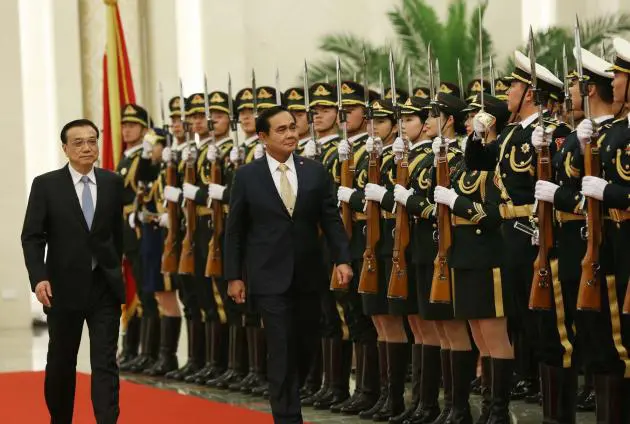
Prayut witnessed the signing of the four MoUs and pacts with Chinese Premier Li Keqiang after their meeting in Beijing, according to Thailand’s Government House.
The People’s Bank of China and the Bank of Thailand signed a yuan-baht bilateral swap agreement (BSA) and an MoU to establish yuan clearing arrangements in Thailand.
The BSA is an extension of an agreement signed three years ago.
Under this swap arrangement, 70 billion yuan (Bt370 billion) will be made available for three years, the BOT said.
The swap transactions between the BOT and the PBC would provide access for both central banks to the local currency of the other party, Government House said.
This would bolster confidence in the private sector and financial institutions in relation to the availability of local currency for cross-border trade and investment settlements, it said.
Lower costs, greater efficiency
The BOT said the establishment of the yuan clearing arrangements would facilitate access to China’s onshore foreign-exchange market. This would lower the cost and enhance efficiency for Thai commercial banks when conducting transactions between the two countries, it said.
The PBC will appoint eligible Chinese commercial banks operating in Thailand as yuan clearing banks in order to conduct yuan settlements in this country.
Beijing has similar currency arrangements in Hong Kong, which is part of China but has its own currency, and other countries in the region so as to allow easy access to the yuan for traders and investors, according a BOT official.
Beijing recently proposed implementing an Asian currency-stability system in a bid to ensure that the yuan would have more roles and could become a stable convertible currency in the region.
Chinese leaders proposed during a meeting with Asean members in August that countries in East Asia lessen their dependency on Western currencies, notably the US dollar.
Thailand’s previous elected government began to show interest in currency cooperation with China in order to have alternative currency arrangements for the flow of money and capital in the region, as Chinese trade and investment are increasing and Western currencies are fluctuating.
Prayut’s two-day visit to China ends today. Premier Li left Bangkok at the end of the fifth Greater Mekong Subregion summit on Saturday.
The two countries on Friday signed two pacts for Thailand’s US$10.6-billion (Bt348-billion) railway development and purchases of Thai farm products, notably rice and rubber.
Prayut’s visit aimed to forge mutual relations and a deeper relationship with China’s leaders, as well as express Thailand’s intent to strengthen its comprehensive strategic cooperative partnership with China, the Thai government said in the statement.
Joint visions on the next phase of the Thailand-China cooperation will also be determined, particularly those related to regional economic connectivity for mutual benefits, it said.
The details of the MoUs were not revealed.
