
Protests over bonus are 'temporary'


Play
Employers advised not to yield to pressure or they will set precedent
News of employees demanding a rise in their bonus payments has returned this year, but a labour-relations expert with MR&TS, Supachai Manusphaibool, expects such protests to be a temporary event before the bonus-payment season.
He does not expect Thailand’s labour situation to get worse in 2015, considering the economic and business outlook. Supachai had warned several months ago that employees at some firms would stage protests for high bonuses around the year-end just before their companies made an announcement, as a tactic to get more pay.
“But after December, things will return to normal,” he said.
He advised employers not to yield to such pressure, otherwise they would set a precedent and their workers would expect compensation to increase every year, regardless of the business situation.
“Employers must fight [for lower bonuses], otherwise they will never be able to bring them down in the future,” he said.
Many Thai and foreign firms have fixed bonuses. Some corporate conglomerates have different pay policies for each company within the group. Charoen Pokphand has a fixed two-month bonus, while its retail subsidiary CP All has a flexible bonus paid according to performance every quarter.
Pichpajee Saichuae, managing director of Towers Watson (Thailand), said bonuses paid by Thailand-based companies were forecast to be roughly the same last year, this year and next, while average salary increases would be 6 per cent this year and the employee turnover rate 13.3 per cent. To attract talent, companies still use base pay as the No 1 tool, followed by career growth opportunities.
A survey conducted by Hay Group, a global consulting firm, indicated the same trend. It said most companies currently used basic salaries as their primary basis for remuneration. However, a growing number of companies plan to change how they manage remuneration by emphasising benefits and other types of compensation.
Moreover, while most companies set their remuneration policy at P50 (the median of their defined market), there is an increasing trend towards remuneration policies between P50 and P75 because there is a lot of competition for talent currently.
According to the Hay Group’s survey, the three sectors that will offer the highest bonus payments in 2015 are chemicals (4.03 months), followed by industrials (3.98 months) and construction and materials (3.69 months). The overall forecast of bonus payments in 2015 is slightly lower than for 2014 (from 3.44 months in 2014 to 3.40 months in 2015).
Thailand’s top three industries that will make the highest salary increases for 2015 are the construction and materials sector (6.30 per cent), the oil and gas sector (6.28 per cent) and the chemicals sector (6.25 per cent). The overall forecast for salary increases in 2015 is slightly higher than for 2014 (from 6.01 per cent in 2014 to 6.06 per cent in 2015).
The report also shows that top three sectors with the highest basic salaries are oil and gas, fast-moving consumer goods, and chemicals.
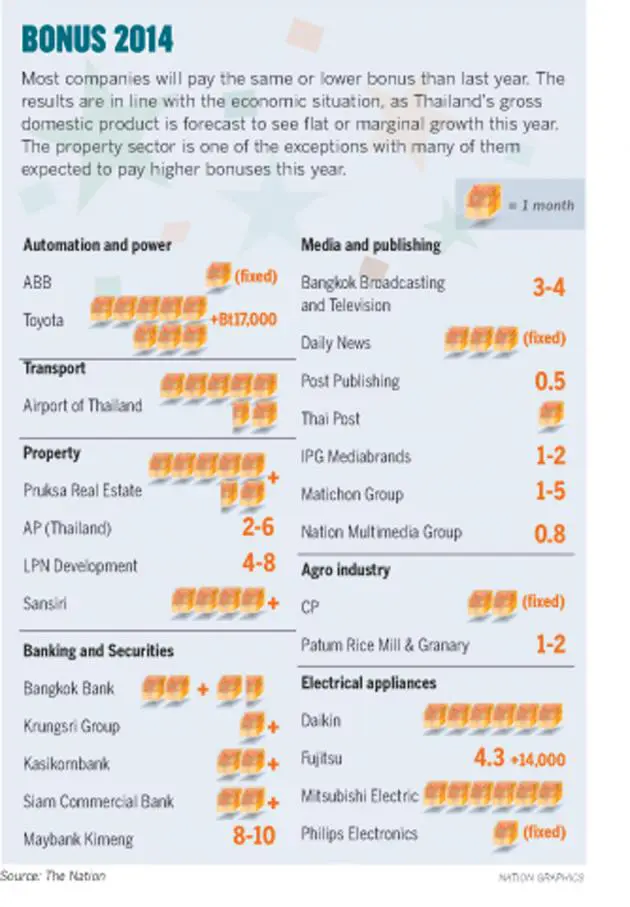
According to a survey conducted by The Nation, most companies this year will pay the same bonus as last year, or lower. This in line with the economic situation, as gross domestic product is forecast to book almost flat growth. The property sector is one of the exceptions, with many companies expected to pay higher bonuses this year.
Sansiri president Srettha Thavisin said his company would pay higher bonuses to its staff this year because its net profit was better than in 2013. Last year, its bonuses averaged four months’ salary, with some of its staff getting more than that because of better performance than their peers, while others got less. That performance-based policy will be followed again this year, he said.
Somkiat Makcayathorn, president of the Thai Rice Packers Association and managing director of Patum Rice Mill and Granary, said many rice traders this year would pay bonus of about one or two months’ salary, the same as last year, as the economy had begun to recover. He said his own company would do the same, though in the past it had paid more than two months’ bonus during strong economic growth.
Fixed bonus in banking sector
Many car companies are paying bonus of six to eight months’ salary, while parts firms are paying between three and seven months.
The banking sector pays fixed bonuses with special incentives based on the performance of employees and return on assets (ROA). Siam Commercial Bank pays its bonus twice a year, in June and December, each fixed at one month’s salary. A special incentive will be paid in February.
Bangkok Bank also pays fixed one-month bonus in June and December. A special incentive of around 1.5 months’ salary will be paid by the end of January.
Krungsri Group paid a one-month bonus on December 25 and will pay a special incentive based on its Key Performance Index on March 25. Kasikornbank will pay a fixed two-month bonus in February, and incentives based on the bank’s ROA will be paid in March.
It has not been a good year for advertising and media businesses because of slow spending due to political unrest during the first half along with weak purchasing power.
Sources have told The Nation that leading advertising agencies, newspapers, television stations were offering bonus lower than last year’s, while some of them would maintain last year’s rate.
In the newspaper business, Thai Post gives a one-month bonus. Post Publishing is expected to reward its employees with 50 per cent of their monthly salary, down from last year’s 150 per cent. Daily News offers a three-month bonus, less than last year’s. Matichon Group offers a 1.5-month bonus, compared with last year’s two months.
A source at Bangkok Broadcas-ting and Television said it would pay bonus rates of about three to four months, similar to last year.
A source at IPG Mediabrands said bonuses would average about one to two months.
