
Thailand picked as training centre
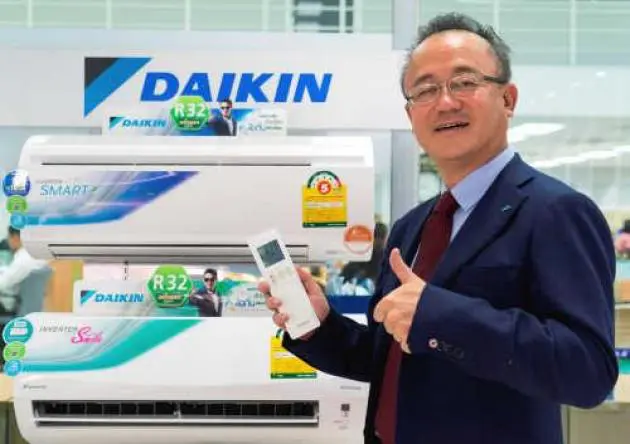


THE DAIKIN GROUP has assigned its factory in Thailand to act as a regional training centre for its people involved in manufacturing, installation and maintenance services in Asean.
The move is part of the Japan-based air-conditioner maker’s plan to cash in on the Asean Economic Community, to be effective this year. The AEC will promote market integration and regional standards for manufacturing and sale of particular products, which may include air-conditioners.
The Daikin Group claims to be the first in Asean to adopt the environmental-friendly refrigerant R32. This organic compound, which has just one-third the global-warming potential of conventional refrigerants, has been used in Japan since 2013, and since the beginning of last year in Thailand.
Takayoshi Miki, president of Siam Daikin Sales Co, said Daikin had used Thailand as its centre for research and development into adapting the Japanese parent company’s core technologies and know-how to be more appropriate for the Asean region.
He said Asean was one of the fastest-growing economic communities in the world, and Daikin’s policy was to cash in on this potential and become the No 1 player in particular markets in the region. Its key strategy is to provide a full line-up of home and commercial air-conditioners offering environmentally friendly and energy-saving benefits.
In Thailand, the Daikin Group operates five companies: Siam Daikin Sales Co, Daikin Industries (Thailand), Daikin Airconditioning (Thailand), Daikin Trading (Thailand), and Daikin Compressor Industries Ltd.
Established in 1982, Siam Daikin Sales is in charge of domestic sales of Daikin air-conditioners in the Thai market.
With an air-conditioner factory in Amata Nakorn Industrial Estate in Chon Buri, Daikin Industries (Thailand) has been promoted by the group to be its centre for all training and human-resource development in the region.
“It is a major policy of Daikin both for Thailand and the Asean region to give priority to concerns for the environment and energy saving,” Miki said.
However, he added that Thailand was lagging behind other countries in the use of inverter-type air-conditioners, with a penetration rate of only 14 per cent on a unit basis and 19 per cent in terms of value. Elsewhere in Asean, this energy-efficient type of air-conditioner is becoming much more popular.
The Daikin companies are under the administration of Daikin Industries (Japan) Co, a leading manufacturer of air-conditioners for commercial buildings and industrial plants in its home country. It is also a top supplier of residential air-conditioners, chillers, refrigerants and hydraulics. These products are manufactured in Japan, Belgium, Thailand, Malaysia, the Czech Republic, China and the United States and distributed in more than 80 countries worldwide.
Miki said that in Asean, Daikin planned closer collaboration between its factories in Thailand and Malaysia, especially in the area of product development and exchange of production know-how.
“The key benefit earned from the implementation of the AEC is the exemption of import tariffs and trade regulations among Asean members. Particular products produced in one country can be exported and sold in other markets within the region.”
Miki said he hoped that under the AEC, member countries would share the same regulations on energy-saving products, including air-conditioners. If so, the same technological goods could be distributed and sold in any country in the region.
“Located in the heart of Asean, Thailand is quite suitable to be a centre to disperse all innovation and developments into the rest of the region,” he said.
