
Thailand's Major Developers Chart Divergent 2026 Strategies as Market Bifurcation Accelerates


From luxury pivots to multinational expansion, Thailand's property titans are abandoning one-size-fits-all approaches amid persistent headwinds
- Confronted by a bifurcated market with a struggling mass-market segment and resilient luxury/provincial demand, Thailand's major developers are abandoning uniform approaches for highly specialized 2026 strategies.
- Developers are diversifying their focus: Sansiri is targeting the international luxury market, Supalai is expanding into Australia, and Asset Wise is concentrating on niche lifestyle segments like "Campus Condos."
- Other distinct strategies include Sena's focus on making affordable housing viable through energy-efficient homes and Frasers Property's integration of residential, industrial, and commercial assets.
- Ambitious new models are also emerging, such as Reignwood Park's creation of a self-contained "mega-township" to attract global elites and Asset World Corporation's development of tourism-centric lifestyle destinations.
From luxury pivots to multinational expansion, Thailand's property titans are abandoning one-size-fits-all approaches amid persistent headwinds.
As Thailand's property market confronts its most challenging period in decades, the nation's leading developers are unveiling sharply divergent strategies for 2026—signalling the end of mass-market approaches and the beginning of a new era defined by specialisation, geographic diversification, and unprecedented market segmentation.
Thailand's residential property market faces a prolonged 2-3 year slowdown, driven by crushing household debt that reached 16.34 trillion baht—equivalent to 89 per cent of GDP—alongside tighter bank lending and collapsing consumer confidence.
According to KKP Research, nationwide property transfers are projected to decline 6 per cent in 2025, following a 15 per cent drop in 2023 that pushed transaction volumes to a seven-year low.
The crisis has been particularly acute in the mass market. Mortgage rejection rates for homes priced under 3 million baht have hit an unprecedented 70 per cent, according to Terra Media and Consulting.
For new-build properties from developers in the Bangkok area, the estimated decline reaches a staggering 20 per cent.
Market forecasts suggest total value could sink to 700 billion baht by year-end 2025, the steepest decline since the 1997 Asian financial crisis.
Yet even amid this distress, stark regional divergence has emerged.
Whilst Bangkok grapples with approximately 235,000 unsold condominium units—the highest inventory since 2018—growth markets including Phuket, Surat Thani (Koh Samui), Prachuap Khiri Khan (Hua Hin), and Nakhon Ratchasima present dramatically different pictures.

Phuket maintains steady absorption of approximately 1,000 condominium transfers to foreign buyers annually, with 10 per cent year-on-year growth in 2025, and analysts forecast the island could achieve 8-10 per cent annual price growth through 2026.
Kiatnakin Phatra Securities anticipates a mild cyclical rebound for Thailand's residential property sector in 2026, following 2025's deep trough when Bangkok and vicinity presales hit a 23-year low.
The brokerage highlights that whilst 2025 marks the sector's bottom, the subsequent recovery will be modest and primarily benefit large, well-capitalised developers.
Throughout 2025, the sector traded at trough valuations, with price-to-earnings ratios between 7.0x and 8.3x—levels last seen during the 2008 global financial crisis and the 2020 COVID-19 lockdown.
Against this backdrop of crisis and opportunity, Thailand's major developers are positioning themselves with unprecedented strategic precision for 2026, each carving distinct niches in an increasingly fragmented market.
Sansiri: The Global Ambassador
Sansiri is leaning heavily into the international luxury market. President Uthai Uthaisangsuk outlined plans to launch 29 new projects—14 low-rise and 15 condominiums—with combined value of 52 billion baht. The company set sales targets at 53 billion baht and transfers at 46 billion baht for 2025-2026.
Their strategy prioritises luxury and "super-luxury" segments less sensitive to interest rate hikes. Sansiri is pursuing partnerships with two Japanese investment firms and two Thai companies to expand its investment portfolio. The company allocated 2 billion baht for land acquisition, focusing particularly on Phuket, driven by strong foreign demand.
Sansiri has adapted by diversifying into home construction services, using existing factory capacity to build homes for customers who own land but cannot secure financing, thereby generating alternative revenue streams whilst mitigating completion risks.
Supalai: The Multi-National Expansion
Supalai is aggressively diversifying geographic risk under its "Future Proof" strategy, accelerating its transition into a multi-national entity.
Whilst maintaining the largest provincial footprint in Thailand (30 provinces), Supalai's 2026 growth will be heavily bolstered by Australian joint ventures contributing significantly to its record-breaking bottom line.
For 2025, the company planned to launch 36 new projects—28 low-rise and eight condominiums—valued at 46 billion baht, with sales targets of 32 billion baht and revenue targets of 30 billion baht. The company allocated 8 billion baht for land acquisition in Thailand to expand into new high-potential areas.
Supalai is leveraging artificial intelligence and data analytics for personalised home-buying experiences, whilst committing to reduce greenhouse gas emissions by 40 per cent by 2030.
Asset Wise: The Lifestyle Specialist
Celebrating its 20th year, Asset Wise is doubling down on "Campus Condos" and lifestyle-driven niches. Their 2026 roadmap focuses on hotspots like Salaya and the northern Green Line extension, targeting "genuine demand" from medical personnel and students—segments insulated from broader volatility. The company recently won awards for projects like Chann The Riverside Borommaratchachonnani, demonstrating niche market excellence.
Sena Development: The Affordable Vanguard
As leader in the affordable segment (1-3 million baht), Sena faces the toughest headwind: 70 per cent mortgage rejections in this price bracket. Their 2026 strategy revolves around "financial engineering" for buyers and a deep partnership with Japan's Hankyu Hanshin Properties to introduce energy-efficient, solar-powered homes that reduce long-term living costs, addressing affordability through lower total ownership costs rather than initial purchase price.
Frasers Property Thailand: The Integrated Platform
Frasers Property pursues its "One Platform" strategy, integrating residential, industrial, and commercial properties.
The industrial division set a goal to increase total assets under management to 4 million square metres by 2026, valued at 100 billion baht. The company introduced its "Built-to-Function" solution targeting logistics providers requiring specialised warehouse functions.
Group chief executive officer Panote Sirivadhanabhakdi recently presented a six-point climate strategy, emphasising sustainability is "essential for future development", noting urban real estate contributes up to 70 per cent of global warming effects in city centres.
Reignwood Park: The Mega-Township Disruptor
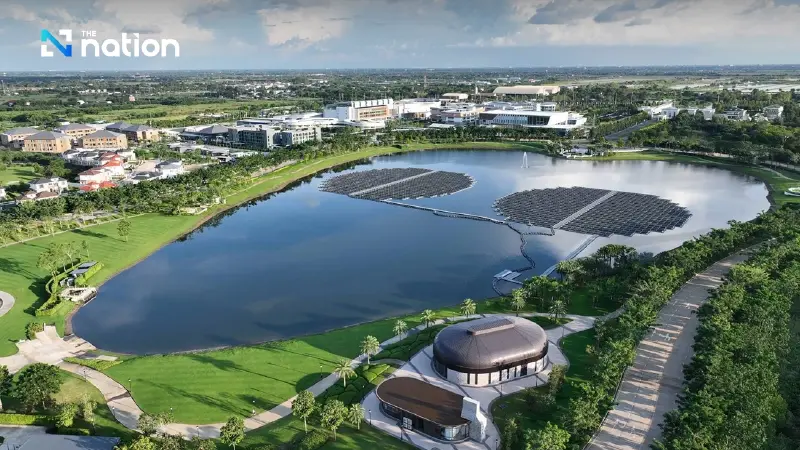
The most ambitious entry is Reignwood Park in Pathum Thani. This 2,000-rai "Superior Living Ecosystem" represents a 30-billion-baht investment and won "Thailand Mega Project of the Year" at the DOT Property Thailand Awards 2025.
Chief executive officer Woraphanit Ruayrungruang emphasised the project's ambition to create "a world-class community where every generation can flourish together."
For 2026, Reignwood Park is going global with bold new ventures: expanding into yacht services (showcasing at the Thailand International Boat Show 2026), developing air taxi infrastructure, and opening its world-class Sports Complex & Hotel featuring a FIFA-standard football pitch, Olympic-sized swimming pool, fitness centre, spa, and state-of-the-art rehabilitation centre.
The project, completing in stages through 2027, features Robinswood Golf Club (positioned among Asia's premier private clubs), KIS International School (150-rai campus with full IB curriculum), PARK11 Community Mall (8,600 square metres), and luxury residences under the Reignwood Residence Collection.
The development leverages brand prestige through global "Icons of Football" events to attract ultra-high-net-worth individuals from Singapore, Hong Kong, and Dubai.
Asset World Corporation: The Tourism Catalyst
AWC, led by Wallapa Traisorat, focuses on the "Better Planet, Better People" philosophy. By end-2025, AWC aimed for total asset value of 218 billion baht.
For 2026, their focus remains on luxury hospitality and "lifestyle destinations" like Asiatique and the new InterContinental Chiang Mai, betting on continued high-end international tourism recovery.
In November 2025, AWC unveiled Skyflyers: Wings of Garudapterus at Asiatique The Riverfront Destination, Asia-Pacific's tallest giant swing ride towering at the height of a 36-story building.
Michael Hariz, chief commercial officer of AWC, stated the attraction "marks a significant achievement in Asiatique's evolution into a world-class riverside destination."
The company recently won recognition for its Hatch Dome project at Asiatique The Riverfront. Looking to the medium term, AWC plans to open Fairmont Bangkok Sukhumvit in 2026 and the Lannatique Chiang Mai project, designed to promote Chiang Mai as a centre for cultural arts and sustainability, featuring Thailand's first electric tram tour with Lanna-style design.

Strategic Imperatives: What Success Looks Like in 2026
The divergent strategies employed by Thailand's major developers reflect a fundamental shift in market dynamics.
The era of mass-market, large-scale projects has ended, replaced by an environment where survival depends on financial prudence, hyper-specific targeting, and the ability to identify and serve niche segments with precision.
Speaking at the "Thailand's Real Estate Outlook 2026: Challenges & Opportunities" forum in September 2025, Chetthawat Songprasert, senior analyst at SCB Economic Intelligence Centre, outlined four primary factors creating cascading impacts on the residential property market: domestic economic slowdown with GDP growth projected to fall short of 2 per cent, weakened purchasing power particularly amongst middle to lower-income groups earning less than 50,000 baht monthly—representing nearly 70 per cent of the market, persistently high household debt constraining buyer capacity, and mortgage rejection rates reaching unprecedented levels.
Vissarut Panyapinyopon, real estate lending head at KKP Bank, offered stark advice to developers: "Look at your own wallet and see if you can withstand slower sales, then reduce project size appropriately. And third, if possible, find a location with specific demand."
KKP's forecast for 2026 anticipates continued contraction, albeit at a slower rate of approximately 6 per cent. Unsold inventory is projected to fall 6 per cent to around 207,998 units as developers hold back on large-scale launches.
The return of "real demand" buyers will be slow and heavily contingent on tangible economic recovery.

Emerging Opportunities Amid Crisis
Despite the challenges, several trends offer opportunity for strategically positioned developers.
The decentralisation of housing demand from Bangkok to major provincial cities presents new markets, whilst increasing interest in second-hand homes given affordability constraints has prompted major developers to adopt "buy-renovate-sell" strategies, particularly for well-located two-bedroom condominiums along major mass transit lines.
The condominium segment appears relatively attractive, with inventories falling over six consecutive years indicating faster supply normalisation compared to landed housing, where inventories continue to expand.
The rental market also shows promise, with DDproperty reporting that condo demand increased by 12 per cent year-on-year nationwide, and by 10 per cent year-on-year in Bangkok, driven by a substantial expatriate community and strong digital nomad interest.
International investment continues to flow into Thailand, particularly from China and the Middle East, funnelling capital into prime mixed-use projects, data centres, and hospitality portfolios.
The government's 2025-2026 transport plan covers 287 projects valued at 253.45 billion baht, channelling public outlays toward light-rail links in Phuket and Chiang Mai, as well as expressway extensions around the capital, expanding the development canvas for private investors.
On the policy front, whilst industry calls for extending foreign leasehold rights to 99 years have intensified, the government shelved the proposal in September 2025, focusing instead on immediate stimulus measures.
The Bank of Thailand relaxed loan-to-value rules from May 2025 through June 2026, permitting loans up to 100 per cent of collateral value for first homes over 10 million baht and second homes under 10 million baht.
The government simultaneously slashed transfer fees from 2 per cent to 0.01 per cent and mortgage registration fees from 1 per cent to 0.01 per cent for properties up to 7 million baht.

The Path Forward: Strategic Precision Over Scale
As Thailand's property market navigates through persistent headwinds into 2026, the strategies employed by major developers signal a fundamental transformation in how the industry operates.
The bifurcation between struggling mass-market segments and resilient luxury developments will likely persist, with success depending on developers' ability to read shifting consumer preferences, identify pockets of demand in an otherwise constrained market, and maintain financial discipline whilst positioning for eventual recovery.
Sansiri's pivot to international luxury and partnerships, Supalai's multinational geographic diversification, Asset Wise's lifestyle specialisation, Sena's affordability innovation through solar-powered homes, Frasers Property's integrated platform approach, Reignwood Park's mega-township disruption with global lifestyle amenities, and AWC's tourism-catalyst strategy through world-class attractions each represent distinct bets on different aspects of Thailand's fragmented property market.
Kiatnakin Phatra Securities expects a slight sector presales recovery of 3 per cent in 2026 for the top ten listed firms, and 6 per cent for the leading three developers.

With projected 5 per cent core profit growth and dividend yields ranging from 5.0 per cent to 8.0 per cent, further downside valuation risk is seen as limited. The brokerage maintains SPALI as its top pick due to its robust balance sheet, operational efficiency, and favourable presales outlook.
The Thailand Real Estate Market size is estimated at 58.78 billion dollars in 2025, and is expected to reach 77.15 billion dollars by 2030, representing a compound annual growth rate of 5.59 per cent during the forecast period, suggesting long-term structural growth despite near-term headwinds.
For investors, buyers, and industry stakeholders, 2026 promises to be a year of strategic repositioning, where the most successful players will be those who have abandoned the mass-market playbook in favour of precision targeting, financial discipline, and the ability to serve specific market segments with excellence.
The question is not whether the market will recover, but which developers' strategic bets will prove most prescient when it does.
