
Assistance urged for struggling TV operators


Play
THE BROADCASTING regulator should be assisting those digital-TV companies that are struggling with intense competition during what is still an early stage in Thailand's digital era, a forum was told yesterday.
“The broadcasting regulations are not supportive of the digital-TV operators, to help them grow in the early stage when each operator needs to invest a huge amount on content and production to create quality TV programmes to attract audiences,” said Kematat Paladesh, president of Bangkok Media and Broadcasting – operator of the PPTV high-definition channel.
Meanwhile, digital terrestrial TV coverage is still limited in key areas, he said. To solve this problem, his company had to create and develop a mobile application to allow viewers to watch live PPTV programmes as part of its efforts to build an audience base.
“We are focusing on ‘personalcast’, on top of the broadcast approach,” he said, adding that PPTV had also introduced more sport content to expand its target group.
Kematat made these remarks at the “Winners and Losers in Digital Terrestrial TV Business” seminar, organised by the journalism and mass communications faculty of Thammasat University.
Technically, yesterday marked the first anniversary of the terrestrial-based digital-TV broadcasting era in Thailand, after the National Broadcasting and Telecommunications Commission (NBTC) gave the green light for 24 holders of digital-TV licences to start test runs.
In addition to Kematat’s comments, a representative from Amarin Television said he was worried about the low penetration rate for digital-TV receivers in the Kingdom.
Spring News
Suthichai Bunnag, president of Spring News Corp – the operator of the Springnews TV digital channel – suggested that the broadcasting regulator should provide an assistance scheme for digital-TV players in the early stage of the sector’s development, for example by reducing licence fees.
His company needed to create quality content, but it was burdened with a high licensing-fee cost, he said.
To create different and quality content, Time Chuastapanasiri, a researcher at Media Monitor and Thai Public Broadcasting Service (Thai PBS), told the forum that broadcasters should understand the changes in consumer behaviour due to advanced communications technology.
Television screens would increasingly become background screens while people used other screens like smartphones and tablets, he said.
“Each TV operator should get well prepared for the multi-screen approach via content marketing,” he suggested.
Such a strategy would help broadcasters improve their TV ratings, advertising rates and revenue, he added.
Though major players like Bangkok Broadcasting and Television – the operator of Channel 7 – and Bangkok Entertainment Company, which operates Channel 3, still played a key role in the Bt80-billion broadcasting industry, Thawatchai Jittrapanun, a member of the broadcasting committee of the NBTC, suggested that there was more room for growth for other potential players.
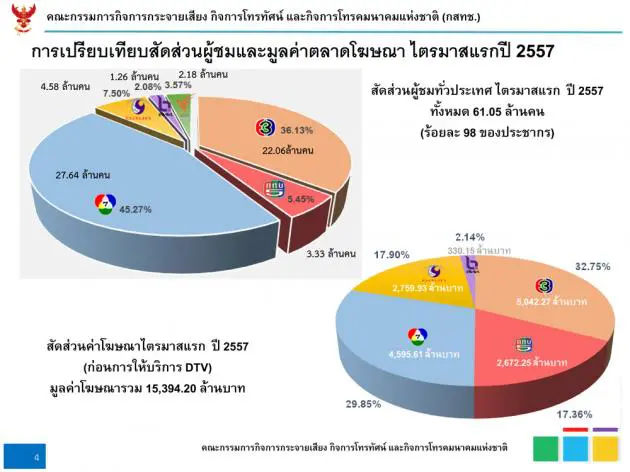
In addition, NTBC secretary-general Takorn Tantasith said in his opening address at the event that since the launch of digital terrestrial TV, both audiences and advertising expenditure had been migrating from traditional stations such Channel 3, TV 5, Channel 7, MCOT’s Modernine TV and NBT to new digital channels.
Referring to Nielsen Company (Thailand) data as of March 15, he said the audience share of 21 digital channels accounted for 25.7 per cent of the country’s households, a significant rise from 9 per cent in April last year.
Meanwhile, analog terrestrial TV channels’ audience share had dropped to 74.3 per cent from 91 per cent a year ago.
Advertising spending via the 21 new channels is also expected to have shown positive growth since the launch, he added.
Nielsen found that total TV advertising spending in February was Bt7.39 billion, with five analog TV channels accounting for some Bt4.54 billion and digital TV channels for about Bt2.84 billion.
