
Honda gets Green Label for all cars produced in Thailand
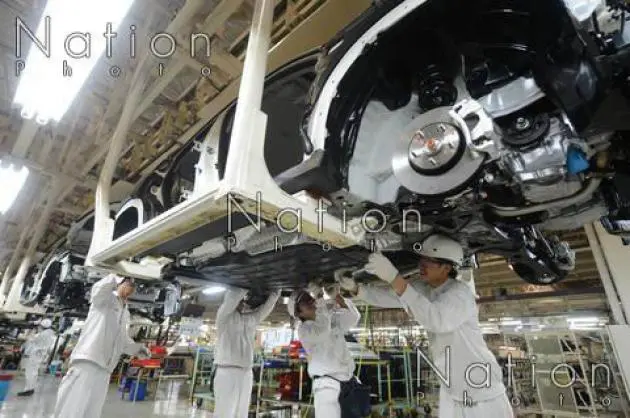


Honda Automobile (Thailand) has received Green Label certification for all car models manufactured in the Kingdom from the Thai Industrial Standards Institute and the Thailand Environment Institute, following the company's successful exploration of innov
The company recently hosted a factory tour to showcase eco-friendly manufacturing processes and efficient energy management at its Green Factory, reaffirming Honda’s global environmental slogan of "Blue Skies for Our Children".
The 12 Honda models manufactured in Thailand – the Brio, Brio Amaze, Jazz, City, City CNG, Civic, Civic Hybrid, Mobilio, Accord, Accord Hybrid, HR-V and CR-V – are all subject to the institutes’ Green Label accreditation.
The certification assures that these cars have passed environmental regulations encompassing production process, use and disposal, as well as efficiency of resources management.
Honda is currently the only automotive manufacturer operating in Thailand to carry the Green Label, and these models are produced under industry standards at its factory at Rojana Industrial Park in Phra Nakhon Si Ayutthaya, which has achieved ISO 9001: 2008 certification for quality management systems and ISO 14001certification for environmental management systems.
Hathai Uthai, secretary-general of the Thai Industrial Standards Institute, said all Thai-manufactured Honda models had been granted the Green Label, with Honda being "a private organisation that is aware of environmental issues and dedicated to developing environment-friendly products with sustainability in every process with a sense of social responsibility".
The Honda plant is truly a green factory, he said, adding that the institute appreciates the Japanese maker’s commitment and earnest effort to maintain manufacturing quality under Thai industrial standards and conserve the environment sustainably.
Honda Automobile (Thailand)’s chief operating officer, Pitak Pruittisarikorn, said that back in 2010, Honda Motor in Japan had announced its "Vision 2020" for creating products with speed, affordability and low CO2.
"An environmental target was set to reduce CO2 emissions from all our product types by 30 per cent, including automobiles, motorcycles and power products. Honda commits to research and develop automobile technologies that ensure both quality and eco-friendliness.
"We also explore innovative measures to reduce CO2 emissions in order to pass on a sustainable society where the next generation can enjoy life, in accordance with Honda’s global environmental slogan of ‘Blue Skies for Our Children’," he explained.
All Honda associates in the factory always take environmental conservation as a prioritised area of its operation, he said.
All work processes have been scrutinised, and the data and information collected have been analysed to discover new approaches, technologies and equipment that will minimise environmental impact with an aim to make Honda’s plant a genuinely Green Factory, said the chief operating officer.
One of the fundamental targets of reducing environmental impacts from all production processes is to apply the "3 Rs" principle of "Reduce, Reuse and Recycle" in all its production activities, and in compliance with the company’s "Green Factory Policy", which focuses on energy saving, waste reduction and coexistence with local communities, said Pitak.
The policy comprises five principles: CO2 reduction, VOC (volatile organic compound) reduction, water saving, waste reduction, and coexistence with local communities.
At present, the Honda Green Factory has an emission level of 410 kilograms of CO2 per car produced.
In 2017, the company is targeting a lower emission level of 392kg of CO2/car, while by 2020 the figures will be reduced to 327kg of CO2/car.
Each year, it can reduce CO2 emissions by 3,300 tonnes on aver
age, or an equivalent of CO2 absorption by living trees in an area of 6,679 rai (1,068 hectares).
In addition to the Green Factory in Phra Nakhon Si Ayutthaya, Honda’s second automobile factory – at Rojana Industrial Park in Prachin Buri – has been designed with the concept of "producing the world’s cleanest products at the world’s cleanest plant".
The new factory will apply technologies and the most efficient production systems being used at the Yorii plant in Japan, which is regarded as Honda’s archetypical auto plant.
It will be the company’s next Green Factory, and one of Honda’s people-friendly and environmentally-responsible automobile plants, said Pitak.
Construction at the second Thai facility has already progressed beyond 80 per cent, with the plant scheduled to start running with selective production lines for automobile parts and engines in October – and set to become fully operational next March.
