
Solar power for a remote community
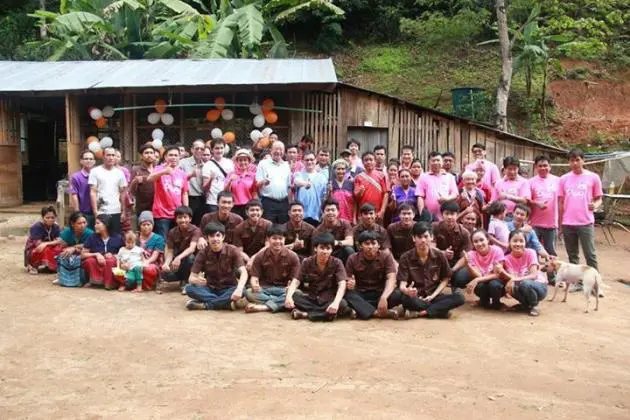


Nestled in a lush forest and a surrounding valley, Omkoi district at the southern end of Chiang Mai province has long been recommended as a tourist attraction for those wishing to experience beautiful scenery and a wildlife sanctuary.
However, villagers in the area have always struggled in their daily lives without access to electricity – until now, that is.
Things in the remote community are changing because Power Buy, recognising that access to power is a crucial element for a community’s development, has initiated the "Power Buy Brings Power to Children in Omkoi" project.
In collaboration with Rajamangala University of Technology Lanna, the electrical-appliance retail chain selected Baan Pi Por in Omkoi district as the pilot for a wider project aimed at bringing electricity to remote communities.
Arnut Changtrakul, president of Power Buy, and Assistant Professor Chairatana Pansuvannajit, vice president of Rajamangala University of Technology Lanna, recently delivered a 6-megawatt solar-power station to the Mae Fah Luang Hilltribe Learning Centre in Pi Por village.
The joint project is aimed at supporting learning development through distance learning via a satellite-based system, and facilitating the community.
Solar power is appropriate for remote areas and is a clean energy that helps reduce greenhouse-gas emissions, said Arnut.
The project costs were met by proceeds from the sale of "Let’s Plug" T-shirts, financial support from Power Buy’s trade partners and donations by customers and staff, he said.
The funds were then handed to the Engineering Faculty at Rajamangala University of Technology Lanna for the design, construction and system installation of the power station.
About 875 kilometres from Bangkok by road, the remote village is located in Omkoi’s Mae Tuen sub-district, which until now was among the country’s poorest communities without access to electricity.
However, the new solar power station has sufficient capacity to supply electricity to the village school and all of the 60-plus households.
Power Buy has also provided and arranged the installation of a light bulb for each household, enabling more than 300 villagers to have a better quality of life, said Arnut.
In addition, the company contributed an electrical rice-milling machine for the community, replacing an oil-powered machine, and a large public refrigerator has been provided to keep food fresh for school cooking and use by villagers.
The Power Buy chief added that besides education and basic lighting for the village households, the solar plant has sufficient capacity to support community businesses. The village is now building a coffee-roasting plant, which will also utilise the solar power station.
In addition, Central Group subsidiaries have delivered sports equipment, snacks, stationery and learning materials to the Mae Fah Luang Hilltribe Learning Centre, Baan Pi Por and residents in three nearby villages.
Vice president Chairatana said the Power Buy project is in line with the university’s goal to provide solar energy in remote communities.
The engineering students are also proud to take part in the CSR project and dedicate their knowledge to benefit the communities, besides which it is an opportunity for them to learn through hands-on practice, he said.
One power station per year
Arnut added that Power Buy would press ahead with its plan to provide solar energy for remote communities without access to electricity, with the company’s plan being to install one solar power station each year.
The electricity will have a significant positive influence on those living in rural communities, from improved health to better educational facilities and an improved standard of living, he explained.
Other Power Buy CSR initiatives are the use of recycled paper for its monthly brochures; a training course on the repair of home electrical appliances for the disabled at the Redemptorist Foundation for people with Disabilities in Chon Buri; and the plantation of coral.
Jiralak na Chiangtung, Power Buy vice president – marketing, said the chain had launched an eco-responsible paper policy last month to help reduce global warming, by printing its monthly brochures for customers using recycled paper, even though the cost is some 58 per cent higher than if the company used normal paper.
"We print more than 100,000 pieces per month, which are available at 89 Power Buy outlets nationwide. This is another move in line with our corporate strategy on environmental concerns," she said.
The company also wants to encourage greater public awareness of the significant benefits of paper recycling, notably that the recycling of one tonne of paper can save as many as 17 trees and help reduce water and power consumption in the paper-production process, she added.
