
Govt to mull power offer from Laos


Play
THAILAND will consider a proposal to increase the memorandum of understanding on the purchase of electricity from Laos from 7,000 megawatts to 10,000MW after committing to buy 3,316MW this year, Energy Minister General Anantaporn Kanjanarat said yesterday
The minister said that under the current MoU, which expires at the end of this year, the Kingdom had committed to buying about 5,000MW of electricity from Laos, including 1,473MW from the Hongsa Power Plant.
A contract for a further 2,000MW will be signed next year, making the ongoing commitment 7,000MW in total.
Meanwhile, the Laotian energy and mines minister, Khammany Inthirath, has proposed increasing the amount of power purchased under the MoU to 10,000MW, with such an agreement possibly to be signed next year, Anantaporn |said.
If approved, this would enable Thailand to boost the electricity it purchases from abroad to 14,700MW by 2036, he added.
According to Thailand’s 20-year sustainable-electricity plan, it will buy 7,000MW from Laos between 2015 and 2026, and a further 7,700MW from Laos and other Asean countries such as Myanmar from 2027 to 2036.
Completion by March
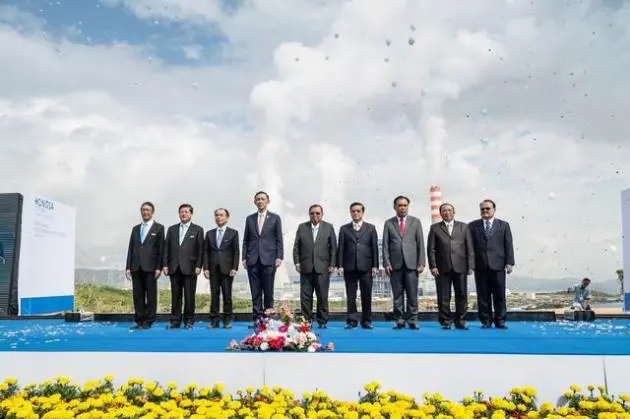
The third and final generation unit at Hongsa Power Co’s lignite-mine-mouth power plant will be completed by March.
The next three projects under the Kingdom’s power deal with Laos – the Xe Pian-Xe Nam Noi, Nam Ngiep 1 and Sai Ya Buri hydropower plants – will supply electricity to Thailand by 2019.
Hongsa Power Co was formed in 2009 by Banpu Power, which holds a 40-per-cent stake, Ratchaburi Electricity Generating Holding, also with a 40-per-cent holding, and Lao Holding State Enterprise, which owns the remaining 20 per cent, to develop and operate a 1,878MW plant at a total investment of US$3.71 billion (Bt133 billion).
The consortium has been granted a 25-year concession to operate the plant from next year. It has created 700 jobs, up to 60 per cent of them for Laotians.
Banpu chief executive officer Somruedee Chaimongkol said Hongsa Power formed a key element in its strategy to diversify further from mining to power-plant business. At present, up to 40 per cent of Banpu’s net profit is from power-plant operations – driven by both lignite and renewable energy – while 60 per cent is from mining.
By 2020, the company targets its power-plant business will generate up to 50 per cent of net profit, she said.
In Laos, besides the Hongsa power-plant project, Banpu is |interested in expanding its investment in others forms electricity |generation such as hydropower, to drive its electricity portfolio to 2,400MW by 2020 and 4,000MW by 2025.
The company has already expanded its overseas power-plant investment in Japan, Laos and China, and is studying further investment – both lignite- and renewable energy-based – in Indonesia, Myanmar and Vietnam, the CEO said.
Ratchaburi Electricity Generat-ing Holding CEO Rum Herabat said his company was also studying expanding its investment in hydropower projects in Laos after Hongsa Power Plant’s successful opening.
“We are considering expansion in Laos and other countries in Asean, such as Myanmar and Indonesia, which would both extend our investment and secure the country’s electricity system,” he said.
