
SCG wants to emphasise speed and execution


Play
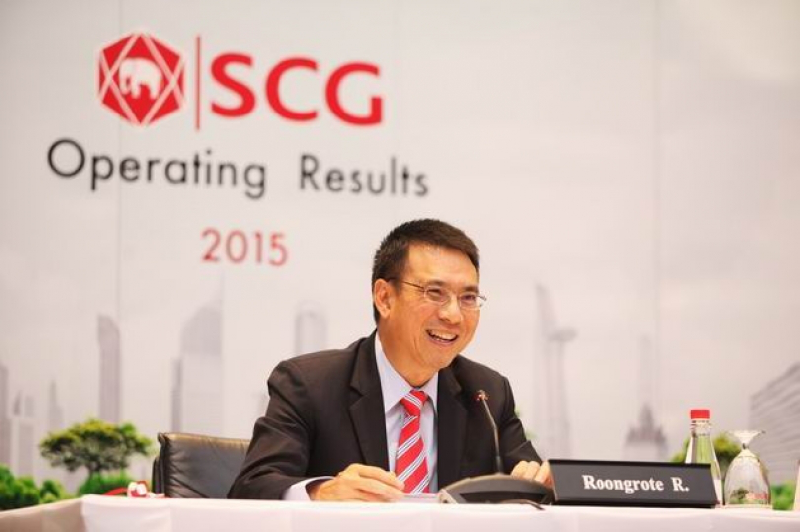
NEW CHIEF EXECUTIVE Roongrote Rangsiyopash sees no need for Siam Cement Group (SCG), the country’s leading industrial conglomerate, to do something drastically different at this time, but rather to do what it already does better and faster.
“I would like to keep the main policies for a while, and would like to emphasise speed and execution in our work,” he said yesterday.
He will keep his predecessor’s policies of expanding in Asean and increasing the group’s capacity for innovation and value-added products.
Roongrote, who succeeded Kan Trakulhoon, the president and CEO for a decade, at the beginning of this year, told his first press conference that considering the market and competition, SCG should continue to focus on the Asean market and focus more on high value-added products (HVAs).
SCG might intensify its research and development (R&D) efforts, while rolling out more HVA products to other Asean markets.
Besides expanding its production base in Asean, the group will also extend the coverage of its distribution channels in markets such as Myanmar, where it is forming a joint venture to handle cement and building materials, and where it will commence its first cement plant in the middle of this year.
Last year SCG boosted its R&D spending 30 per cent to a record Bt3.5 billion, or 0.8 per cent of sales. This year it plans to increase its R&D budget to exceed 1 per cent of sales.
However, sales from HVA products and services last year dropped 4 per cent to Bt161.85 billion, or 37 per cent of total sales. Meanwhile, SCG reported to the Stock Exchange of Thailand that its board of directors yesterday approved the proposal of its wholly owned subsidiary SCG Building Materials to acquire the remaining 15 per cent of the Prime Group and related assets in Vietnam for Bt2.19 billion.
Prime Group is the largest ceramic tile manufacturer in Vietnam with sales of Bt8.3 billion in fiscal 2015.
SCG saw its operating profit leap 35 per cent to Bt45.4 billion last year, thanks to the wide margins for petrochemical products. Sales slipped 10 per cent to Bt439.6 billion on a big decline in oil prices, which pounded the prices of petrochemicals.
Increased competition and flat demand in the home market were the major reasons for the sluggish performance of the group’s cement and building materials business, whose earnings before interest, tax, depreciation and amortisation fell 8.6 per cent.
“Considering additional production capacities and the market outlook [for the cement and building material business] will continue to face challenges in the next one to two years. It will require high management capability,” he said.
SCG will continue to look for ways to boost energy efficiency and workforce productivity and to apply more automation and mechanics in its operations.
Its US$4.5-billion (Bt161 billion) petrochemical-complex project in Vietnam will be delayed by at least six months while it looks for another partner by the first half of this year, after Qatar Petroleum dropped out.
The Thai economy is expected to perform better this year if the government can push its infrastructure projects ahead as scheduled. This would inject more money into the economic system during the second half of this year.
It is difficult to predict the margins of petrochemical products this year as oil prices were volatile and tumbled by about 10 per cent in less than a month.
Thanks to the start-ups of its cement plants in Cambodia, Indonesia and Myanmar, SCG’s sales from its Asean operations are expected to grow by about 20 per cent this year from Bt47.17 billion last year.
