
Ambitious Alibaba breaks new ground in online shopping
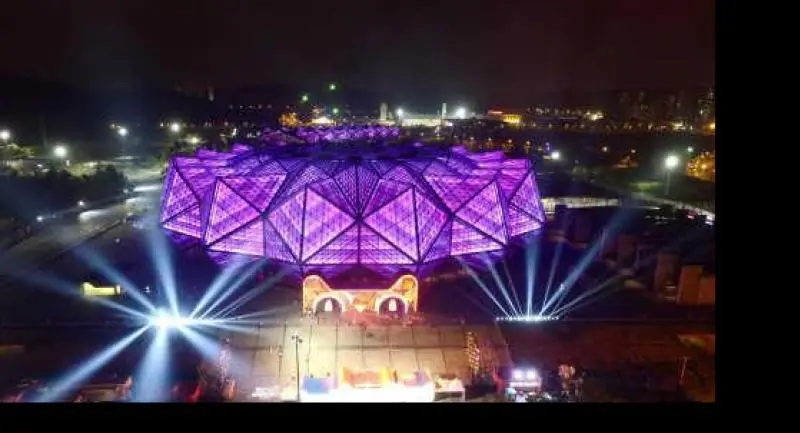


ALIBABA is bringing the world to the future of online shopping. On Friday, the Alibaba Group launched the world’s largest 24-hour online shopping event this year, in Shenzhen. There was a huge gala show and mega-sales surpassed 120 billion yuan in gross merchandise volume (GMV).
In Shenzhen, where the 11.11 gala was held this year, more interactive features were added. The more than 100 million viewers could play director by sending feedback via smartphones to change what the stars do on stage.
“Alibaba is not lacking engineers or customer service representatives. We need economists, sociologists, people with integrated knowledge to deal with challenges,” Jack Ma, Alibaba’s executive chairman, said.
Live broadcasts and entertainment were used in the run-up to this year’s event. More than 600 international brands used Alibaba’s live-steaming capabilities to introduce their brands and 11.11 products got customer feedback in real time.
At Alibaba’s 11.11 Countdown Gala Celebration, consumers in front of the televisions could be seen shaking, scanning, chatting, browsing and buying with their mobile phones. Audiences could even vote in real time to guide the plot direction of the drama shows unfolding on the stage. Alibaba is showing that virtual reality shopping is not sci-fi.
From November 1 until Friday, consumers could demo Alibaba Buy+; the shoppers could browse products at eight virtual reality stores, including Macy’s, Target, Costco, P&G and others, with 360-degree views using a VR headset. There is no need for expensive headsets. At just 1 yuan, the “VR cardboard” can be connected to a smartphone which has been available at the Taobao Marketplace since October 21.
Innovation in online shopping
Alibaba has introduced innovation to enhance consumers’ online shopping with augmented reality and Omni-channel Commerce, a location-based augmented reality mobile game featuring the Tmall cat mascot called “Catch the Tmall Cat”. This Pokemon Go style mobile game drives consumers to physical shops such as KFC, Intime Shopping malls, Suning, Shanghai Disneyland and Starbucks.
Alibaba is working with more than 1 million offline stores across various product categories to present consumers with an integrated online-to-offline experience across products, members and services and a “See Now, Buy Now” initiative. As a core part of the fashion show, consumers could use a “Buy Now” button to order in real time everything they saw on the catwalk in the Tmall and Taobao mobile apps while watching the shows and could also watch a stream on Alibaba’s online video hub Youku.com to pre-order items. More than 1,000 products from 50 international brands were showcased including Adidas, GAP, Levi’s Burberry, Paul Smith, New Balance and others.
When Alibaba’s 2016 11.11 Global Shopping Festival began, in the first 5 minutes total GMV settled through Alipay exceeded 6.8 billion yuan (Bt35 billion). The 11.11 is not just a purely Chinese affair – 235 countries and regions completed cross-border transactions during the festival. This year nearly 100,000 merchants, including 11,000 international merchants, participated. Adidas, Apple, Nike, Pampers, Phillips, Siemens and Uniqlo were among the most popular in their respective product categories.
After 24 hours, total GMV settled 120.7 billion yuan in transactions that played out over Alibaba’s e-commerce platforms – mostly on B2C site Tmall.com and C2C site Taobao Marketplace, a 32-per-cent jump over last year, while order volumes recorded a new high with 175,000 orders in one second.
This was not surprising, as it was the world’s largest sale. Alibaba’s festival stimulated spending of more than $14 billion in GMV last year. “It’s not thinking about ourselves as an ordinary company,” Jack Ma told a crowd of several hundred reporters shortly before the close of Alibaba’s 11.11 2016 mega-shopping event at Media Centre, Shenzhen Universiade Sports Centre
“It’s about thinking of ourselves as an economy.” Alibaba is using technology and data to converge online and offline retail to move beyond simple transactions.
“That’s why we’re not reporting quarterly GMV. It doesn’t represent our true identity, and over-emphasising it makes people just think about e-commerce,” Ma said.
