
A farm concept that empowers communities


OVER the past six years, a Sampran model initiative has been recognised as an effective vehicle for empowering local farming communities to achieve sustainable development.
The key to their success is the adoption of a “Farm-to-functions” concept.
Bliss Foundation - the operator of the Sampran model and its strategic partners, is now expanding “Farm-to-” functions to a group of organic rice farmers in Surin province.
Arrut Navaraj, secretary of Bliss Foundation who initiated the Sampran model, said an annual meeting on December 16 would be held between 13 hotel operators in Bangkok and Ban Thap Thai Organic Agricultural Cooperative in Surin province. The operators would sign a memorandum of understanding and commit a total purchase order of about 7 tonnes of Jasmine rice 105 per month.
In the pilot project last year, the foundation successfully created business-matching between 13 Bangkok hotel and convention and exhibition centre operators, and Amnatcharoen Satjatham Rice Community Enterprise Network. The operators directly placed orders from the network at an average of 20 tonnes of rice per month. All of the Jasmine, riceberry and aromatic black (hom-nin) rice is IFOAM certified organic in-season rice.
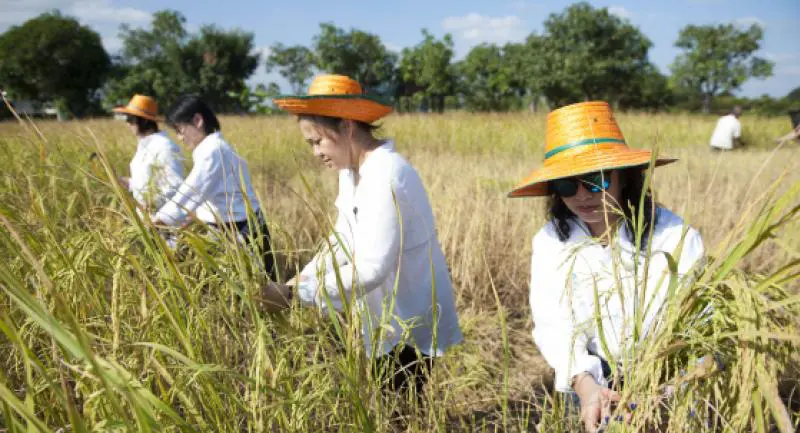
Last month, the foundation arranged a familiarisation trip, bringing hotel delegates to meet Amnatcharoen Satjatham Rice Community Enterprise Network’s farmers for experience in harvesting paddy rice in Tambon Noan Kotung, Phon Mueang Noi, Hua Taphan district of Amnat Charoen province.
Arrut said that besides the hotels, a famous restaurant chain, Sizzler, and Seefah Group directly purchased Jasmine rice through the Sampran model. S&P restaurant is also interested in ordering rice from the farmers.
“As many groups of organic farmers from various parts of the country want to participate in the Sampran model, the foundation is convincing various operators including hotels and airlines to engage in the Farm to - Functions,” said Arrut.
At the annual meeting, the foundation invited the member hotels nationwide via Thailand Incentive and Convention Association (TICA), Thai Hotels Association (THA) to join in exchanging ideas and experience with farmers and operators who participated in the Sampran model.
Arrut pointed out that in addition to strengthening a network of small organic farmers based on fair trade through the organic value chain, it was a platform to help enhance the MICE industry’s competitiveness with an assurance for customers in regard to food safety and mitigation of a carbon footprint.
Recently, the Sampran model became a key selling point for the Thailand Convention and Exhibition Bureau (TCEB) at a PCMA annual meeting for the business events industry. The 60 industry leaders will convene in Bangkok and get local experience at Sampran organic farms.
Sookjai Day 2016
This year, the Bliss Foundation and its strategic partners network formed a partnership with Tourism Authority of Thailand (TAT) to organise Sookjai Day 2016 (an annual organic agriculture fair). Under the theme “Discover the Royal Initiatives ... Experience sufficient agricultural model”, the event will take place at Sampran Riverside from December 16-18. The aim is to inspire people to change their way of life in accordance with the sufficiency economy principle.
Meanwhile, Sampran organic farms will be promoted as a pioneer for TAT’s Central Region domestic tourism campaign 2017 – Tha Tiew Kham Phak (challenge to travel across the regions), encouraging Gen-Y, women and silver age (high spending power and travel time) travellers to reach the distinctive local experiences and feel a different way of life.
The concept of Sookjai Day is to allow people to get first-hand experience in organic agriculture and inspire them to change their way of life. In addition, the foundation has joined all parties concerned to enhance the Sampran model in order to carry on the Royal initiative of sufficiency economy.
The three-day event will consist of nine key zones and a portrait for people to pay respects to His Majesty King Bhumibol Adulyadej; an exhibition of Royal initiatives; registration to receive TAT’s guidebook of 70 Royal initiative discovery routes and organic riceberry rice; a workshop to provide organic farm clinics and a variety of activities; main stage for an exchange of ideas and experiences as well as lessons learned from successful farm models. They will include Jon Jandai – who founded Pun Pun as a self-reliance learning centre – and experts on seeds preservation, Witoon Lianjamroon, director of the BioThai Foundation, and Vitoon Ruenglertpanyakul, founder and director of GreenNet social enterprise.
The Sampran model zone offers visitors advice on campaigns such as the Farm to Firm platform, bridging farmers and consumers via websites developed by Kasetsart University, Kamphaeng Saen Campus. Moreover, organic vegetables, fruits and herbal products under the Pathom brand are available for health-conscious consumers.
The Sookjai market zone is not restricted to organic products and food. Visitors can enjoy an array of organic shops of farmers and entrepreneurs from all over the country.
In addition, the Food Truck zone will tempt visitors to taste a variety of local dishes made from organic ingredients.
Somchai Chompoonoi, executive director Central, Tourism Authority of Thailand (TAT) said TAT would take this opportunity to introduce the agro-tourism locations in Nakhon Pathom and also distribute over 20,000 guidebooks of 70 Royal Initiative Discovery routes.
“The TAT has chosen Nakhon Pathom as the first location in the Central part to kick off the campaign. It will encourage target travellers from other regions to gain first-hand experience of this distinctive way of life, obtain knowledge about organic agriculture, and enjoy trips to environmentally-friendly locations,” said Somchai.
Sookjai Day 2016 is expected to welcome more than 20,000 visitors, generating over Bt270 million in revenue.
Developing the Sampran model
Arrut said the Sampran model had 11 groups of organic farmers with 10-20 member families in each.
The most important thing was how to elevate the Sampran model as a learning role model, demonstrating the engagement of public and private organisations, communities and educational institutes. Definitely, he said, the foundation had to gain strength through the value chain.
For upstream development, the foundation would collaborate with Kasetsart University’s Bang Khaen campus to enhance the quality of farmers’ work. The academics would provide knowledge on improving production and better quality of products such as a new way to produce organic fertilizers.
In the middle stream, the foundation would team up with the home economics and agriculture faculty at Kasetsart University to create value-added from organic rice, vegetables and fruits.
Meanwhile, Kasetsart’s Kamp-haen Saen campus will provide training to farmers on management after the harvest, such as logistics.
The foundation will develop downstream through collaboration with the TAT and TCEB to promote the Farm to Functions concept.
Arrut said that starting with Jasmine rice, the foundation would next year join with Plaza Athenee Bangkok, a Royal Meridien Hotel, to pioneer a Farm to Functions scheme for organic vegetables and fruits. Now, the member farmers in Nakhon Pathom, Kanchanaburi and Ratchaburi provinces can supply more than 30 kinds of vegetables and fruits to meet the demand.
