
Media, entertainment industry turns to online platforms as ad spending rises


THE THAI media and entertainment industry this year has been transforming itself into a digital ecosystem by shifting from traditional formats to new platforms in terms of strategy and budget allocation.
Reflected mainly in an allocation of advertising spending from offline to online media outlets, major brands and advertisers are putting more emphasis on digital tools not only to raise brand awareness and customer engagement, but also to drive e-commerce business.
Digital-media owners and agencies are likely to be big gainers in this changing game.
The Digital Agency Association (Thailand) has forecast that ad spending on digital media will likely reach more than Bt10 billion in the coming year.
Based on this year’s figures, DAAT president Supachai Parchariyanon said the biggest ad spenders, and particularly those making and selling skincare products, continued to spend more on digital media than they did a couple of years ago, reflecting the fact that online media had become the mass channel for consumer goods.
TNS Thailand reported in its research, undertaken in collaboration with the DAAT, that skincare products were now among the fastest-growing industries by sales volume, followed by non-alcoholic beverages, banks, alcoholic drinks, and vitamins and food supplements.
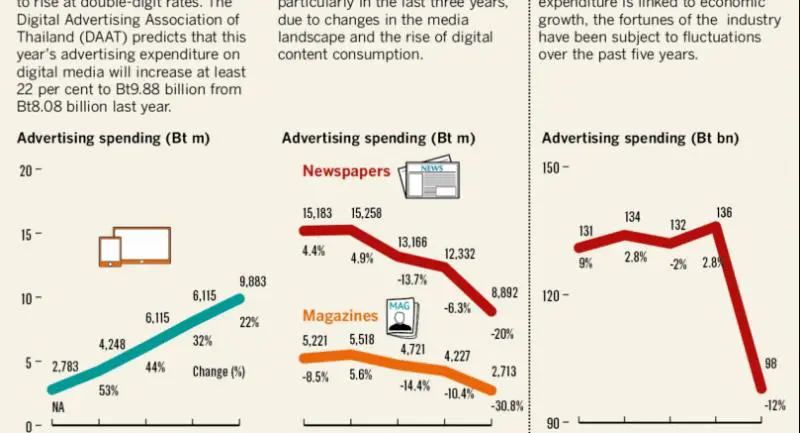
The DAAT predicted that overall digital-advertising spending would come in at Bt9.88 billion this year, an increase of 22 per cent from last year’s figure. Unfortunately, however, Thai online-media owners seem to have gained less than the global social-media giants have.
Facebook ads are expected to dominate the digital-advertising segment, with Bt2.84 billion this year, followed by YouTube with Bt1.66 billion, and display ads with Bt1.62 billion.
Downward trend in print media
Media scholar Sikares Sirakan has questioned what Thai media powerhouses will look like in the future, with global competitors playing an increasingly significant role in the Thai market.
Print media appear to have suffered the most in terms of advertising revenue, as both multinational and local advertisers tended to allocate their budgets to digital media outlets.
Looking back at ad expenditure by brand owners and corporates throughout the last four or five years, it is clear that both the magazine and newspaper sectors have had limited opportunity to move forward, he said.
Nielsen Thailand reported that in the first 11 months of this year, advertising in magazines was down 30.84 per cent from the same period last year.
That said, magazine advertising has been in a state of continuous decline since 2012.
Newspaper ad spending has been on a similar downward path, decreasing from Bt15.18 billion in 2012 to Bt12.33 billion last year, while spending was just Bt8.89 billion in the first 11 months of this year.
Wannee Rattanaphon, chairwoman of IPG Mediabrands and vice president of the Media Agency Association of Thailand, said the overall Thai media industry had experienced three consecutive years of decline, mainly due to the domestic economic slowdown and weak consumption.
TV still key but digitisation needed
Throughout this year, TV broadcasters have also been putting more effort into developing their digital platforms in order to expand their video-on-demand service for new-generation audiences.
Some have also used social-media networks to engage with target viewers and lure them back to TV sets to help boost ratings.
Workpoint TV, a digital-TV station run by Workpoint Entertainment, is a good example.
On top of creating its own favourite shows and the acquisition of international hit TV formats, station CEO Chalakorn Panyashom said his digital-content team also provided the programmes on YouTube and its official websites and mobile application for catch-up service.
With growing demand, Chalakorn said the company aimed to increase digital-content staff from 10 to 30 next year.
Workpoint TV has used social media to remind its audience to get updates about which TV shows are live, he added.
“We believe that when they see those live shows on their Facebook Live feed, they will turn to the TV screen to enjoy the programme. We do not see Facebook Live as a threat for entertainment shows, but we have found that this new feature appears to attract viewers from news programmes,” he suggested.
The strategy has also created a new revenue stream for Workpoint TV. So far this year, its content supplied to YouTube has generated more than Bt50 million in revenue, compared with Bt20 million for all of last year.
Revenue from all social-media platforms has reached Bt60 million-Bt70 million this year.
Dew Waratangtragoon, deputy CEO of One31 digital-TV station, said his station continued to collaborate with social-media giants to increase its audience share and revenue.
“However, we believe revenue from our live programmes via main screens will still represent 80 per cent of our income, while the rest will come from revenue-sharing with online platforms like YouTube and Line TV,” he said.
OOH media still on the rise
“Out-of-home [OOH] media consumption still means business opportunities for brands,” said Somwalee Limrachtamorn, managing director of Nielsen Thailand.
Referring to overall sales of consumer goods via modern traders, which were worth about Bt900 billion a year, she said only 30 per cent was from in-home consumption.
Ad spending via OOH media increased in the first 11 months, she added.
IPG Mediabrands, the country’s leading provider of media planning and buying services, partnered this year with VGI Global Media, the biggest OOH media provider, to commence programmatic buying to automate the purchase of advertising in real time.
Moreover, VGI aims to capitalise on the digital trend by acquiring 90 per cent of both Bangkok Smartcard System Company and BSS Holdings Co.
Its CEO, Surachet Bamrungsuk, said the Rabbit business would help the company become a “data-centric media hypermarket”.
