
Sumitomo banks on rising demand for building machinery in SE Asia
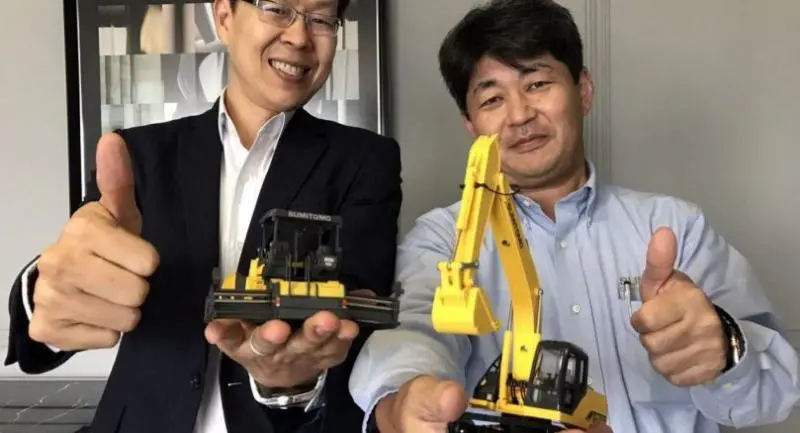


SOUTHEAST ASIA is expected to account for a bigger slice of the global business of Sumitomo Construction Machinery Group (SCM) over the next five years.
The Japanese machinery giant is basing its expectations on the region’s strong economic growth and large population, especially with its high proportion of young people.
In Thailand, sales of Sumitomo excavators increased significantly to about 820 units last year, and are expected to reach 1,000 units this year. Over the next three years, a further 600 excavators are expected to be sold in the country, which is SCM’s fastest growing market in the region.
Kazuhiko Sasaki, president director of Sumitomo Construction Machinery Southeast Asia, told The Nation that such encouraging factors form the basis of Sumitomo’s growth expectations for its construction machinery business in the region.
The Indonesian-based executive said SCM Group’s annual revenue from the Asean region had increased gradually from 5.1 billion yen (Bt15.7 billion), or 3.8 per cent of the group’s total revenue in fiscal year 2011, to about 9.8 billion yen, or 6.5 per cent of total revenue in 2015.
“We expect the contribution from Asean to reach 10 per cent of our total revenue in the next five years,” Sasaki said.
He said Sumitomo is one of the oldest and most diversified business groups in Japan, drawing on 400 years of history that began with a family-owned copper mining business.
The founding family’s business philosophy, which is “steadiness and reliability are of the great importance”, have been followed by Sumitomo’s employees to the present day. Major businesses include banking and financing, insurance, machinery, chemicals and trading.
“Our heavy industry business, which has been in the business for between 60 and 70 years, is also one of 23 major companies within Sumitomo Group,” he said.
SCM Group has three major manufacturing plants for construction machinery, including excavators and asphalt pavers: at Chiba in Japan, Tangshan in China, and Karawang in Indonesia.
The Chinese factory will manufacture special models of construction machinery for the China market only, while the Indonesian plant will supply products to the Southeast Asian market – manly Thailand, Malaysia, Myanmar and the Philippines.
Sasaki said that according to Japan Construction Equipment Manufacturers Association, the demand for hydraulic excavators in China dropped by 75 per cent from 157,000 units in 2011 to only 40,000 units last year amid the country’s economic downturn.
The huge decline in excavator demand in China had also affected the global demand for hydraulic excavators, which had been also reduced from 301,000 units in 2011 to about 165,000 units last year.
In the Asean region, the demand for excavators dropped by 54 per cent from 22,000 units in 2011 to 12,000 units last year, reflecting the fallout from the slowdown in China. Asean countries are key suppliers of natural resources - including coal, nickel and bauxite – to the Chinese market.
Sasaki said that SCM Group had adjusted its business strategy to deal with the downtown by focusing more on the large and growing markets of Thailand, Indonesia, Myanmar and Malaysia.
He said that, in the region, SCM was able to largely maintain the volumes of shipments of its hydraulic excavators. These dropped slightly from 690,000 units in 2011 to 651,000 last year.
SCM Group’s two largest markets – Japan and North America – have seen a strong increase in demand for hydraulic excavators, with sales up from 1.7 million units and 1.8 million units, respectively, in 2011, to three million units and two million units last year.
Japan, North America
Japan and North America together contribute about 60 per cent of SCM Group’s total business.
SCM Group’s market share for hydraulic excavators in the Asean region had increased from 4.5 per cent in 2015 to 6.5 per cent last year due to a recovery in the Indonesian market. The group has a similar market share, of 7 per cent, in Thailand and Indonesia,
Sasaki said the Thai market had strong potential for the expansion of construction machinery into neighbouring Indochina market. Individual contractors in Thailand have gained much construction work in Laos and Myanmar. From the logistics point of view, Thailand also serves as a hub for used machinery in the Indochina region.
“With Leadway Group as our sole distributor, Thailand has been promoted as our marketing and distribution hub to cover the whole of Indochina,” he said.
“We will also apply the “one country, one distributor” policy as it is comfortable for us to invest under this model.”in a long term journal,” added Sasaki.
