
Better living through water management


THE HONDA KHIANG Khang Thai Fund (HKKT Fund) – under the Honda Thailand Foundation and in collaboration with the Utokapat Foundation, under the royal patronage of His Majesty the late King Bhumibol Adulyadej – is making progress with a water resource development project in the Prachinburi basin.
The project is under the royal patronage of the late King.
These partners have also initiated a water resource development project in the Nan basin, in an area covered by “bald” mountains that poses a considerable risk of drought and landslides.
The Nan project is scheduled to be completed in 2019. It will enable both basins to provide adequate water supply for consumption for citizens in 4,757 households, increase water resources for agricultural activities on 15,256 rai (2,441 hectares) of land throughout the year.
Eventually it is hoped the bald mountains will be revived over an area of more than 3,000 rai (480 hectares) so it becomes a watershed forest and aids in mitigating the risk of drought and landslides.
HKKT Fund managing director Pitak Pruittisarikorn said that water crisis was an urgent issue and a national agenda priority. The HKKT Fund recognised that and has supported the water resource development project in the Prachinburi basin since 2015.
The project has become a major success as it provides effective mitigation of flash flooding and drought that has become chronic problems in the Na Kham and Muang Khao sub-districts. It also enables the community to become a model for others in term of sustainable management of communal water resources.
Consequently, the project was extended to the implementation of the water resource development project in the Nan basin in the area of Ban Dong Pha Poon and Ban Na Bong communities. The goal is to revive the watershed forest in the area in a sustainable manner as it is been severely affected by the bald mountains issue that is caused by deforestation.
The HKKT Fund is supporting the Nan project with a budget of Bt12 million that is focused on promoting community engagement to develop communities’ capacity to self-manage their water resources while at the same time extending these engagement initiatives to neighbouring communities.
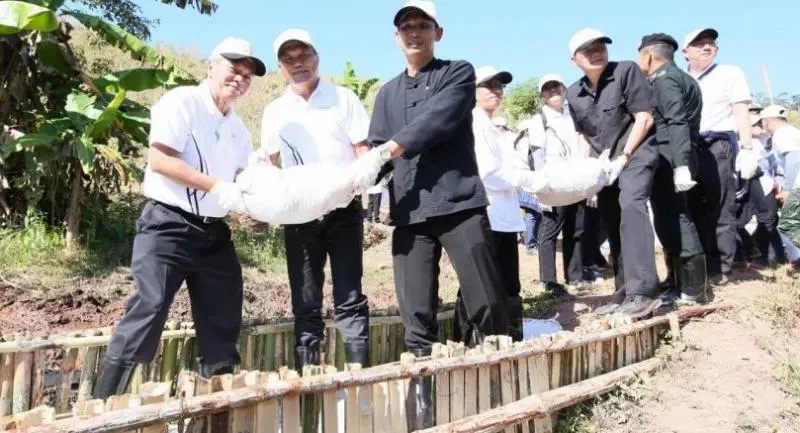
The project will increase water resources for consumption and year-round agricultural activities for people in 272 households around the area. The pilot activity in the first phase of the project began on December 24, with the objective of reviving the watershed forest in Ban Dong Pha Poon, Bo Klua district.
The pilot activity is focusing on the management of water distribution systems as a way to increase soil moisture and soil improvement and includes the construction of five check-dams and the planting of water-absorbent plants such as wild bananas, cultivated banana and tao (a local palm). This will become a stepping-stone plan to rehabilitate the bald, Pitak said.
Dr Royol Chitradon, secretary-general of the Utokapat, said the development model and the extension project to mitigating the bald mountains problem involved adopting King Bhumibol’s suggestion, which were provided on July 25, 2011, stated that to extend community water management that is successfully conducted in some communities, villagers from those communities, who have relevant experience and success in community water management operations, should assist villagers in other communities. This is in accordance with the principle of understand, achieve and develop that creates sustainability in community water management.
Additionally, the project is in response to Prime Minister Prayut Chan-o-cha, chairman of national water resources board, alarm over most of the mountains in Nan being deforested from villagers opting for large-scale monocultures in mountainous areas which depend on only rainwater.
Basically, there is no appropriate water distribution system to grow perennial plants. The three models of watershed forest management include upgrading all of seven 130-litre water supply tanks for consumption and the development of a suitable water system to increase soil moisture via building check-dams and improving soil improvement by planting wild bananas, tao and other useful trees.
The third measure centres on cultivation that focuses on the rehabilitated areas of both horizontal and vertical farming by adopting a new principle of cultivation called “3 Forests, 4 Benefits” and integrated farming systems so that farmers have sustainable, year-round production, resulting in increased water storage for consumption and agricultural activities during droughts.
Consequently, the area will become another model that succeeds in community water management and in line with the late King’s inspired vision, and create a network of community water management for other communities, Royol said.
Pitak said: “I’m very grateful to see such constructive collaboration among so many diverse sections of society, ranging from public sectors, the general population, the Third Regional Army, students of Pua Vocational College, volunteers from Honda Group, Honda car and motorcycle’s dealers, and particularly locals of the Ban Dong Pha Poon and Ban Na Bong communities. Together we have helped to conduct a survey to facilitate data collection and indepth problem analysis in order to hopefully submit guidelines for the rehabilitation and development of community water resources in a sustainable way as a stepping stone to be adapted to become a prototype in the sustainable management of the watershed forest, in response to HM the King Bhumibol Adulyadej’s vision.
“Lastly, we would like to express our commitment in supporting and assisting all of Thai people who are consistently affected by any natural disaster. Additionally, we strongly believe that the water resource management supported the sustainable livelihood of people.”
