
Recipe to turn used cooking oil into fuel
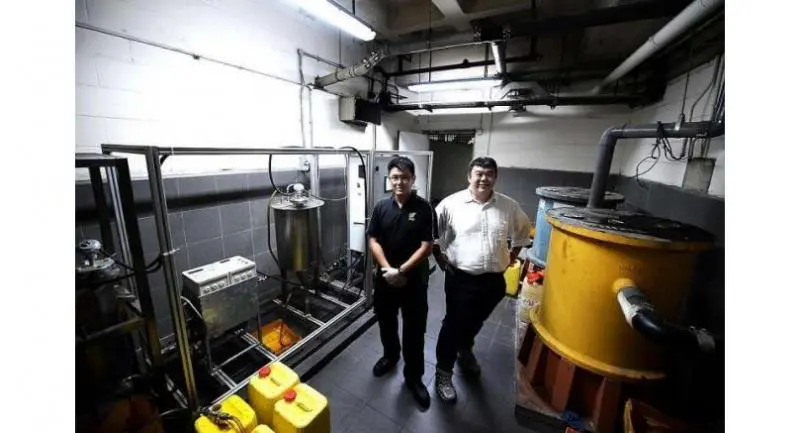


A SINGAPORE recycling firm is imagining a future where a shopping centre’s used cooking oil is transformed into biofuel that can power the building.
Alpha Biofuels is taking a small step towards that goal at Raffles City Shopping Centre with a pilot project that gives the used oil a second lease of life.
The facility, believed to be the first in a shopping mall, can produce up to 200 litres of biodiesel a day from used cooking oil – enough to power a double-decker bus for one full day.
Once the biodiesel is collected, it is sent to Alpha Biofuels’ plant, where the fuel is used to power vehicles, generators and forklifts used in construction sites.
Allan Lim, chief executive officer of Alpha Biofuels, said that while it costs a lot more to set up a biodiesel plant like the one his company has in Tuas, a planning area in Singapore’s West Region, a small system like the one in Raffles City costs US$40,000 (Bt1.4 million).
The facility, completed last November, recycles used cooking oil daily from Fairmont Singapore and Swissotel The Stamford hotels as well as more than 30 food and beverage outlets at Raffles City Shopping Centre.
An average of 2,500 kilograms of cooking oil per month – or a little over 30,000kg per year – is recycled at the two hotels.
If the pilot is successful, Lim hopes that the biodiesel could eventually be used to supply the energy needs of the shopping mall, although this means that the building would have to be retrofitted.
“This reduction of energy for transportation, along with the conversion of waste into useful energy, cuts down on the amount of greenhouse gas produced over its [used cooking oil’s] entire life cycle,” he added.
In November, Singapore’s National Environment Agency (NEA) announced a new licensing scheme in which food establishments must engage licensed collectors for collection of used cooking oil.
Dr Victor Chang, deputy director of the Residues and Resource Reclamation Centre at Nanyang Technological University, said the potential for biodiesel as a form of clean energy was high, although it also depends on global energy demands and oil prices.
“What was traditional waste is now turned into a resource,” Chang said.
However, rapid adoption of the system will be unlikely, as the machine is not cheap, he said.
“While there may be companies which would invest in this new machine to convert cooking oil to biodiesel, it will most likely be because they are aiming to go green or to fulfil corporate environmental responsibilities.
“In terms of operation costs, time is needed for a better evaluation of the cost and benefit.”
Elaborating on the benefits of biofuel, Lim said: “Biodiesel burns exactly like diesel. Engines don’t need to be modified to burn it.”
The Fairmont Singapore and Swissotel The Stamford hotels have been recycling used cooking oil for more than five years and the pilot project makes it more convenient, said Robert Stirrup, director of culinary for the two hotels.
There are a total of 15 restaurants and bars at both hotels, as well as a banquet kitchen that supports all events at Raffles City Convention Centre.
