
Myanmar to draw SMEs development strategy
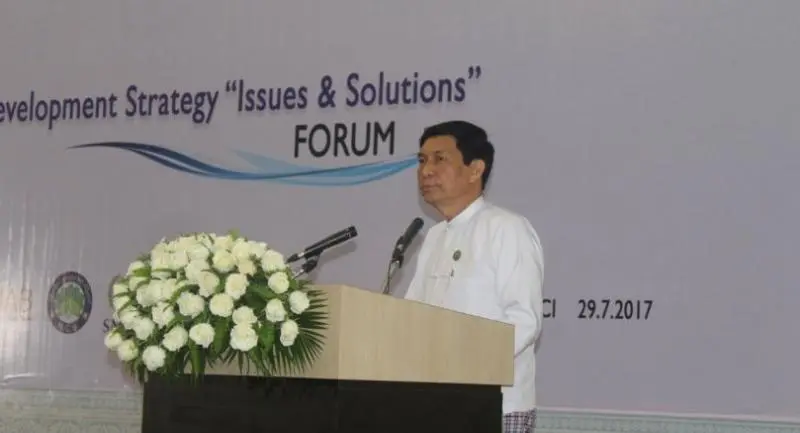


MICRO, small and medium enterprises in Myanmar would be encouraged on a very large scale to boost the nation’s economy under its first civilian government, a forum has been told.
Industry Minister Khin Maung Cho told the “SMEs development strategy: Issues and Solutions” forum on Saturday that the government would focus on drawing up and implementing effective strategies for SMEs, as they accounted for about 98 per cent of all the businesses in Myanmar.
“In order to produce more value-added products, we need to have standard operation procedures in place. We need to review our ways of implementation to get ourselves ready for the road ahead,” he said.
Khin Maung Cho stressed the importance of much-needed infrastructure development and technology transfer.
“When it comes to supporting small businesses here, we need to select which sectors should be urgently prioritised to enjoy rapid growth. We need to find out the most important thing to do and tackle that first. Then, we should go to improving other steps, step by step,” he said.
The minister admitted that it was difficult for many small businesses to survive due to the entry of multinational players in the market. He pledged to boost government support for SMEs in coming years.
“SMEs cannot usually invest a large sum of money. More importantly, they cannot fulfil market needs due to their lack of technology and low quality of their products. We are far behind other Asian nations in this regard. We are fully aware of that and are prepared to address it,” he said.
“But we cannot change everything in one day. All the staff need to be enthusiastic about reform. We need to encourage small businesses more than ever before. We need to provide more SME loans with lower interest rates. Honesty is really important in providing loans so that we can actually meet our target.”
Khin Maung Cho said the government would also encourage entrepreneurs and protect their rights by enacting laws and regulations related to information technology and intellectual property. Some of the laws would be enacted soon, once the Parliament approves the draft bills, he said.
He added that the government would prioritise human resource development. That initiative should begin in Yangon region first and then be integrated into other parts of the nation.
At the event, Phyo Min Thein, chief minister of the Yangon region government, revealed three priorities this year: collecting data about SMEs in the region, negotiating with banks on how they can support SMEs, and improving the functions of technology and computer science universities in Yangon.
“Firstly, we will do research to know how many SMEs are actually located in each district and township of the region. Only when we know it, can we draw more effective plans to support them.
“Secondly, we will have discussions with the banks here to find out how they can help the SMEs grow. We need to improve small businesses’ access to finance so that they can survive in the long run.
“Last but not least, we will try to create an effective linkage between technological universities and industrial zones. Today we have three technology universities and one computer-science university in Yangon region. Their locations in Thanlyin, Hlaing Thar Yar and Hmwebi are in a prefect position to establish industrial zones. So, we will make it happen this year,” he said.
Aye Aye Win, director general of the Central Department of Small and Medium Enterprises Development under the Ministry of Industry, said negotiations were under way to increase government loans for SMEs threefold from 50 billion kyats (Bt1.2 billion) this year to 150 billion kyats next year.
She said export-oriented businesses would be given favourable consideration for government loans to promote substitutes for imported products.
