
Sixth Airbus A350 helps sharpen THAI’s competitiveness


THE DELIVERY of its sixth Airbus A350 XWB aircraft will enable THAI Airways International (THAI) to strengthen its competitiveness in the airline industry, a THAI vice president said.
The new aircraft would help improve the airline’s products, Pranee Chandracherd, THAI vice president of business development and corporate strategy, said during an official delivery of the aircraft at Airbus Delivery Centre in Toulouse last week.
THAI ordered 12 A350-900 aircraft with eight of them on lease from US-based CIT. The first THAI A350 XWB arrived in August last year. The other six carriers will be delivered by next year.
The objective of ordering those new aircraft was to modernise THAI’s fleet by decommissioning older aircraft and replacing them with new ones, Pranee said.
The new planes fit the company’s strategy of increasing productivity to support the company’s growth through an increase in flights on popular routes, Pranee said.
The A350 XWB is a mid-size long-range commercial aircraft that Airbus bills as the most technologically advanced, modern and efficient commercial aircraft in the world.
It features the latest aerodynamic design, carbon-fibre fuselage and wings, and new fuel-efficient Rolls-Royce Trent XWB engines.
Jaoquin Toro-Prieto, Airbus head of market analytics and messaging, said the A350 sets a new standard of efficiency in its class, burning 25 per cent less fuel and generating 25 per cent less CO2 emissions compared to the long-range aircraft it replaces.
As of August, there were 848 firm orders from 45 customers for the A350 XWB. Some 212 of those orders are for the A350-1000, the newest member of the family.
One hundred A350-900 aircraft have been delivered and 98 are in service with 14 airlines.
In its statement, Airbus said it had set a target to ramp up A350 production to 10 aircraft per month by the end of 2018.
Airbus forecasts demand over the next 20 years for 8,100 new twin-aisle passenger and freighter aircraft spread across all manufacturers.
Last week marked one year since THAI received its first A350 XWB. The Thai pilot who first flew that airplane sees many benefits from the new aircraft for pilots and the company.
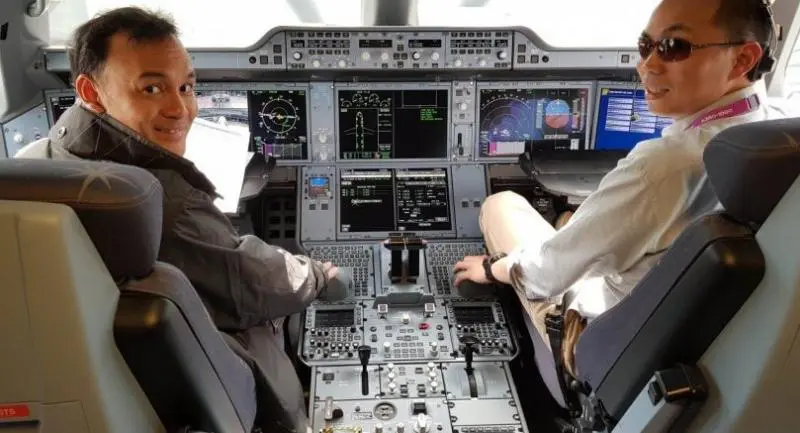
From a pilot’s perspective, adding the latest technologies inside the cockpit can help reduce their workload by more than 30 per cent, freeing up more time to monitor all critical systems, said Itt Sirisawat, the THAI chief technical pilot for A330/350.
“It’s like in the past you drove a manual transmission car but right now you use an automatic transmission car,” Itt said.
“The jetliner can fly faster but the safety is also enhanced,” said the 48-year old pilot, who flew THAI’s first A350 from Toulouse back to Thailand in August last year.
The cockpit features six large screens that are interchangeable and can swap information.
“I love it [the cockpit]. Most of the pilots that fly A350 also love it. The cockpit is wider and has a lot of space. This is the most beautiful cockpit in the world right now compared to other aircraft,” said Itt, who has flown the A350 for more than 100 flights in the past year.
The A350 XWB benefits from Airbus’ philosophy of commonality across all aircraft product lines, making operations, training and maintenance easier and less expensive for airlines, Itt said.
Pilots who fly the A330 can move to the A350 after spending only eight days in training, but pilots from another type of aircraft would require longer training, he said.
When a pilot can fly both the A330 and A350, the company can maintain the same number of pilots, Itt said, allowing the company to more efficiently utilise pilots.
More than 100 THAI pilots are now able to fly the A350 and all were A330 pilots.
“Passengers also love it. So THAI could make more income than using the old aircraft to serve passengers,” the pilot said.
The sixth THAI A350 has been royally bestowed the name “Phu Pha Man” and will be added for service to the current A350 routes: Bangkok-London, Bangkok-Frankfurt, Bangkok-Milan, Bangkok-Rome, and Bangkok-Brussels.
Though THAI has no plans to increase the number of aircraft within five years, that doesn’t preclude them from opening a new route, Pranee said.
