
Japanese automakers hit by US tariffs — 7 major brands lose ¥1.5 trillion revenue in first half of 2025
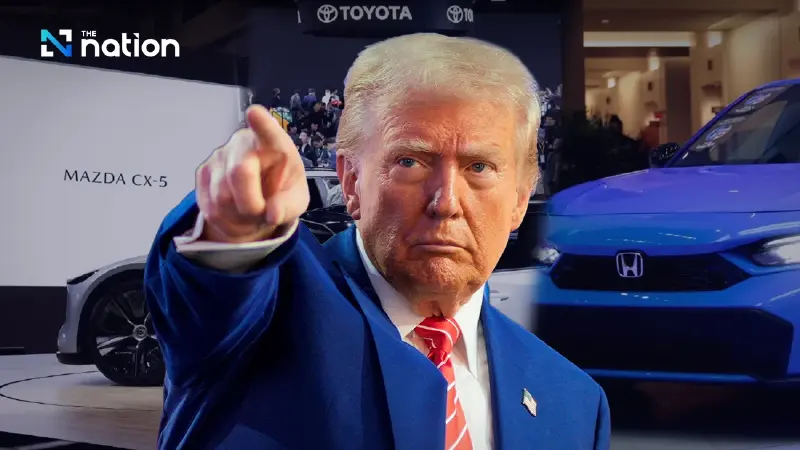


Japan’s top 7 automakers lose ¥1.5 trillion in revenue in H1 2025 due to US tariffs worth US$9.7 billion; Toyota suffers least, driven by hybrid sales

Combined net profit among the seven companies dropped 30% year-on-year to ¥2.1 trillion (440 billion baht), extending the downturn for a second consecutive year. Analysts estimate that without the tariffs and currency fluctuations, overall profits would have risen significantly.
Noriya Kaihara, Executive Vice President of Honda Motor Co., told reporters:
“This is the new normal. We expect these conditions to persist for the foreseeable future.”
A stronger yen compounded the losses, reducing total operating profit by ¥700 billion. Three automakers — Nissan Motor, Mazda Motor, and Mitsubishi Motors — posted net losses for the period.
The tariffs are expected to cut Japanese automakers’ profits by ¥2.5 trillion (520 billion baht) for the full fiscal year ending March 2026.
Mazda and Subaru hit hardest
Mazda Motor Corp. and Subaru Corp. — both heavily reliant on the North American market — were among the worst affected. The US accounts for about 30% of Mazda’s global sales, and most of its exports are shipped directly from Japan. The tariff barrier caused Mazda’s profits to plunge by ¥97.1 billion during the first half, pushing it into its first net loss in five years.
Jeffrey H. Guyton, Mazda’s Chief Financial Officer, said the tariff reduction in September came later than expected, initially projected for August.
“The delay caused a second-quarter hit of ¥10.3 billion, which explains our losses,” he noted.
Subaru, with 80% of its sales in the US, also suffered heavily. Although sales rose following new model launches, ¥154.4 billion in tariff payments wiped out much of the company’s profit. Believing tariffs could become permanent, Subaru has launched a ¥200 billion cost-cutting initiative through 2030 to maintain profitability.
Chip woes add new uncertainty
Beyond tariffs, automakers are bracing for supply chain risks after Nexperia, a Chinese semiconductor manufacturer facing export restrictions from the Dutch government, temporarily halted shipments. The disruption affected production at multiple automakers.
Honda had to scale back production in Mexico and the US in late October due to Nexperia-related shortages. The company lowered its full-year profit forecast for fiscal 2025, estimating an operational impact of ¥150 billion.
Meanwhile, Suzuki Motor Corp. was least affected by the tariffs since it does not sell four-wheel vehicles in the US, but it remains cautious about potential chip-related issues in the second half of the fiscal year.
Toyota stands strong amid crisis
Toyota Motor Corp. emerged as the most resilient automaker, absorbing roughly ¥900 billion in tariff-related costs while still posting strong global results. The company’s global sales rose 5% year-on-year, hitting a new record, driven largely by the 9% growth in hybrid car sales and effective cost reductions.
Kenta Kon, Toyota’s Chief Financial Officer, said:
“Hybrid demand in the US remains robust, and we expect the trend to continue.”
Toyota also recorded 6% sales growth in China, in contrast to Honda and other Japanese automakers struggling to compete with local brands.
Seiji Sugiura, senior analyst at Tokai Tokyo Intelligence Laboratory, noted:
“Toyota’s strong product lineup is setting it apart. The company’s rebound in both China and North America is an encouraging sign.”
Currency trends offer mixed relief
Automakers had projected the yen at 140–147 per US dollar, but the actual exchange rate reached ¥154 per dollar, providing a modest cushion for overseas revenue.
Sugiura cautioned, however, that the full impact of the tariffs has yet to be fully assessed:
“It’s still too early to gauge the long-term effects. Each company’s results depend on how they manage supplier costs and tariff burdens, which vary widely.”


