
Thai car exports fall as parts costs and weak demand weigh on output
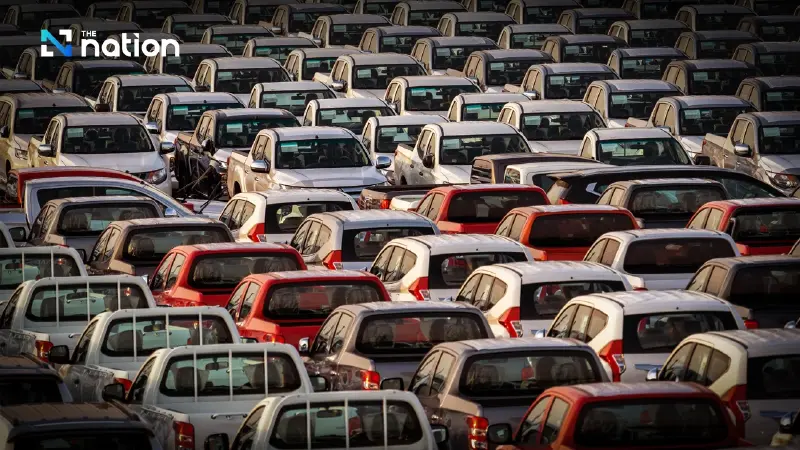


Thailand’s car exports fell in the first four months of 2026, as the FTI warned that rising parts costs and weak purchasing power could hit output.
Thailand’s exports of finished vehicles fell in the first four months of 2026, despite a rise in overall production and stronger domestic car sales, as the automotive industry warned that higher parts costs and weak purchasing power could drag down future output.
The Automotive Industry Club of the Federation of Thai Industries (FTI) reported that vehicle production, domestic sales and exports from January to April 2026 showed mixed signs for the sector.
Total vehicle production over the four-month period stood at 473,545 units, up 4% from the same period last year. Of that total, 316,605 vehicles, or 66.86%, were produced for export, an increase of 4.56%. A further 156,940 vehicles, or 33.14%, were made for the domestic market, up 2.90%.
Passenger car production reached 156,599 units, down 1.83%, while production of one-tonne pickup trucks rose 6.35% to 311,290 units.


Vehicle exports fall, led by pickup weakness
Exports of finished vehicles totalled 280,184 units in the first four months of 2026, down 3.45% from the same period last year. The total value of automotive exports, including engines and parts, stood at 267.90 billion baht, down 6.16%.
Exports of pickup trucks fell 5.88% to 176,415 units, a figure that included 155 battery electric vehicle (BEV) pickups.
Passenger car exports showed a more mixed picture. Hybrid electric vehicle (HEV) exports rose 62.90% to 27,759 units, while internal combustion engine (ICE) passenger car exports dropped 39.66% to 25,159 units. BEV passenger car exports surged 984.24% to 7,156 units.
Domestic sales rise as BEVs continue to grow
Domestic vehicle sales from January to April 2026 reached 230,477 units, up 15.02% from the same period last year.
Pickup sales fell 5.84% to 48,324 units, while sales of passenger cars and sport utility vehicles rose 23.91% to 157,099 units.
Of that total, BEV sales reached 64,109 units, up 90.61%, while hybrid vehicle sales rose 24.76% to 51,434 units.

April sales drop from March as risks weigh on buyers
Surapong Paisitpattanapong, adviser to the chairman of the FTI’s Automotive Industry Club and the club’s spokesman, said domestic vehicle sales in April 2026 totalled 48,394 units. The figure was down 19.16% from March 2026, although it was still 2.54% higher than in April last year.
He said investment and employment remained worrying, weakening consumers’ purchasing power. The global economy also continued to face risks from international conflicts and trade wars.
However, he said Thailand’s 2.8% economic growth in the first quarter of 2026, together with projects approved by the Board of Investment, could help create jobs and support stronger economic growth if investment is realised this year.
The government’s 400-billion-baht borrowing plan could also support the economy by reducing energy imports and increasing investment, which would help generate more employment in Thailand, he added.
Surapong said one of the most worrying negative factors was the request by some suppliers to raise prices for various automotive parts, citing the impact of the war in the Middle East.
Higher parts costs could further undermine vehicle sales and production, he warned.
