
BOT Governor Vows to Erase 'Ivory Tower' Image, Tackle Sub-2% Growth
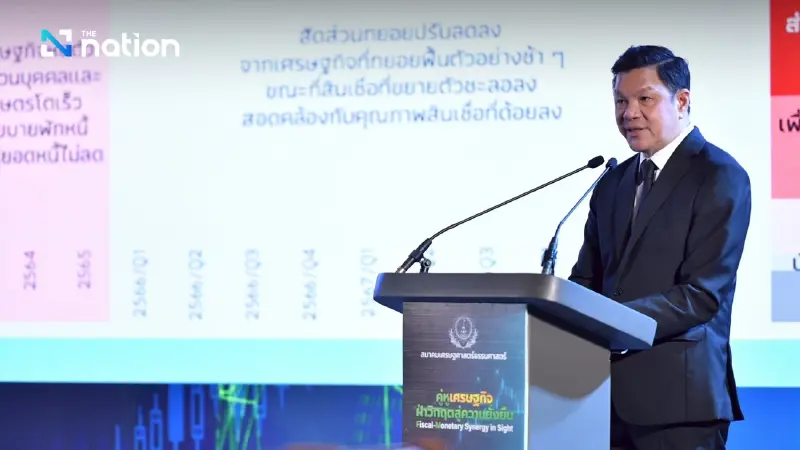


Vitai Ratanakorn shifts central bank's focus to structural issues; launches 'Social AMC' to help 2 million citizens clear household debt
- The Bank of Thailand (BOT) Governor is shifting the central bank's focus from macro-stability to tackling structural economic problems as Thailand's growth is forecast to fall below 2%.
- To shed its "ivory tower" image, the BOT is launching a "Social AMC" to help nearly 2 million citizens resolve household debt through interest reductions and manageable repayment plans.
- A new credit guarantee mechanism is being created to unlock an estimated 100-120 billion baht in new credit for Small and Medium-sized Enterprises (SMEs) facing negative credit growth.
- The Governor stated that traditional monetary tools like interest rate cuts are now largely ineffective, necessitating this new mandate and targeted solutions.
Vitai Ratanakorn shifts central bank's focus to structural issues; launches 'Social AMC' to help 2 million citizens clear household debt.
The Bank of Thailand (BOT) governor Vitai Ratanakorn announced a radical shift in the central bank's role on Monday, stating the institution is ready to move beyond its traditional focus on macro-stability and become a leader in solving Thailand’s deepening structural economic problems.
Vitai noted that the country's economic context has fundamentally changed, declaring that the economy is entering a "New Normal" of significantly slower growth.
"The Thai economy is at a point where we must accept that growth has declined considerably," he said.
While pre-COVID-19 growth hit 4%, the forecast for this year is a mere 2.1%, dropping further to an estimated 1.6% next year, signalling a high probability of settling at or below the 2% mark.
The Challenge of Uneven Prosperity
The governor highlighted that the low growth is compounded by a stark lack of dispersion. While large corporations maintain good access to credit, Small and Medium-sized Enterprises (SMEs) have endured negative credit growth for 13 consecutive quarters (three years).
Households face similar struggles, with personal income growth shrinking and expenses outstripping earnings for several years, leading to mounting debt pressure.
Vitai stressed that these issues are structural, not problems of general demand, making the use of the policy interest rate largely ineffective. He noted that four consecutive 0.25% rate cuts would collectively boost the economy by less than 0.2% over two years.
"If the BOT relies only on its primary monetary tool, the effect on the economy will be minimal, and the BOT could be viewed as merely 'analysing' problems without acting," he stated.

A New Mandate and Targeted Solutions
The Governor announced a revised mandate: beyond safeguarding economic stability, inflation, and financial institutions, the BOT will become a "leader" in addressing structural economic issues.
"This change will allow the BOT to solve more structural problems, and the term 'ivory tower' will no longer apply to the Bank of Thailand."
The new approach is centred on Targeted Measures to directly solve structural issues:
1. Household Debt Resolution (NPLs under 100,000 baht)
The BOT is transforming the state-owned Asset Management Company (SAM), which it 100% owns, into a Social AMC focused on helping citizens escape Non-Performing Loan (NPL) status rather than generating profit.
The first phase will assist nearly 2 million debtors, including 300,000 from state banks, with an average debt of approximately 27,000 baht per person.
Assistance includes reductions in interest, fees, and a portion of the principal. For those unable to pay, a 36-month repayment plan (approx. 300-400 baht per month) will be offered, allowing debtors to clear their records and potentially access credit again.

2. SME Credit Mechanism
The BOT is collaborating with the Government and the Thai Bankers' Association to launch a new guarantee mechanism, distinct from traditional soft loans, expected to unlock an estimated 100-120 billion baht in new credit.
This funding will be targeted at sectors with high competitive potential, such as food, agriculture, wellness, and smart electronics.
Plans are also underway to improve credit access for small businesses and grassroots individuals who have historically been excluded from the lending system.
