
Southern floods cut GDP by 0.2% as Ekniti submits relief plan to economic cabinet
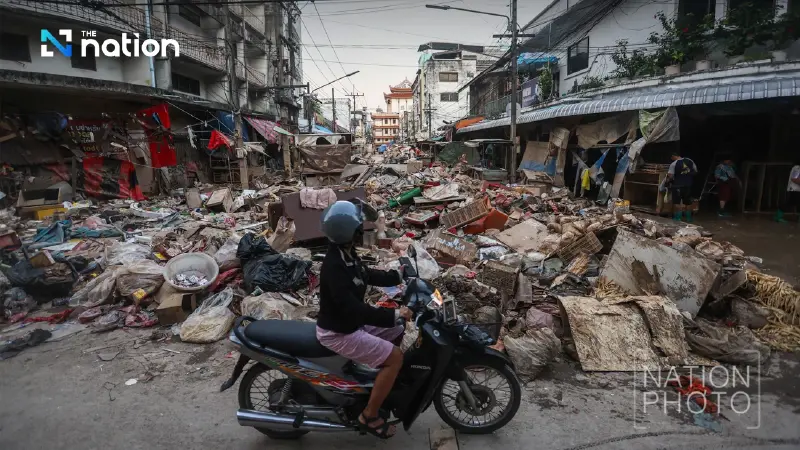


Southern floods may cut GDP by 0.1–0.2%, prompting government plans for debt relief, business support and long-term recovery, including a Hat Yai smart-city push.
- The recent floods in the South are estimated to have a limited macroeconomic impact, reducing the country's GDP by 0.1-0.2%.
- Finance Minister Ekniti Nitithanprapas is submitting a relief plan to the Economic Cabinet to address the damage caused by the floods.
- The plan's short-term measures include suspending principal and interest payments for affected individuals and supporting businesses to prevent layoffs.
- Long-term recovery strategies involve transforming Hat Yai into a Smart City and promoting the semiconductor industry to build future resilience.
Deputy Prime Minister and Finance Minister Ekniti Nitithanprapas, together with Bank of Thailand (BOT) Governor Vitai Ratanakorn, delivered a keynote address titled “Fiscal–Monetary Synergy in Sight: A Dual-Engine Strategy for Sustainable Growth” at an event hosted by the Thammasat Economics Association on December 1, 2025.
Ekniti said the recent flooding in the South had limited macroeconomic impact, but caused severe hardship and damage to people’s lives and property.
At Monday's (December 1, 2025) meeting of the Economic Cabinet, relevant state agencies and private-sector bodies, including the Joint Standing Committee on Commerce, Industry and Banking (JSCCIB) and the BOT, were convened to discuss joint relief measures.
“We are preparing to propose short-term relief focusing on giving people ‘breathing space’, including suspending principal and interest payments. The Labour Ministry, through the Social Security Office, will also step in to support businesses so they will not be forced to lay off workers,” he said.
For long-term recovery, the government is exploring plans to transform Hat Yai into a Smart City, making it stronger and more resilient. This includes promoting the semiconductor industry by leveraging the academic strengths of Prince of Songkla University.

He added that a package of SME-support measures would also be submitted to the Economic Cabinet. Short-term measures include liquidity aid, loan guarantees and low-interest soft loans, while long-term support will focus on technology adoption and AI-driven business transformation.
The “Older Siblings Help Younger Siblings Project” scheme will help SMEs integrate into supply chains, and a THB10 billion BOI (Board of Investment) fund will be used to support automation projects that reduce operating costs.
The government is also preparing a capital-market savings package aimed at reducing inequality. Ekniti said wealthier groups currently benefit more from tax deductions.
Under the new framework, each citizen will receive an Individual Saving Account (ISA), allowing them to invest directly in capital-market instruments such as equities or government bonds according to their risk appetite.
The reform aims to correct distortions associated with the former long-term equity fund (LTF) scheme and will be proposed to the Economic Cabinet next week.
Vitai noted that although the flooding in Hat Yai and Songkhla had only limited macroeconomic effects, the affected areas contribute around 2.6% of GDP.
The overall economic impact is estimated at no more than 0.1–0.2% of GDP. “What has been most severely affected is people’s livelihoods, especially daily-wage earners who have lost everything,” he said.
The BOT has instructed financial institutions to apply all possible regulatory relaxations, including easing loan-classification rules to prevent accounts from slipping into non-performing loan status, reducing principal and interest burdens, and lowering minimum credit-card payments from 8% to 0–3%.
State-owned financial institutions have already cut interest rates to 0% in severely affected areas and introduced supplementary measures in nine flood-hit provinces.
“Today, the cooperation between the Finance Ministry and the BOT faces no policy-coordination issues. The Finance Ministry focuses on short- and long-term growth, while the central bank is responsible for long-term macroeconomic stability and structural reform,” Vitai said.
