
Krungsri Chief Says Thailand's Economic 'Sickness' Requires Structural Treatment as Bank Lifts ESG Target
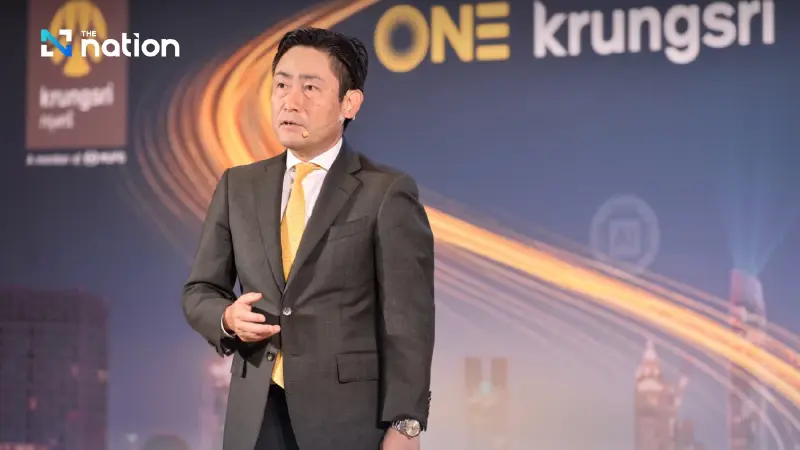


President Yamato responds to 'sick man' label, calls for reforms beyond stimulus whilst setting 350 billion baht sustainable finance goal
- Krungsri's President, Kenichi Yamato, acknowledged Thailand's economic challenges, agreeing with the "sick man of Asia" label due to issues like slow growth and high household debt.
- He stated that the country's economic malaise requires deep "structural treatment" through public-private collaboration, rather than temporary stimulus measures.
- The bank identified five key areas for reform: reducing household debt, supporting SMEs, boosting future industries, advancing climate action, and building financial trust.
- Amidst these economic concerns, Krungsri announced it is raising its sustainable and social finance portfolio target by 40% to 350 billion baht by 2030.
- Yamato emphasized that political stability and a clear long-term national roadmap are essential to attract foreign investment and implement the necessary structural changes.
President Yamato responds to 'sick man' label, calls for reforms beyond stimulus whilst setting 350 billion baht sustainable finance goal.
The president of Thailand's fifth-largest bank has acknowledged the country's economic challenges following its recent characterisation as the 'sick man of Asia', arguing the malaise requires deep structural reforms rather than temporary stimulus whilst unveiling a strategy to bolster sustainable finance by 40 percent to 350 billion baht (US$10.1 billion) by 2030.
Kenichi Yamato, president and chief executive of Krungsri, told reporters on Thursday that while Thailand faces significant structural challenges, the condition is treatable through concerted action involving both private and public sectors.
Responding to recent media reports labelling Thailand the 'sick man of Asia', Yamato said: "Thailand is currently like the 'sick man of Asia'. While the condition is not terminal, it is a disease that cannot be cured by simply taking medicine. We require structural treatment. It is essential that the private and public sectors work together to address these issues at their root."
The assessment comes as Thailand struggles with anaemic economic growth expected to remain below 2 percent in 2026, elevated household debt, and mounting pressures on its traditional manufacturing base from the global shift away from internal combustion engines.
Call for Comprehensive Reform
Yamato's remarks underscored growing concerns about Thailand's competitiveness relative to regional peers such as Vietnam and Indonesia, which have demonstrated stronger resilience amidst global economic headwinds.

The bank executive emphasised that household debt—affecting approximately 50 percent of Krungsri's 1.9 trillion baht loan portfolio—presents a critical obstacle to sustainable growth.
The bank has identified five structural priorities requiring immediate attention: household debt reduction through a three-tiered framework of relief, recovery, and resilience; support for small and medium enterprises; driving competitiveness in future industries including semiconductors and data centres; advancing climate action; and building financial trust through enhanced cybersecurity measures.
Yamato called for political stability and a clear long-term roadmap as prerequisites for attracting foreign direct investment.
"Political stability and a clear direction for the country are the most important factors for international investors," he said. "We need a long-term roadmap to address structural issues so that investors can be confident in the future of Thailand."
Yamato's willingness to acknowledge Thailand's structural challenges while emphasising their treatability reflects a careful balancing act.
By accepting the "sick man" characterisation while arguing the condition is curable, the bank executive signals both realism about current difficulties and optimism about Thailand's potential under the right policy framework.
The emphasis on "structural treatment" rather than stimulus aligns with growing recognition amongst economists that Thailand's challenges stem from deeper competitiveness issues rather than cyclical factors.
His explicit call for action within the new government's first 100 days suggests mounting impatience within the financial sector over the pace of reform.

Sustainable Finance Target Lifted
Against this challenging backdrop, Krungsri unveiled its 2026 business direction centred on the strategic theme "One Krungsri for a Sustainable Future", emphasising integrated services across its domestic and international networks whilst leveraging artificial intelligence and data analytics.
The bank, which holds a 60 percent market share in environmental, social, and governance (ESG) finance, announced it would raise its social and sustainable finance portfolio target to 350 billion baht by 2030, up from its previous goal of 250 billion baht.
The increased commitment reflects confidence in demand for transition financing as Thailand pursues net-zero emissions targets by 2050.
"Amid the structural challenges Thailand is facing, as a Domestic Systemically Important Bank (D-SIB), Krungsri recognises that our role must go beyond providing credit," Yamato said. "We are committed to being a trusted partner that strengthens the economy and stands alongside households and SME entrepreneurs, enabling them to move forward."
He added: "Our ultimate goal is not solely Krungsri's growth, but to build long-term resilience for customers, the business sector, and Thailand's economy as a whole."

Conservative Growth Targets Set
For 2026, Krungsri is targeting loan growth of 2–4 per cent with an overall net interest margin (NIM) of 4.0–4.3 percent, comprising domestic NIM of 3.25–3.50 percent.
The bank aims to maintain its cost-to-income ratio in the mid-40 percent range whilst projecting non-performing loans (NPLs) of 3.25–3.5 percent.
The elevated NPL target reflects a strategic shift towards higher-yielding SME and retail segments alongside a realistic assessment of economic headwinds.
The bank characterised the projection as a "prudent realignment" rather than deterioration in asset quality.
In 2025, Krungsri reported net income of 71.7 billion baht (US$2.1 billion), representing 7 per cent year-on-year growth driven by strong interest income and disciplined cost management.
The performance provided what executives described as a "solid foundation" for the bank's regional expansion ambitions.
Five-Point Action Plan
Yamato outlined five structural priorities to help lay the foundation for sustainable growth.
"First, easing Thailand's household debt so people can regain financial stability through a three-level approach: immediate assistance to enhance liquidity during crises; collaboration with the government to ensure debt-relief measures reach those who truly need support; and sustainable household debt solutions through debt restructuring aligned with individual repayment capacity, alongside financial literacy support," he said.
The second priority focuses on enhancing SMEs, described as "the backbone of Thailand's economy", to help them "survive, thrive, and grow sustainably".
Third, the bank aims to drive Thailand's competitiveness by supporting future industries and investment while connecting regional opportunities through collaboration among the public sector, industry players, and educational institutions.
The fourth priority advances climate action to enable "a tangible and inclusive transition to a low-carbon economy across all sectors".
Finally, the bank is focused on building financial trust by upholding transparency and stability to build lasting confidence in Thailand's financial ecosystem.

Technology Investment Accelerates
The bank designated 2026 as the "Year of Execution" for digital transformation initiatives, outlining three strategic pillars: customer-first service design, AI and technology adoption, and cross-unit collaboration under the "One Krungsri" framework.
Key initiatives include the "Jupiter Programme" to modernise core banking systems, development of a unified mobile application scheduled for launch in early 2027, and consolidation of more than 20 contact centre numbers into a single point of access.
The bank is also deploying AI-driven real-time fraud detection capabilities to combat rising cybercrime.
Krungsri is shifting towards "life-stage" banking models, exemplified by its "Family Suite" initiative offering zero per cent interest for four months on tuition fees and point-sharing capabilities between family members.
Regional Hub Ambitions
As a strategic member of Japan's Mitsubishi UFJ Financial Group (MUFG), Krungsri is positioning itself as a bridge for Japanese investment into Southeast Asia, particularly in electric vehicle and hybrid supply chains.
The bank is targeting 10 per cent growth in ASEAN-related business for 2026.
Management said the MUFG connection provides access to global capital markets and expertise in sectors including disaster prevention technology, where Japanese capabilities could differentiate Thailand's offering to international investors.
The bank has facilitated more than 400 business matches via its MUFG and ASEAN network, connecting local SMEs with global corporate partners to secure order flows and access lower-cost financing.
Banking on Reform
Krungsri's elevated ESG financing target, while ambitious, reflects the bank's strategic bet that climate transition will drive Thailand's next phase of industrial evolution.
However, the 40 percent increase from 250 billion to 350 billion baht also raises questions about demand absorption capacity in an economy growing below 2 per cent annually.
The bank's conservative loan growth guidance of 2–4 per cent—barely above projected GDP growth—suggests management expects the economic malaise to persist through 2026.
The willingness to accept higher NPL ratios in pursuit of SME and retail expansion indicates a calculated bet that market share gains will offset near-term credit costs.
