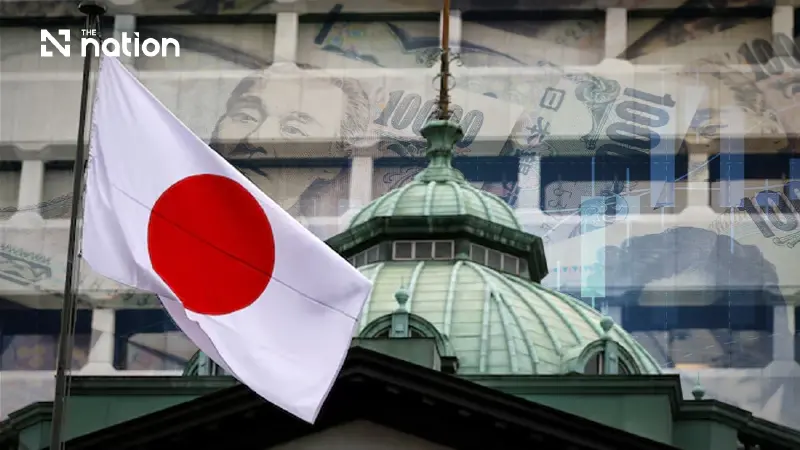
The BOJ voted 8–1 to keep its policy rate unchanged at 1%, while reiterating that borrowing costs could rise further if inflation risks intensify
The Bank of Japan (BOJ) kept its short-term policy rate unchanged at 1% in an 8-1 vote by its Policy Board.
Despite holding the rate, the BOJ signaled that borrowing costs could rise in the future if inflation risks increase.
The signal for potential hikes is supported by the central bank's assessment that inflation risks are "tilted upwards" and a slightly upgraded economic outlook.
One board member, Hajime Takata, dissented from the decision, proposing an immediate 25-basis-point rate increase to 1.25%.
The Bank of Japan kept its short-term policy rate unchanged at 1% on Friday, while reiterating that borrowing costs could rise further if inflation risks increase.
At the end of its two-day meeting, the Policy Board voted 8–1 to maintain the rate. Hajime Takata dissented and proposed a 25-basis-point increase to 1.25%, although the central bank had raised rates at its previous meeting in June.
The decision came after the yen rose sharply against the dollar during New York trading on Thursday in what market participants described as official Japanese yen buying coordinated with intervention by South Korea.
The operation lifted the currency from near its weakest level in four decades and produced its largest one-day advance against the dollar in almost two years.
Inflation outlook keeps further increases in view
Although the unchanged rate had been widely expected, economists interpreted the BOJ’s accompanying outlook as relatively firm.
Kazutaka Maeda, senior economist at Meiji Yasuda Research Institute, noted that the central bank had slightly upgraded its economic outlook, giving it further grounds to continue raising rates.
He argued that currency intervention could provide temporary relief but would not remove the pressure for tighter monetary policy if the underlying weakness of the yen persisted.
Naka Matsuzawa, chief macro strategist at Nomura Securities, took a more cautious view. She considered Takata’s solitary dissent evidence that support for another immediate increase was not yet widespread within the Policy Board.
Marcel Thieliant, head of Asia-Pacific at Capital Economics, described the outlook report as hawkish and maintained his forecast that the policy rate would reach 2% by the end of 2027.
He highlighted the BOJ’s assessment that inflation risks remained tilted upwards and that underlying inflation could rise above the central bank’s 2% target.
Masato Koike, senior economist at Sompo Institute Plus, also viewed the language on prices as firmer. He judged that the prospect of an October rate increase had strengthened relative to a move in December.
Hirofumi Suzuki, chief foreign-exchange strategist at SMBC, regarded the decision as consistent with expectations because the BOJ had raised rates only a month earlier. However, he said renewed yen depreciation could prompt markets to expect another increase sooner.
Japan’s currency intervention timeline
Japan’s Finance Ministry determines whether to intervene in foreign-exchange markets, with the BOJ conducting transactions on its behalf. The country has historically acted in both directions, buying yen when it weakened sharply and selling it when excessive strength threatened exports or economic recovery.
The following timeline retains the sequence of Japan’s main intervention episodes in reverse chronological order.
July 2026: The yen rose by more than 3% on July 30, reaching 157.8 per dollar one week after falling to 163.99, close to its weakest level in four decades.
The movement followed repeated warnings that Japan could intervene without advance notice. A South Korean market source reported that Seoul was selling dollars in coordination with Japan.
April–May 2026: The yen advanced as much as 3% to 155.5 per dollar on April 30 after weakening to 160.72, its lowest level since July 2024.
Japan’s Finance Ministry later reported spending 11.7 trillion yen, or about US$72.5 billion, on intervention over the period, setting a record monthly total.
July 11–12, 2024: Japanese authorities spent 5.53 trillion yen, or about US$36.8 billion, intervening in currency markets.
The operation helped lift the yen from 161.76 per dollar to as high as 157.30.
June 26, 2024: Masato Kanda, then Japan’s senior currency official, announced that authorities were seriously concerned and on high alert over the yen’s rapid decline as it traded near a 38-year low.
April–May 2024: Japan carried out a record single-day yen-buying operation on April 29 after the currency reached 160.245 per dollar.
A second round followed on May 1, bringing total spending across the two operations to 9.79 trillion yen, or about US$62.2 billion.
March 27, 2024: The BOJ, Finance Ministry and Financial Services Agency held talks after the yen fell to a 34-year low, signalling that intervention remained an option.
October 21–24, 2022: Japan spent 6.3499 trillion yen, or about US$42.8 billion, buying yen and selling dollars.
At the time, it was the country’s largest yen-supporting intervention.
September 7, 2022: The government expressed concern about rapid and one-sided currency movements after the yen weakened beyond 143 per dollar.
June 10, 2022: The government and BOJ issued an unusual joint statement expressing concern over the yen’s sharp decline after it moved beyond 134 per dollar.
August and October 2011: Japan intervened to restrain the yen’s rise, which officials feared could hinder the economy’s recovery from the March 2011 earthquake and tsunami.
March 18, 2011: The Group of Seven economies conducted coordinated intervention after the yen reached a record high following the earthquake.
September 15, 2010: Japan intervened for the first time in six years, selling yen after the dollar fell to a 15-year low of 82.87 yen.
March 2004: Japan ended a 15-month campaign aimed at limiting the yen’s appreciation.
Authorities had spent 35 trillion yen, then worth more than US$300 billion, during the intervention programme.
May–June 2002: The BOJ sold yen in operations sometimes supported by the US Federal Reserve and European Central Bank, although the Japanese currency continued to strengthen.
September 2001: The BOJ sold yen after the September 11 attacks in the United States. The European Central Bank and Federal Reserve Bank of New York conducted operations on the BOJ’s behalf.
January 1999–April 2000: The BOJ sold yen at least 18 times because of concern that a stronger currency would weaken Japan’s economic recovery.
The campaign included operations conducted through the Federal Reserve and European Central Bank, but the yen continued to appreciate.
1997–98: The yen weakened during the Asian financial crisis and approached 148 per dollar in August 1998, despite joint yen-buying by Japanese and US authorities.
April 1994–August 1995: The dollar fell to a record low against the German mark and a post-war low against the yen.
The United States intervened repeatedly, often alongside Japanese and European central banks, to support the dollar.
1993: The BOJ sold yen for much of the year to restrain the currency’s appreciation.
1991–92: The central bank intervened to support the yen by selling US dollars.
1988: The dollar fell to 120.45 yen on January 4, then a post-war low. The BOJ responded by buying dollars and selling yen.
1987: Six members of the Group of Seven signed the Louvre Accord in February, seeking to stabilise currencies and halt the dollar’s broad decline.
1985: The Group of Five industrial nations signed the Plaza Accord, agreeing that the dollar was overvalued and should be weakened.
1973: Japan allowed the yen to float freely against the US dollar, ending the fixed exchange-rate system that had previously governed the currency.
The latest BOJ decision leaves Japan using two distinct tools to address currency and inflation pressures: direct market intervention to counter rapid yen movements and monetary policy to manage broader economic and price conditions.
Attention will now turn to whether the yen retains its gains and whether the BOJ’s firmer inflation assessment leads to another rate increase later in 2026.