
Thai Airways Unveils Fleet Modernisation Strategy with Airbus A321neo Launch
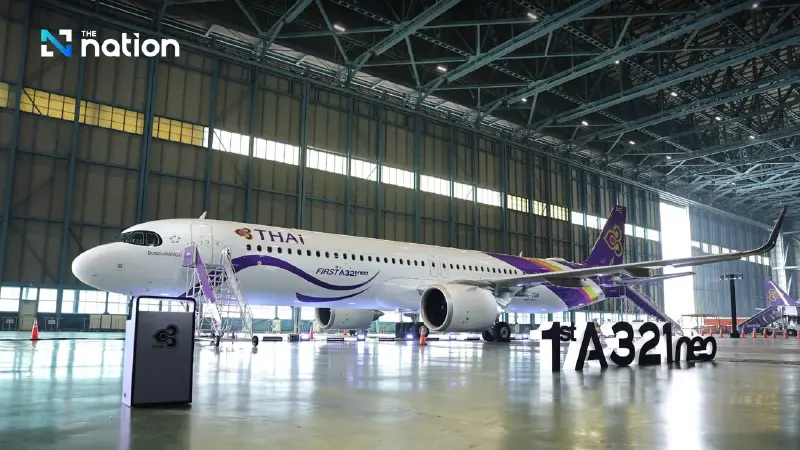


Thailand's flag carrier eyes 100-aircraft fleet by year-end as it introduces fuel-efficient A321neo 'Bowonrangsi' on regional routes
- Thai Airways has launched its first Airbus A321neo, named "Bowonrangsi," as a key part of its fleet modernization and post-rehabilitation strategy.
- The airline plans to expand its fleet from 79 to 100 aircraft by the end of the year, with the A321neo being the first of 32 new-generation planes scheduled for delivery.
- Chosen for its efficiency, the A321neo offers a 20% improvement in fuel consumption and will be deployed on regional routes across China, India, and ASEAN markets.
- The new aircraft features a modern cabin with enhanced passenger experience, including fully flat-bed seats in Business Class and upgraded in-flight entertainment systems.
Thailand's flag carrier eyes 100-aircraft fleet by year-end as it introduces fuel-efficient A321neo 'Bowonrangsi' on regional routes.
Thai Airways International has marked a pivotal moment in its post-rehabilitation transformation with the launch of its first Airbus A321neo aircraft, signalling an ambitious fleet expansion strategy that will see the carrier return to pre-pandemic operational capacity by the end of 2026.
The airline unveiled the aircraft, registration HS-TOA and named "Bowonrangsi" by royal bestowal, at a ceremony at Thai Technical Hangar at Suvarnabhumi Airport on Friday.
The event was attended by board members Sumrid Sumneing and Chananyarak Phetcharat, along with Chief Executive Officer Chai Eamsiri and business partners.

Strategic Fleet Expansion
In an interview at the launch event, Chai outlined the airline's vision to position Thai Airways as a comprehensive network carrier.
The fleet, which currently comprises 79 aircraft, is set to expand to 100 by year-end, matching pre-COVID levels whilst transitioning entirely to new-generation aircraft.
"The introduction of the Airbus A321neo into Thai Airways' fleet marks a significant milestone, reinforcing THAI's commitment to enhancing and elevating the passenger experience through modern, comfortable cabin design and in-flight products," said Chai. "At the same time, it reflects THAI's dedication to driving the aviation industry in Thailand and the region towards a more sustainable and environmentally friendly future."
The A321neo represents the first of 32 such aircraft ordered from Airbus, with deliveries scheduled over the next three years.
The initial ten aircraft will operate under operating lease agreements with AerCap, one of the world's largest aircraft lessors. Sixteen additional units are expected to arrive in 2026 alone.

Operational Efficiency and Sustainability
The airline's choice of the A321neo underscores its commitment to both economic and environmental performance.
According to Chai, the aircraft delivers a 20% improvement in fuel consumption compared with the A320, with a corresponding reduction in carbon dioxide emissions per seat. The aircraft is also capable of operating on up to 50% sustainable aviation fuel (SAF).
These efficiency gains align with Thai Airways' sustainability integration efforts and support its financial rehabilitation plan, which has seen the airline clear accumulated losses.
Financial results for the period are expected at the end of February, with dividend payments under consideration should the company achieve profitability.
Route Network and Market Growth
The A321neo will primarily serve regional routes across China, India, and ASEAN markets.
The inaugural commercial flight, TG413 to Singapore, is scheduled for 22 January, with the aircraft subsequently operating on a rotation including Phuket and Delhi through 28 March 2026.
Thai Airways projects 5% growth for 2026, with particular focus on expanding Chinese services to cities including Chongqing, Changsha, Shenzhen and Xiamen, as well as India and the CLMV (Cambodia, Laos, Myanmar, Vietnam) region.
This strategy capitalises on the Asia-Pacific region's position as the fastest-growing aviation market globally, with anticipated growth of 6-7% compared with 4-5% worldwide.
Chai acknowledged global supply chain challenges affecting aircraft manufacturers, noting that IATA estimates a five-year timeline for production to normalise.
However, Thai Airways has secured its delivery schedule through decisive procurement decisions, experiencing only minor delays of approximately one month for the current aircraft.

Premium Passenger Experience
The airline has invested considerable effort in cabin design, with products selected based on stakeholder feedback and social media insights rather than standard configurations.
Business Class features 16 seats arranged as four single "Throne Seats" and twelve double seats under a "Your Personal Room Concept".
These fully flat-bed seats recline to 180 degrees and include 17.3-inch touchscreen inflight entertainment displays with 4K resolution.
Economy Class accommodates 159 passengers in a 3-3 configuration, with ergonomically designed seats featuring 10-degree recline, six-way adjustable headrests, and 13.3-inch touchscreen displays.
Both cabins benefit from enhanced overhead storage and Bluetooth connectivity.
The aircraft is equipped with high-speed inflight internet via the SES Open Orbits multi-orbit network, supporting speeds of 200-300 Mbps, scheduled for availability from the first quarter of 2026.

Heritage and Identity
The aircraft's name, "Bowonrangsi", carries significant historical and cultural weight.
Previously bestowed upon a Boeing 747-400, the name derives from the historic Bowonrangsi community in Bangkok, associated with Wat Bowonniwet Vihara in the Bang Lamphu area.
The name combines "Bowon", originating from Bowon Sathan Suthawat (the Front Palace), a former centre of authority, with "Rangsi", meaning light and radiance.
Together, they signify an area under the influence of a revered institution, symbolising auspiciousness and historical value.
In a subtle nod to tradition, airline representatives noted that the "neo" suffix (from A321neo) resonates with "Wat Mai" (New Temple) in Thai, linking Latin nomenclature with local heritage.
The aircraft features new livery elements designed under the "Thai Contemporary" concept, with a neon violet colour tone symbolising innovation whilst maintaining consistency with Thai Airways' Airbus family branding.

Market Position
Chai characterised Thai Airways stock as a "value share" based on operational performance rather than speculation, emphasising the airline's adherence to its rehabilitation plan.
The company's progress is viewed against broader industry challenges, including manufacturers' production constraints affecting both new and legacy aircraft globally.
With the A321neo entering service, Thai Airways positions itself to compete more effectively in regional markets whilst advancing its environmental commitments—a dual focus the airline considers essential to sustainable growth in the Asia-Pacific's dynamic aviation sector.
