
Thai companies land S&P Global Sustainability Yearbook 2026 top 1% distinction
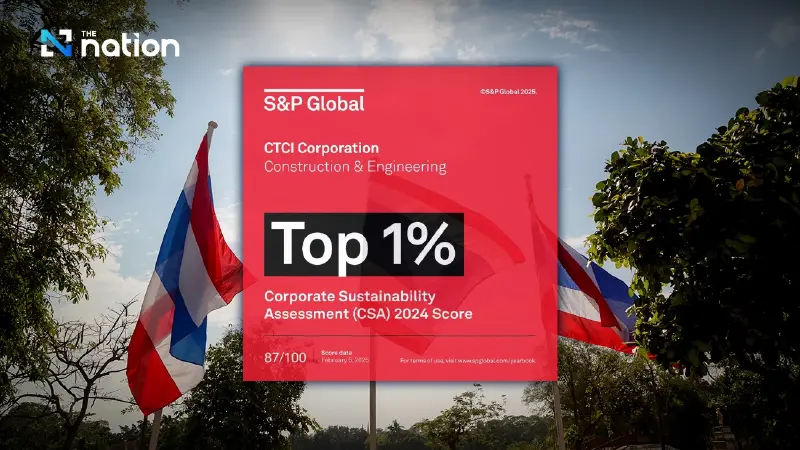


S&P Global’s Sustainability Yearbook 2026 selects 848 firms from 9,200+ assessed; Bangkok Biz News lists Thai companies earning the top 1% ESG distinction.
- Thai businesses named among Top 1% in S&P Global’s Sustainability Yearbook 2026
- S&P Global has announced the companies selected for the Sustainability Yearbook 2026, based on the 2025 Corporate Sustainability Assessment (CSA), its annual ESG assessment.
- Several leading Thai companies were ranked in the Top 1% of their respective industries, including AOT, AWC, BDMS, BJC, GC, OR, PTT, SCGP, TOP, TU, TRUE, VGI and WHA, according to Krungthep Turakij.
- Top 1% means that, within each industry, a company must have a minimum CSA score of 60 and a score within 1% of the industry’s top-performing company.
- Selection is highly competitive: 848 companies were chosen from more than 9,200 assessed globally, reflecting a global-level standard.
Corporate sustainability assessment is increasingly becoming a global competition stage. S&P Global announced the results of the 2025 Corporate Sustainability Assessment (CSA)—an ESG assessment used to question, analyse and compare companies worldwide—before using the scores to select companies for the Sustainability Yearbook 2026. The latest information clearly shows that ESG standards are being used as a marker of long-term business competitiveness.
The CSA covers Environment, Social and Governance (ESG). Companies must answer hundreds of in-depth questions and provide supporting evidence, to assess capabilities in risk management, governance, and impacts on society and the environment.
As of January 23, 2026, more than 9,200 companies assessed in the 2025 CSA were considered for inclusion in the Sustainability Yearbook 2026. This year, only 848 companies were selected for the S&P Global Sustainability Yearbook 2026, which launched on February 18, 2026.
Thai businesses named as Top 1%
Krungthep Turakij compiled a list of Thai companies that received Top 1% CSA scores from S&P Global, as follows.
Top 1% means that, within each industry, companies must have a CSA score of at least 60 and a score that falls within the top 1% range, close to the best-performing company in that industry.
Airports of Thailand Public Company Limited (AOT)
Industry: Transportation & transportation infrastructure
Asset World Corp Public Company Limited (AWC)
Industry: Hotels, resorts & cruise lines
Bangkok Dusit Medical Services Public Company Limited (BDMS)
Industry: Health care providers & services
Berli Jucker Public Company Limited (BJC)
Industry: Consumer staples retailing
PTT Global Chemical Public Company Limited (GC)
Industry: Chemicals
PTT Oil and Retail Business Public Company Limited (OR)
Industry: Retailing
PTT Public Company Limited (PTT)
Industry: Integrated oil & gas / upstream & integrated
SCG Packaging Public Company Limited (SCGP)
Industry: Containers & packaging
Thai Oil Public Company Limited (TOP)
Industry: Oil & gas refining & marketing
Thai Union Group Public Company Limited (TU)
Industry: Food products
True Corporation Public Company Limited (TRUE)
Industry: Telecommunications services
VGI Public Company Limited (VGI)
Industry: Media, movies & entertainment
WHA Corporation Public Company Limited (WHA)
Industry: Real estate management & development
Overview of the selection process
Excluding any modelling approaches to reflect real company data as much as possible, the selection process also incorporates exclusion screening criteria. Companies must pass ethical and risk screening, such as issues related to human rights or major disputes.
Distinction levels are calculated by benchmarking against the top-performing company in each industry to account for differences in business structure, after which exclusions are applied in the next step. Distinction levels and scores are assessed only within the same industry.
Passing the CSA and being included in the Sustainability Yearbook can have multiple effects: enhancing credibility among institutional investors, reflecting long-term risk management, and helping access green finance and sustainable investment.
Global companies face tougher sustainability tests
Robert Dornau, Head of Solutions and Corporate Engagement at S&P Global Sustainable1, said the Sustainability Yearbook 2026 was produced in a new context in which sustainability performance is being tested more intensely—driven by shifting regulatory expectations, rising stakeholder demands, and a more complex business environment affecting both disclosure and consistency of progress reporting.
He said this year’s Yearbook results reflect both the continued leadership of companies maintaining transparency and ESG momentum, and a clearer divide compared with companies facing pressure that has slowed measurable progress.
On the scale of the assessment, Dornau said that out of more than 9,200 companies assessed in the 2025 CSA and eligible for the 2026 Yearbook, only 848 were selected—highlighting the CSA’s strictness and the increasingly competitive selection standard. Consistency of performance, credible disclosure, and year-on-year improvement are becoming even more critical factors for organisations.
However, even as companies operate under real-world constraints and challenges, those selected for the Yearbook have demonstrated that credible sustainability performance can still be achieved and measured when integrated into governance structures, corporate strategy, risk management and operational decision-making. This also reflects a global market direction towards clearer benchmarking standards, higher demand for tangible impact evidence, and the rising value of “trust” in the world economy.
