
Thai Airways hikes fares 10-15% as jet fuel costs surge; bookings still strong
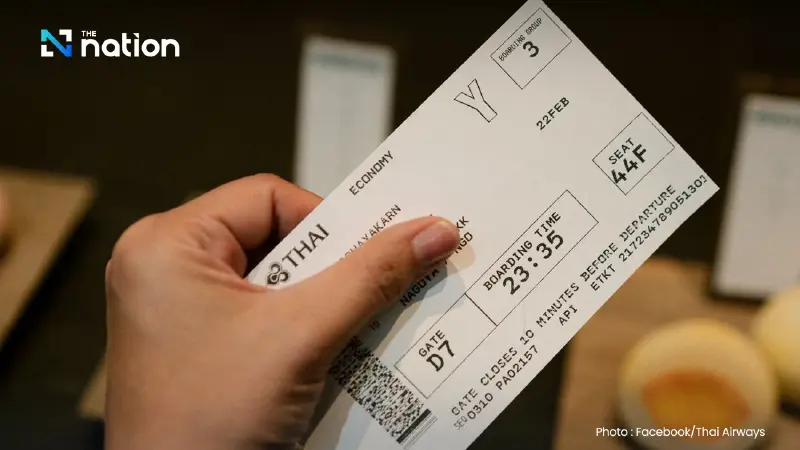


Thai Airways has started increasing airfares by 10-15% to reflect higher jet fuel costs linked to Middle East tensions, while saying advance bookings remain strong and its fleet is set to grow to 102 aircraft in 2026.
Thai Airways International Plc (THAI) has begun raising ticket prices by around 10-15% to reflect higher fuel costs driven by the situation in the Middle East, while noting it already has a mechanism to adjust pricing through a fuel surcharge.
Cherdchome Therdsteerasukdi, Chief Financial and Accounting Officer of THAI, said the airline has started adjusting fares to match the increase in oil prices. He said the company already has a fuel surcharge mechanism, but must set the surcharge ceiling jointly with the Civil Aviation Authority of Thailand (CAAT). She added that the current situation remains manageable, and the ceiling can be adjusted if necessary.
THAI said it has not seen signs of a travel slowdown and has not cancelled flights due to the situation. Advance bookings for March 2026 remain strong, with direct Europe-Thailand routes showing robust demand and an average cabin factor of 80-90%.
Over the past two weeks, tickets have been in short supply—not only on Europe routes but on several others as well—reflecting very high demand. In the short term, THAI has observed some passengers shifting towards direct flights to avoid transiting through Middle East hubs.

The airline has also adjusted flight paths to avoid conflict areas—such as routing around Iranian airspace—resulting in a slight increase in fuel burn, though it said the impact is not operationally significant.
This year, THAI expects multiple aircraft to join the fleet, both wide-body and narrow-body, alongside new routes, the resumption of previously served destinations, and increased frequencies—measures it expects will support improved performance.
However, THAI said it will prioritise maintaining liquidity amid the abnormal situation, and has no plans to seek new loans at present. Its credit rating process remains under consideration.
Chai Eamsiri, THAI’s Chief Executive Officer, reiterated that fares have been increased on some routes to reflect jet fuel costs, which have surged by nearly 100%. “We are not taking advantage of the situation—this is simply an adjustment in line with higher costs,” he said.

Rath Rauksamrauat, Director of Corporate Finance at THAI, said the airline plans to expand its fleet from 80 aircraft to 102 aircraft by 2026, comprising 67 wide-body and 35 narrow-body aircraft. This year, THAI is due to take delivery of 14 Boeing 787-9 wide-body jets and 14 Airbus A321neo narrow-body aircraft.
In 2027-2028, THAI aims to expand the fleet further to 112 and 129 aircraft, respectively, targeting a 2:1 wide-body to narrow-body ratio to support its hub strategy—bringing passengers from around the world to connect in Thailand to destinations across the region.
For 2026, THAI plans new and expanded routes, including Amsterdam (Q3), Auckland in New Zealand (Q3), and more destinations in China using narrow-body aircraft—such as Changsha, Xiamen and Chongqing (Q2-Q3)—as well as Busan in South Korea (Q2) and Da Nang in Vietnam (Q4).
“Today we are seeing a positive effect after Middle East aviation hubs closed, with more passengers choosing direct flights. Of course, this is a short-term impact. In the medium to long term, the company is monitoring bookings closely. March bookings are still positive compared with the same period last year. We still see positive signals, but if signals turn negative, the company will adjust plans accordingly,” Rath said.
