
Farmdar Brings AI Crop Intelligence to Thailand’s Sugar Belt
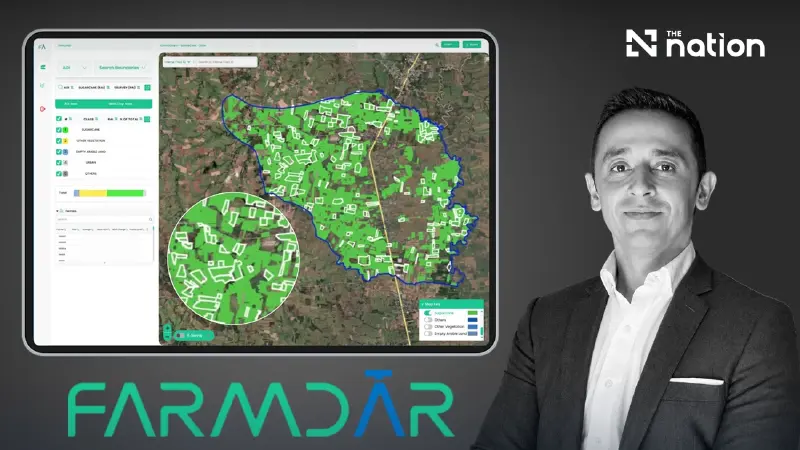


The agritech platform is helping leading Thai sugar producers improve cane visibility, harvest planning, and field-level decision-making
- The AI-powered agritech platform Farmdar is partnering with leading Thai sugar producers, including Mitr Phol, TRR Group and Cristala, to improve cane visibility, harvest planning, and field-level decision-making.
- Farmdar deploys its CropScan™ and YieldPro™ products, which use a combination of satellite intelligence, AI, and soil sensing to provide highly accurate data on crop area, yield prediction, and in-season plant health.
- This technology replaces traditional estimation and manual labor, increasing cane estimate accuracy from around 75% to over 90% and allowing for proactive agronomic interventions.
- The implementation of Farmdar's tools has delivered significant commercial impact, including reported ROIs of up to 260% by optimizing harvest monitoring and fertilizer application.
The agritech platform is helping leading Thai sugar producers improve cane visibility, harvest planning, and field-level decision-making.
Thailand's sugar industry has long been one of the country's most strategically important agricultural sectors – and one of its most complex to manage. With sugarcane cultivation spread across vast provinces, thousands of smallholder farmers, and supply chains that stretch months ahead of any visible harvest, decision-making has historically relied on approximation, manual labour, and considerable uncertainty.
That is beginning to change. Farmdar, the Singapore-headquartered AI and satellite-powered crop intelligence platform, has established itself as a technology partner to some of Thailand's most prominent sugar producers, including Mitr Phol, one of Asia's largest sugar groups, alongside Cristalla and Thai Roong Ruang Sugar Group (TRR).
The company is deploying its core intelligence products — CropScan™ for large-scale planning and YieldPro™ for in-season field monitoring — across millions of hectares of Thai sugarcane. These platforms combine AI-backed satellite intelligence and near-infrared (NIR) soil sensing to deliver decision-ready crop intelligence. The data is used either to complement the customer’s own technology ecosystem or through Farmdar’s own platform.
The partnerships signal a broader inflection point: Thailand's sugar industry, long reliant on fragmented and delayed field data, is beginning its transition towards structured, AI-led operations.
From estimation to intelligence
The challenge facing Thailand's sugar producers is not unique, but it is acute. Mills commit to procurement volumes and resource allocation months before any physical crop is visible.
By the time a yield shortfall or field stress event becomes apparent on the ground, the financial exposure has already been locked in. Labour-intensive field surveys cannot scale across the breadth and pace that modern agribusiness demands.
For millers and agri-businesses in Thailand and across the world, Farmdar's CropScan™ addresses this problem at the planning stage.
Using a combination of multi-source satellite data and proprietary models trained across the world on hundreds of thousands of verified ground data points, CropScan™ delivers up to 95% accuracy in crop area identification, sowing time analysis, harvest monitoring, and yield prediction — all before boots hit the ground. Agribusiness leaders are able to plan procurement volumes, set export and production targets, allocate capital, and make commercial commitments based on verified field intelligence rather than historical assumptions.
For in-season management, YieldPro™ provides near-daily monitoring at field level, tracking germination rates, plant health, nitrogen uptake, evapotranspiration, and early stress signals. Farmers and operations teams are alerted to underperforming zones while the season is still recoverable — a shift from reactive damage assessment to proactive agronomic intervention.
Specifically, historical productivity reports enable variable-rate fertiliser application, which, in today’s geopolitical climate and with uncertain fertiliser prices, is a critical business insight.
Layered on top of both platforms is NIR-based soil sensing, which enables instant, on-the-spot, granular analysis of soil nutrients, organic matter and moisture conditions, giving operations teams a richer picture of productive potential and input requirements across individual fields.
“Thai sugar mills have operated successfully for decades without satellite or AI-based crop intelligence. But the operating environment has changed. Climate volatility, tighter supply chains, and stronger competition now mean that better information directly translates into better business decisions. Farmdar gives millers large-scale visibility over cane availability, crop condition, and harvest progress with far greater accuracy than traditional estimation methods. In practical terms, this can improve cane estimate accuracy from around 75% to 90–95%, reduce reliance on delayed field reporting, and help mills understand where cane is being harvested, how much remains, and how far it is from the factory. That matters commercially because better harvest visibility can influence cane purchasing decisions, improve cut-to-crush planning, and ultimately support higher sugar recovery per tonne of cane,” Manghi said.
A partner to Thailand's sugar leaders
The challenges of modern sugar production are felt across the entire industry: limited visibility into sugarcane acreage outside GPS-mapped zones, costly and slow manual monitoring, supply diversion risks from competing mills, and early crop development uncertainties that complicate both replanting decisions and farmer financing.
To solve these friction points, Farmdar has established growing partnerships with Thailand’s premier sugar producers, some of whom are at the forefront of technology adoption and have invested significantly in developing their own technology ecosystems and teams as well.
Through these multi-year partnerships, some now entering their third consecutive year, Farmdar acts as a critical technological ally. The platform shares high-resolution crop insights with the advanced technology ecosystems of these major milling groups.
For those customers who do not have their own platforms, the Farmdar platform is used off-the-shelf. By replacing analogue field survey routes with satellite-derived sugarcane analysis, Farmdar enables its partners to systematically monitor vast agricultural areas with unprecedented clarity.
Depending on operational needs, these partnerships leverage ultra-high-accuracy insights driven by high-resolution imagery at 3 metres per pixel. Across the board, the focus extends far beyond raw data to genuine capacity building. Farmdar actively engages in "training the trainers" with its partners' agronomy teams, helping those teams build the internal capability to use crop intelligence in daily field operations.
The collective commercial impact of this technological transition is already evident across Farmdar's Thai portfolio. During highly competitive harvest seasons, deploying advanced tools like CropScan™ for harvest monitoring has delivered up to 260% ROI.
By identifying early crop stress signals and optimising the application of expensive fertilisers through Farmdar's suite of solutions, Thailand's leading sugar mills are successfully moving away from historical estimation toward high-precision business management.
Aligned with Thailand's AI ambitions
The timing of Farmdar's expansion in Thailand is not incidental. In recent years, Thailand has positioned digital and AI-driven transformation as a national economic priority, with agriculture identified as a key sector for modernisation under broader strategic frameworks including Thailand 4.0.
Farmdar’s work with major agribusinesses is consistent with that direction, while remaining focused on private-sector implementation and commercial value.
While Farmdar focuses on private sector partnerships, its operations are strongly aligned with national priorities regarding digital agriculture, food security, and farmer resilience. This impact extends beyond the sugar belt; the company is also supporting partner-led work in the rice sector.
By using satellite intelligence and machine-learning models for large-scale detection, field delineation, and crop-stage identification across hundreds of thousands of hectares, Farmdar is helping address the unique challenges of rice production.
In a landscape where many farmers operate small plots and face increasing climate volatility and price pressure, this level of data-driven insight is becoming essential. By improving planning and targeting, these tools provide a vital layer of support for smallholder farming systems, ensuring that Thailand’s broader agricultural ecosystem remains competitive in a digital age.
The company's accuracy credentials lend further credibility to its position in the market. Farmdar’s customers have validated and report 90% to 95% field-validated accuracy across crop identification, yield prediction, and harvest monitoring – a benchmark that has, it says, been sustained across deployments covering more than 200 million hectares globally.
Expanding beyond sugar
While sugarcane has been Farmdar's entry point in Thailand, the company is actively expanding into adjacent agricultural segments — including seeds, crop protection and fertilisers — across major crop types, including rice, maize and cassava.
Farmdar’s experience across multiple crop types and agribusiness categories globally is now being applied to the Thai market. This positions Farmdar not simply as a sugar industry tool but as an AI-based business optimisation platform for Thai agribusiness – capable of serving input companies, food processors, and financial institutions alongside the mills it currently supports.
The move mirrors Farmdar's global strategy. Founded by fourth-generation farmers who began by optimising crop productivity on their own 2,500-acre operation, the company now has deployments in 14 countries, spanning the Asia-Pacific region, Africa, and the Americas. Its enterprise client list includes Bayer and Corteva, alongside its Thai sugar partners.
This expansion is already moving beyond the aspirational phase. Early partnerships are currently in discussion with two global input companies that are leading names in Thailand.
Some of these entities are existing Farmdar customers within the broader Asia-Pacific region, and the current focus is on translating technology, knowledge and experience into specific commercial and business impacts for their Thai operations.
Rather than providing data for its own sake, Farmdar is working with these global entities to ensure its intelligence platforms—covering seeds, crop protection, and fertilisers—directly drive profitability and operational efficiency.
Intelligence-led agriculture, at scale
What distinguishes Farmdar's approach, according to the company, is not simply the volume of data it generates but the operability of its outputs.
Many precision agriculture platforms provide raw indices and satellite imagery that require specialist interpretation. Farmdar's enterprise platform is designed for C-suite, commercial, finance, procurement, operations, and planning teams rather than agronomists alone, translating complex field signals into human-readable intelligence that feeds directly into better decisions.
"The advantage isn't more data," the company states in its positioning. "It's earlier, actionable and accurate intelligence that reduces uncertainty, protects margins, and creates a competitive edge in an increasingly technology-driven world."
For Thailand's sugar industry — which must balance smallholder relationships, mill-level logistics, and commodity market pressures across a growing season that offers little room for costly course corrections — that kind of foresight carries tangible commercial value.
"Thailand’s sugar sector is already one of the most sophisticated in the region; we see a huge appetite for technology, but the next phase will be about precision, speed, and resilience," Manghi said. "Over the next two to three years, we expect leading mills to move rapidly toward near-real-time crop intelligence at scale. Farmdar intends to be a long-term technology partner in that shift, helping mills understand cane availability, harvest progress, crop condition, and supply risk with greater accuracy. The goal is simple: better information and better planning to drive increased profitability and business impact."
Beyond the sugar belt, the company is already scaling its footprint.
"In Thailand, we are also continuing to expand our work across other major crops such as rice, maize, and cassava," Manghi added. "Our focus remains on practical applications — such as crop detection, harvest monitoring, AI-based field delineation, and plant health monitoring — and we expect to share more on these deployments as they progress."
As Farmdar deepens its roots in Thailand and prepares to extend its platform beyond sugar into the country's broader agricultural supply chain, its work with leading sugar millers offers an early but telling picture of what intelligence-led farming looks like in practice — and what the Thai sugar industry stands to gain from seeing its fields through the eyes of AI.
