
World Biodiversity Day: Doi Tung model turns forests into sustainable economic capital
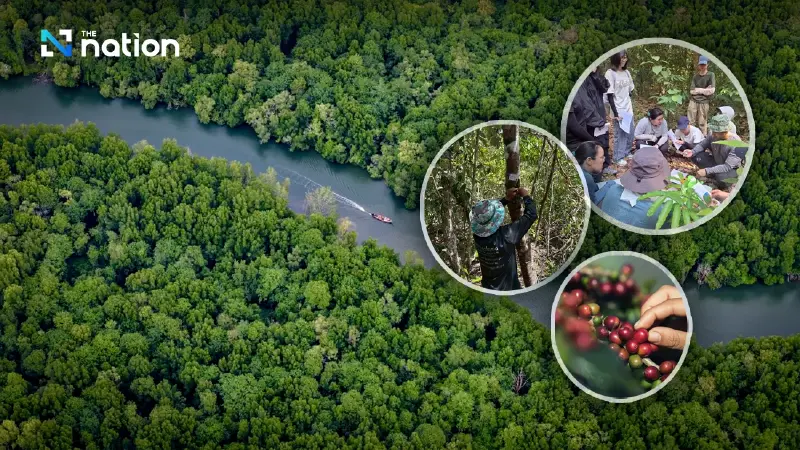


Thailand’s Doi Tung model shows how biodiversity can become economic capital, helping communities, forests and businesses grow sustainably.
When “biodiversity” is no longer just about planting forests, but also about “economic capital” and a tool for tackling the global climate crisis, a new sustainability strategy is emerging — one that turns forests into a mechanism for the bioeconomy while pushing Thai community models towards international standards such as OECMs and biodiversity credits.
Amid the environmental crisis facing the world, the terms “natural capital” and “biodiversity” have moved beyond the world of conservationists to become unavoidable priorities for the economy and business sector.
To mark the International Day for Biological Diversity on May 22, 2026, under the theme “Acting locally for global impact”, Thailand’s sustainable development model is being taken to the next level to prove that people, forests and businesses can genuinely grow and create value together.

From “cultivating people, cultivating forests” to discovering new species
Smitthi Harueanphuech, chief nature-based solutions officer at the Mae Fah Luang Foundation, said the foundation of this effort comes from more than 38 years of experience in the Doi Tung Development Project under royal initiative in Chiang Rai province.
The project covers more than 91,779 rai and has served as a large-scale natural laboratory under the concept of Nature-based Solutions (NbS) — using nature as the basis for solving problems.

The latest scientific surveys found that the forests of Doi Tung are home to:
- 1,459 plant species: Among them are 12 plant species newly discovered by science, including Nakharinthara, Thian Doi Tung and Muang Payap.
- 1,177 wildlife species: These include protected and endangered species such as the serow and the big-headed turtle.
The findings not only reflect the richness of the ecosystem, but are also being used to assess nature-related risks and plan responses to climate volatility that could affect agriculture and ecosystems in the long term.
Three global environmental mechanisms Thailand is driving
Thanit Kongkaew, director of sustainability at the Mae Fah Luang Foundation, said environmental management today is no longer limited to specific local areas.
The foundation has partnered with government agencies, including the Office of Natural Resources and Environmental Policy and Planning (ONEP), the Biodiversity-Based Economy Development Office (BEDO), and global academic institutions such as the National University of Singapore (NUS), to advance three key mechanisms that could reshape conservation in Thailand.

OECM areas under the 30x30 target
The foundation is pushing for Doi Tung and 11 community forests to be recognised as Other Effective Area-based Conservation Measures, or OECMs. These are conservation areas outside formal protected zones.
The move supports the global target of conserving at least 30% of land and sea areas by 2030, with backing from the High Ambition Coalition for Nature and People (HAC).
Biodiversity credits
In partnership with BEDO, the foundation is studying a biodiversity credit trading mechanism under the Terrasos standard from Colombia, with the aim of creating financial incentives for communities that protect forests.
CBD COP17 global platform
Thailand is preparing to present its community-science cooperation model at the 17th meeting of the Conference of the Parties to the Convention on Biological Diversity, or CBD COP17, in Yerevan, Armenia, in late 2026.

Expansion to mangrove ecosystems and business advisory services
Knowledge gained from mountain forests is now being applied to different ecosystems.
A project has been launched to create a biodiversity database and assess the economic value of mangrove forests covering more than 10,832 rai in Trang province. The project will run from 2025 to 2027 and involves cooperation between the government, academia and the private sector, including PTT and ONEP.
At the same time, businesses are under increasing pressure to adapt to tougher environmental standards.
This knowledge has therefore been developed into a Biodiversity Advisory Service, helping private companies design ecosystem restoration projects in areas where they operate.
Examples include a rewilding project in an industrial area of Chon Buri and a community water management project in Chiang Dao.
Mountains and forests are no longer merely green spaces. They are becoming a real and tangible form of capital — and a pathway for the economy of the future.
