
Trade war expected to continue, businesses adopt 'wait and see' approach
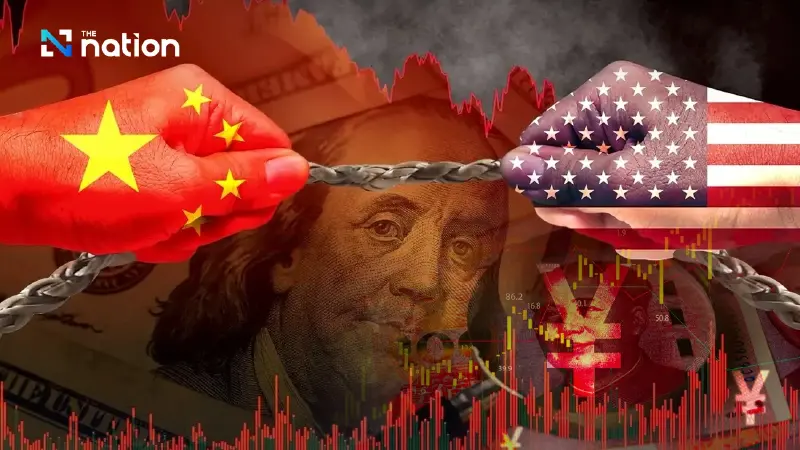


The trade war triggered by US tariff policies is expected to persist, causing businesses to adopt a “wait and see” approach, several Thai experts have said.
According to a report by NBC News, US Treasury Secretary Scott Bessent indicated on Wednesday that the Trump administration is open to extending President Donald Trump’s current 90-day tariff pause beyond July 9 for the US's key trading partners, provided they engage in “good faith” negotiations.
Bessent, speaking before the House Ways and Means Committee in Washington, stated that the US has 18 “important trading partners” and the administration is “working toward deals” with these nations.
“It is highly likely,” Bessent said, that for countries and trading blocs, such as the European Union, “who are negotiating in good faith,” the United States would “extend the deadline to continue these negotiations.”
“If someone is not negotiating, then we will not,” he added.
So far, Trump administration officials have not suggested they would extend the 90-day tariff pause without at least having “terms of an agreement” in place before the deadline.
Bessent’s remarks imply that the Trump administration could be more willing to shift the self-imposed deadline as it draws nearer.
President Donald Trump’s 90-day pause on reciprocal tariffs, which was announced on April 9, is set to expire in less than a month. While Trump officials have consistently stated they are close to finalising trade deals with several countries, the White House has so far only announced a formal trade agreement with the United Kingdom and a framework agreement with China.
The US-China deal, which was announced earlier on Wednesday, but the full details of the agreement were unclear.
Uncertain situation
Kriengkrai Thiennukul, president of the Federation of Thai Industries (FTI), noted that while US and Chinese representatives have negotiated a reduction in tariffs—down from 145% imposed by the US on China to 55%, and from 125% by China on the US to 10%—there are still important details that remain unclear.
He explained that the US president spoke first to highlight the success of the negotiations. However, both sides still have unresolved issues, such as China limiting the export of seven types of minerals, while the US will relax restrictions on certain types of chips and larger models heavily used by China.
Kriengkrai pointed out that for the deal to be finalised, both parties must present the agreement to their respective national leaders for approval. “At least, we can see that the negotiations are progressing. It’s not a deadlock; things are gradually easing,” he said.
He emphasised that the next key point to watch is how the US will continue negotiations with other countries, including Thailand, with just over 20 days remaining.
He mentioned that Thailand has been signalled for talks, but it is uncertain whether negotiations will be completed within the extended 90-day period.
“The concern right now is that the longer the negotiations take without a clear resolution, the more likely investors will pause their activities, or adopt a ‘wait and see’ approach. This could have negative consequences,” he said.
Concerns over difficult trade conditions
Wisit Limluecha, vice chairman of the Thai Chamber of Commerce (TCC), stated that the trade negotiations between China and the US are still uncertain.
He noted that while progress has been made, it is unclear whether a final deal will be reached, as Trump mentioned that the final step depends on both himself and the Chinese president, suggesting an ongoing uncertainty.
Nevertheless, Wisit acknowledged that it is a positive sign that the world’s major economic powers can engage in negotiations. However, he pointed out that the tax rates, particularly on rare earth minerals, are still unclear—China currently imposes a 55% tax on US goods, while the US imposes a 10% tax on Chinese products.
He explained that the significant difference in these figures, especially regarding the rare earth minerals used in chip production, raises concerns about whether China will agree to such terms.
“If the trade deal between China and the US proceeds as Trump posted, it would signal a positive shift for the global market, bringing more clarity to the uncertainty that currently makes trade difficult,” Wisit said. “The biggest concern is the uncertainty that makes trade progression challenging.”
Wisit further emphasised that forecasting sales for three, six, or twelve months ahead is almost impossible under these conditions, and closing deals with other countries has become increasingly difficult due to universal concerns.
He noted that with just 29 days remaining until the US reciprocal tariffs come into effect, countries must negotiate their tariffs with the US. However, no country has concluded such negotiations yet.
In these 29 days, it remains uncertain whether deals can be struck, and if not, what the next steps will be, he said.
He also questioned whether the US would continue with its current tariff approach, possibly dividing the tariffs into groups or extending the deadline by another 90 days. This situation has made forward sales and investments sluggish, as businesses remain cautious.
