
World Bank Chief Calls for $2 Billion Green Infrastructure Investment to Transform Thai Cities
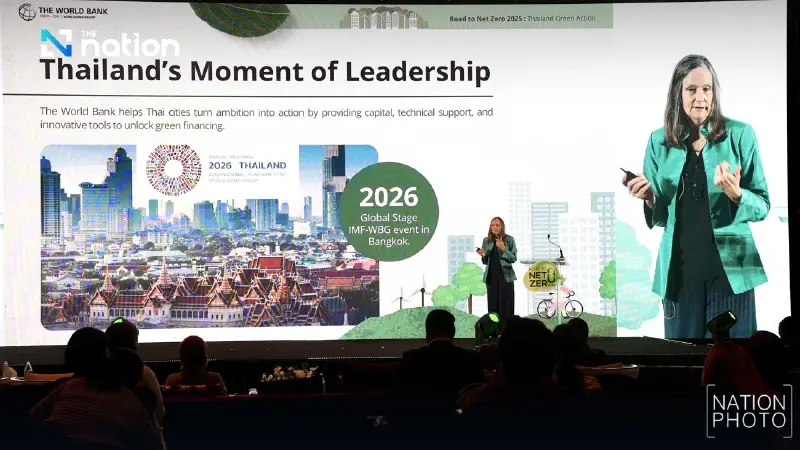


Melinda Good outlines ambitious urban sustainability roadmap at Bangkok climate forum, highlighting Thailand's potential to lead regional net-zero transition
Thailand has the potential to attract up to $2 billion annually in private green infrastructure investment through strategic urban planning reforms, the World Bank's senior official for the region told a major climate conference in Bangkok on Wednesday.
Melinda Good, Division Director for Thailand and Myanmar at the World Bank, outlined an ambitious vision for transforming Thai cities into sustainable urban centres during her keynote address at the "Road to Net Zero 2025: Thailand Green Action" forum hosted by Thansettakij.
Speaking to delegates at the event, Good championed the "SymbioCity" concept—a Scandinavian-inspired integrated approach to urban development that treats cities as living ecosystems rather than isolated infrastructure projects.
"Cities are where we have to act on climate change," Good emphasised. "If we get it right in cities, we're going to get it right for the environment, for the economy, and for the future."
Transit-Oriented Development Key to Urban Transformation
Good highlighted transit-oriented development (TOD) as a cornerstone of sustainable urban planning, noting that cities like Pattaya, Khon Kaen, and Bangkok's outer districts are beginning to implement TOD strategies from the early stages of infrastructure development.
The approach addresses a critical challenge facing Thai workers, many of whom endure two-hour commutes whilst housing developments sprawl ever further from employment centres.
TOD aims to create vibrant, walkable communities that reduce car dependency and transport emissions.
"We estimate that transit-oriented development could attract up to $2 billion a year in private investment for green infrastructure," Good said, contingent on adjustments to land regulation and value capture mechanisms.

Water Crisis Demands Urgent Action
The World Bank official highlighted Thailand's pressing water management challenges, revealing that municipalities across the country lose up to 40% of their water supply through aging infrastructure and leaks.
Good pointed to successful examples, including Nakhon Si Thammarat's integration of affordable piped water with wastewater treatment, which helped rehabilitate the city's urban centre.
In the Eastern Economic Corridor (EEC), annual economic losses from water scarcity reach approximately $170 million.
Artificial intelligence presents promising solutions, with Good citing examples from São Paulo, where AI-driven predictive leak detection reduced water losses by 40%, and Istanbul's digital twin city technology for optimising water and energy usage.
Flood Management and the $12.3 Billion Investment Plan
Addressing Thailand's flood vulnerability, Good referenced the comprehensive master plan developed following the devastating 2011 floods.
The Chao Phraya River Basin, home to 40% of Thailand's population and generating two-thirds of the country's GDP, faces annual flooding challenges.
The nine-phase flood mitigation plan, estimated at $12.3 billion, includes water retention systems, bypass canals, embankment enhancements, and river restoration.
The World Bank is collaborating with Thailand alongside other development partners including the Asian Development Bank and Agence Française de Développement.

Nature-Based Solutions and Blue Finance
Good advocated for nature-based solutions as cost-effective alternatives to traditional infrastructure, highlighting three key opportunities for Thailand: mangrove restoration in coastal urban areas, bio-swales and rain gardens for stormwater management, and green roofs with vertical gardens.
Thailand's coastal economy, contributing 20% of GDP through tourism and generating $6 billion annually in fisheries exports, faces increasing threats from rapid coastal erosion.
The World Bank has provided $1 million in technical assistance to develop blue financing systems and marine spatial planning packages.
Carbon Finance Revolution
Perhaps most significantly, Good outlined Thailand's potential to generate up to $1 billion through urban carbon credit aggregation.
The World Bank is partnering with Thailand's Department of Climate Change and Environment and Ministry of Finance on a low-carbon cities and carbon market development project.
"Thailand has already shown what's possible," Good noted, referencing Bangkok's pioneering electric bus transaction with Switzerland—one of the first under Article 6.2 of the Paris Agreement to successfully monetise emission reductions.
The aggregated approach would bundle emission reductions from multiple urban sources, creating scalable revenue streams to finance the transition from diesel to electric vehicles and from traditional to green infrastructure.
2026 World Bank Meetings Spotlight
Good revealed that Thailand will host the World Bank-IMF Annual Meetings in 2026, presenting an opportunity to showcase the country's climate initiatives to global finance ministers, central bank governors, and technology leaders.
"This is really a chance when the whole world will come to Bangkok, one of the greatest cities in the world, to showcase some of these transformations that are taking place on the ground," she said.
The World Bank official emphasised that the required investments represent core urban infrastructure needs rather than additional climate expenditure, requiring innovative public-private partnerships to achieve Thailand's net-zero ambitions.
"No country's budget can finance everything that needs to happen to bring us to net zero," Good concluded. "We have to come to a partnership with the private sector."
