
OTP targets 2026 for bidding on 997.68 billion baht land bridge linking two ports
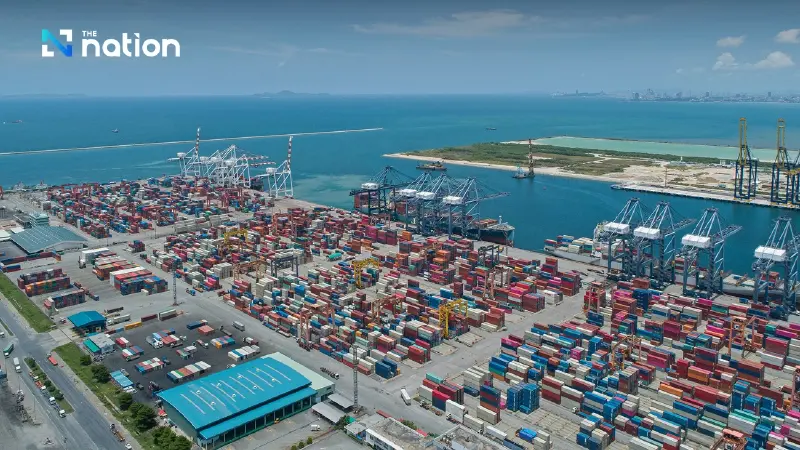


The Office of Transport and Traffic Policy and Planning (OTP) aims to open bidding for private-sector participation in the land bridge project by 2026, with the first phase scheduled to be operational by 2030.
The project, with an estimated investment value of 997.68 billion baht, is designed to link two ports in Chumphon and Ranong provinces.
Deputy Transport Minister Manaporn Charoensri, speaking after presiding over a seminar on the project’s feasibility study, preliminary design, environmental impact assessment and business development model, said the Ministry of Transport had been pushing infrastructure development to enhance the country’s competitiveness and strengthen its trade potential in line with government policy.
She added that the project is part of efforts to transform Thailand from a middle-income country to a high-income nation, while positioning it as a regional transport hub. The land bridge is expected to capitalise on Thailand’s strategic location, offering an alternative sea transport route that will boost trade and competitiveness.

Manaporn also addressed progress on the draft Southern Economic Corridor (SEC) Bill, which is a prerequisite for the Chumphon–Ranong land bridge.
The Comptroller General’s Department and the Finance Ministry had asked for revisions to provisions on establishing a compensation fund for land ownership rights, as private bidders would need to contribute to the fund via the e-bidding process.
Under the proposal, winning bidders would be required to pay into the fund, which would be used to compensate affected residents and improve community living standards before construction begins.
Discussions with the Finance Ministry have now been concluded, and the bill will be submitted to the Transport Ministry before being forwarded to the Cabinet for approval in October, and then to Parliament for deliberation.

Three rounds of study seminars
OTP Director Punya Chupanit said three public seminars had been held to present study results for the land bridge project—two already completed in Ranong (August 21) and Chumphon (August 22).
He said the final seminar would be wrapped up within this year, in parallel with the SEC Bill’s passage through Parliament. At the same time, OTP is preparing terms of reference (TOR) for the bidding process, expected to take 5–6 months. Bidding and construction are targeted to begin in 2026, with phase one operations starting in 2030.
“The investment cost has been revised down from one trillion baht to reflect the current economic situation. Consultants have also reduced the construction timeframe to three phases,” Punya noted, adding that the findings align with those of leading international consultancy firms.
The public-private partnership (PPP) will be structured as a 50-year concession under a PPP net cost model, with a single private operator responsible for both construction and management of the project.
Bidders must have proven experience in port and shipping operations, as well as sufficient financial capacity.
Interest from Thai and foreign investors
Punya said several Thai and foreign investors had expressed interest, including China Harbour Engineering, Gulf Development, DP World Logistics (Thailand), Transworld GLS (Thailand), Mitsui & Co (Thailand), Sahathai Terminal, and the European Association for Business and Commerce.
Shipping companies such as Mediterranean Shipping (Thailand), HMM (Thailand), Evergreen Shipping Agency (Thailand), Eastern Sea Laem Chabang Terminal, and the Bangkok Shipowners and Agents Association have also shown strong interest.
According to the feasibility study, the land bridge project is projected to generate an economic internal rate of return (EIRR) of 14.77% and a financial internal rate of return (FIRR) of 4.57%, with a net present value (NPV) of 307.56 billion baht and a benefit-cost ratio (B/C) of 1.18.

Project outlook
The total estimated investment of 997.68 billion baht is divided into seven key components:
- Construction of Chumphon Port – 217.75 billion baht
- Construction of Ranong Port – 216.79 billion baht
- Chumphon-side Single Rail Transfer Operator (SRTO) – 42.75 billion baht
- Ranong-side SRTO – 40.02 billion baht
- Railway (1.435 metres) – 109.28 billion baht
- Intercity motorway – 162.19 billion baht
- Commercial and multi-purpose developments on both sides of the ports – 208.88 billion baht
