
Cambodia’s economic highs and lows seen through Chinese solar panel industry
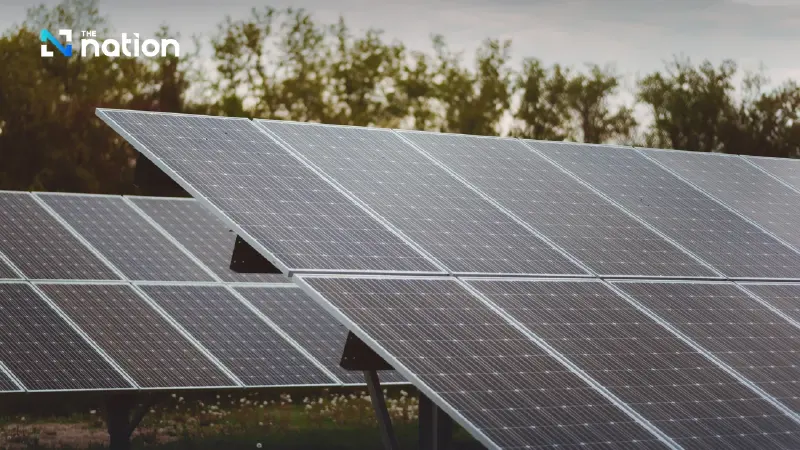


At its peak in 2023, Cambodia exported solar panels worth as much as US$2.4 billion, making them the country’s most significant non-textile manufacturing export.
- Fueled by Chinese investment to circumvent the US-China trade war, Cambodia's solar panel industry boomed to become its largest non-textile export, valued at US$2.4 billion in 2023.
- The industry has since collapsed, with exports plummeting to only US$4.4 million in the first half of this year.
- This dramatic decline was caused by the imposition of severe US tariffs, ranging up to 3,403%, which targeted Chinese-backed production in Cambodia.
- In response, many factories have shut down, while some are attempting to adapt by shifting production to different types of solar panels that face lower tariffs.
At its peak in 2023, Cambodia exported solar panels worth as much as US$2.4 billion, making them the country’s most significant non-textile manufacturing export.
Yet in just two years, that boom has collapsed, with exports plummeting to only US$4.4 million in the first half of this year.
According to Nikkei Asia, the sector’s spectacular rise and dramatic decline have been driven by the fallout of the US–China trade war.
Cambodian entrepreneur Thang Menghout, who also serves as a human resources director, is one of those still fighting to adapt.
Faced with a stark choice between crippling tariffs of 3,403% or shutting down altogether, his factory — backed by Chinese investors Venus Energy and VCOM Power System — halted production of solar modules hit by punitive US tariffs.
Instead, the plant shifted to producing thin-film solar panels, which face an import duty of just 19%. These portable “special” panels, as they are known locally, are pricier but easier to carry, and now sit alongside clothing, footwear and luggage as Cambodia’s top export products.
“Before, we had five companies. Now we only have two left,” Menghout told Nikkei Asia. “But if tariffs rise further, we won’t be able to survive.”
Cambodia’s fledgling solar panel industry, initially buoyed by Chinese investment, is now under severe strain as the United States continues to target Chinese-backed production in third countries.
This sustained pressure has forced many manufacturers to either shift strategy or shut down entirely.
At its peak in 2023, Cambodia exported solar products worth US$2.4 billion (77.3 billion baht), making them the country’s largest non-textile manufacturing export — surpassing tyres and bicycles. Exports to the United States alone were valued at over US$9 billion.
Between 2018 and 2022, as many as 12 solar panel factories opened in Cambodia, employing thousands of workers. However, the latest figures from Cambodia’s Customs and Excise Department show a steep decline, with exports plunging to just US$4.4 million (141 million baht) in the first half of this year.
Most manufacturers had entered Cambodia precisely as the US began investigating Chinese-made solar products following complaints from American producers.
In 2018, the US Commerce Department extended its probe to cover panels from Cambodia, Malaysia, Thailand and Vietnam, alleging that these countries were being used as trans-shipment points.
Just last week, the US International Trade Commission further expanded the inquiry to include Indonesia, Laos and India.
Cambodian plants had a brief reprieve when former US president Joe Biden delayed the imposition of punitive tariffs until mid-2024. Yet once these duties came into effect, the industry began to falter.
His successor, Donald Trump, has since unsettled the market further by imposing tariffs, ranging from 534% to 3,403%.
Import duties on Cambodian solar panels now exceed those imposed on other Southeast Asian exporters. By comparison, tariffs on Malaysia range between 14.64% and 168.8%, on Thailand between 263.74% and 799.55%, and on Vietnam between 68.15% and 542.64%.
According to Nikkei Asia, several Cambodian factories have already shut down as a result.

Solar Long PV Tech, a company based in Sihanoukville that had only just fulfilled an order for BYD America in December, has since shut down, according to a former employee. The same source said his Chinese employer had already left the country.
Matthew Nicely, a partner at the US law and lobbying firm Akin Gump, noted that the scope of American tariffs has widened beyond solar panels to cover components and wafers as well.
His firm is currently negotiating tariff issues for Laos and also lobbying on behalf of the Cambodian government. But he warned that Donald Trump’s approach marks a reversal of decades of US economic policy.
“The Trump administration is a prime case study in trying to overturn Ricardian economics [developed by David Ricardo and centred on the theory of comparative advantage], because we cannot produce everything domestically and must rely on imports,” Nicely said.
He argued that such attempts are doomed to fail, recalling that “the last time we tried something like this was in the 1930s with the Smoot-Hawley Tariff, which worsened the Great Depression.”
Cambodia, as one of the world’s least developed countries, had long benefitted from US Generalized System of Preferences (GSP) trade privileges, which exempted or reduced tariffs on imports for three decades.
However, the US Congress allowed the scheme to expire in late 2020, leaving tariff negotiations as a new challenge for Cambodia — unlike regional manufacturing hubs such as Malaysia, Thailand and Vietnam.
“In the past, this issue didn’t matter much, because we had the GSP and Cambodia’s export volumes were small. But once Chinese producers rerouted production here, we were lumped in with China,” said Edwin Vanderbruggen, Senior Partner at Andersen in Cambodia. “We are collateral victims of the US–China trade war.”
