
FTI Urges New Government to Tackle Trade War and Economic Pressures
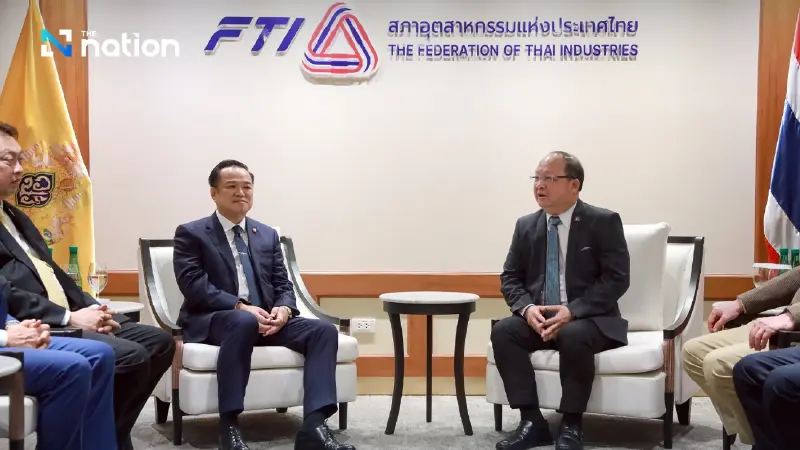


Industry federation presents five-point emergency plan as Thailand faces US tariffs and regional competition challenges
- The Federation of Thai Industries (FTI) has urged the government to address the threat of escalating US import tariffs, which could reach 40%, and to provide clear guidance on trade compliance for exporters.
- The FTI highlighted a severe financial crisis among small and medium enterprises (SMEs), proposing an emergency plan with fast-tracked credit guarantees and special loans to tackle rising debt.
- Concerns were raised over the unusually strong Thai baht hurting export competitiveness and high energy costs, prompting calls for currency investigation and electricity tariff restructuring.
- The federation also requested government action on border trade disruptions with Cambodia and proposed expanding the "Made in Thailand" procurement program to boost domestic industry.
The Federation of Thai Industries (FTI) has presented a comprehensive emergency economic plan to Prime Minister Anutin Charnvirakul, warning of mounting pressures from US trade measures, regional competition, and domestic financial challenges that threaten Thailand's industrial competitiveness.
The five-point proposal, delivered during high-level discussions at FTI headquarters in Bangkok on Monday, addresses immediate concerns over US import tariffs that have reached 19% since 7 August and could escalate to 40% for goods involving third-country violations.

Tariff Threats and Trade Compliance
FTI chairman Kriengkrai Thiennukul warned that Thai exporters face potential tariff increases to 40% for goods deemed to involve circumvention or transshipment violations.
The industry body has called for clear government guidance on Regional Value Content calculations and the establishment of advisory units to help businesses comply with international trade rules.
"We are working with the Ministry of Commerce to clarify the details of local content requirements and determine which industries can meet the standards," Kriengkrai said.

SME Crisis Deepens
With non-performing loans among small and medium enterprises reaching 243 billion baht against total outstanding credit of 3.1 trillion baht as of June 2025, the FTI has proposed a "Fast Track for SME" initiative featuring emergency credit guarantees approved within three to seven days.
The proposal includes government subsidies for initial fees, guarantee ratios of 80-100%, and special 1% liquidity enhancement loans.
Express credit facilities worth 5-10 million baht would be available without collateral requirements for tax-compliant SMEs.

Kriengkrai highlighted Thailand's household debt crisis, which stands at 90% of GDP officially but reaches 104% when unofficial debt is included.
"SMEs are the most vulnerable, especially with such high household debt levels," he said.
Energy and Border Challenges
The federation has called for electricity tariff restructuring to reduce business costs, including acceleration of the new Power Development Plan by 2025 and promotion of renewable energy.
However, Kriengkrai opposed separating gas supply for businesses, arguing that forcing manufacturers to use expensive imported LPG would increase costs by 58%.
Ongoing Thailand-Cambodia border trade disruptions have prompted calls for immediate relief measures, including alternative shipping channels through Chanthaburi and Trat provinces and compensation for additional transport costs during the conflict period.

Currency Concerns
The baht's unusual strength compared to regional competitors has emerged as a significant concern.
Whilst Vietnam's currency has weakened by 3% since the beginning of the year, the Thai baht has strengthened by nearly 8%, making Thai goods more expensive for international buyers.
The FTI has raised concerns about a massive increase in gold exports to Cambodia, which imported almost 10 times more gold from Thailand in 2024 compared to the previous year, valued at over 150 billion baht.
The federation is urging the Bank of Thailand to investigate whether these transactions are contributing to the baht's abnormal strength.

Government Response
Prime Minister Anutin outlined his administration's four-month priority framework, focusing on reducing living costs, resolving Thai-Cambodia disputes peacefully, improving natural disaster preparedness, and tackling social threats including drug trafficking and online gambling.
"We must prioritise immediate problems, whether business issues or Thailand-Cambodia border trade difficulties," the Prime Minister stated. "It's time for Thailand to wake up for the country's survival."

'Made in Thailand' Push
The FTI has proposed expanding the "Made in Thailand" procurement programme, potentially increasing the price advantage for local goods from 5% to 10-20% in government purchases.
A second phase would offer private companies tax deductions of up to twice their spending on Thai products, whilst a third phase would provide export incentives.
The meeting established a framework for ongoing cooperation through the Joint Government-Private Committee for Economic Problem Resolution, with regular forums planned to address critical issues.
"This meeting marks an important beginning for proactive cooperation between government and private sectors," FTI chairman Kriengkrai concluded. "The FTI is ready to support and work closely alongside the government to lead Thailand's economy towards strength, stability, and sustainability."
