
Thailand’s Development ‘Stalled’ Despite 3.37 Trillion Baht Spending, NESDC Warns
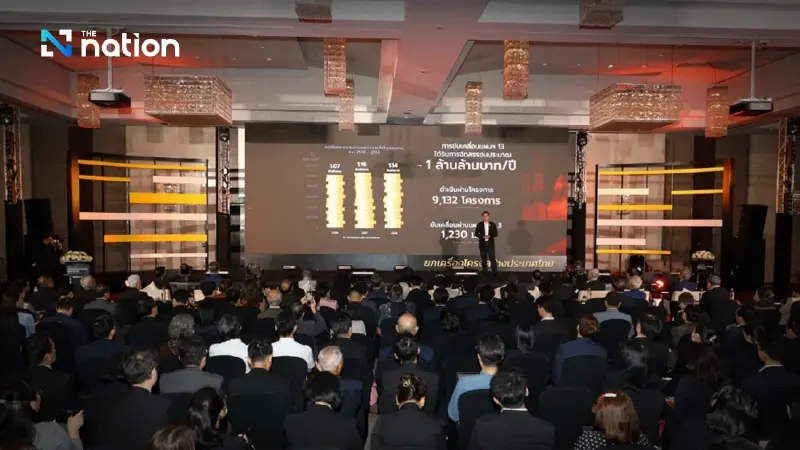


Official body states over 3.37 trillion baht has been consumed by welfare and routine costs, severely jeopardising key national targets
- Thailand's national development has stalled despite over 3.37 trillion baht being spent on the 13th National Development Plan over the last three years.
- The NESDC attributes the failure to a misalignment in spending, with over 50% of the budget going to social welfare and routine costs instead of proactive, long-term investments.
- As a result, key 2027 national targets for GDP per capita, human achievement, inequality reduction, and emissions are now at severe risk of being missed.
- The council links the stalled progress to declining national competitiveness and calls for a major structural overhaul of laws, regulations, and public sector management to escape the middle-income trap.
The National Economic and Social Development Council (NESDC) has issued a stern warning that Thailand’s national development has stalled, with key targets now at severe risk of failure, despite the government allocating over 3.37 trillion baht to drive the 13th National Development Plan over the past three years.
Speaking at the NESDC’s annual conference on Friday, Secretary-General Danucha Pichayanan conceded that while continuous efforts had been made to implement the plan, concrete progress was lacking.
The total spending on 9,132 projects under the 13th Plan averaged over 1 trillion baht annually.

Danucha highlighted a critical misalignment in budgetary spending. Of the average 1 trillion baht allocated per year, over 50 per cent is consumed by social welfare and routine expenditure, including universal health coverage, medical care and education.
A further 18 per cent is allocated to standard infrastructure maintenance, such as roads, while the crucial agricultural sector receives only around 10 per cent (hundreds of billions of baht per year).
The Secretary-General stated that this allocation reflects a focus on supply-side activities (such as dredging and seed distribution) and a severe lack of proactive investment necessary for long-term growth—specifically citing the need to increase agricultural productivity, adopt technology for higher value-added goods, and support priority industries like healthcare.

Danucha detailed several national indicators that are unlikely to meet the 2027 targets:
GDP Per Capita: The goal of 300,000 baht per person per year by 2027 is severely challenged, with the latest projection standing at just 267,661 baht.
Human Achievement Index (HAI): The index has dropped from a high level to a "medium level" of 0.6354, making the human development target highly challenging.
Inequality: The expenditure gap between the richest and poorest groups currently stands at 5.22 times, missing the target of under five times.
Emissions: Greenhouse gas emissions have increased by 1 per cent year-on-year, moving away from the planned reduction target.
The NESDC observed that Thailand’s economic growth has consistently remained below 5 per cent since the 10th Development Plan in 2007, insufficient to propel the nation out of the middle-income trap.
This failure is linked to declining competitiveness across the board, particularly in public sector efficiency, regulatory burden, and core infrastructure.

Danucha concluded that the country must undertake a major structural overhaul with urgent focus on five key areas:
Laws and Regulations: Removing hurdles to fair competition and business creation.
Corruption: Addressing deep-rooted corruption which raises costs for businesses.
Rule of Law: Speeding up the judicial process to restore investor confidence.
Democracy: Leveraging increased political participation to build external confidence.
Public Sector Management: Reducing the size of the state and shifting focus from control to facilitation to spur innovation.
The Secretary-General stressed that Thailand must now apply a D-A-R-E to Reform mindset, calling for determination, collective action, institutional redesign, and an Emergency Mindset to act immediately.
