
Thailand Faces 14% GDP Loss by 2050 Without Climate Action, World Bank Warns


New report reveals investments in flood protection and green transition could boost economy by up to 5% whilst averting catastrophic losses
- A World Bank report warns that Thailand could lose between 7% and 14% of its GDP by 2050 if it fails to implement climate adaptation measures.
- The primary economic threats stem from heat-related labor productivity losses, increased flooding in economically vital areas, water scarcity, and coastal erosion impacting tourism.
- Conversely, strategic investments in climate resilience and green technology could boost Thailand's GDP by 4-5% by 2050, helping it achieve its high-income country goals.
- Failure to decarbonize also poses a "transition risk" to the economy, as major trading partners and multinational corporations are increasingly excluding high-carbon suppliers.
Thailand risks losing between 7% and 14% of its GDP by 2050 if it fails to adapt to climate change, according to a comprehensive World Bank report released on Friday.
However, strategic investments in climate resilience and green technology could instead boost the economy by 4-5% whilst positioning the country to achieve its high-income aspirations.
The Thailand Country Climate and Development Report (CCDR) warns that the costs of inaction far outweigh investment needs, with heat-related productivity losses, flooding, and water scarcity threatening the nation's economic competitiveness and its goal of becoming a high-income country by 2037.
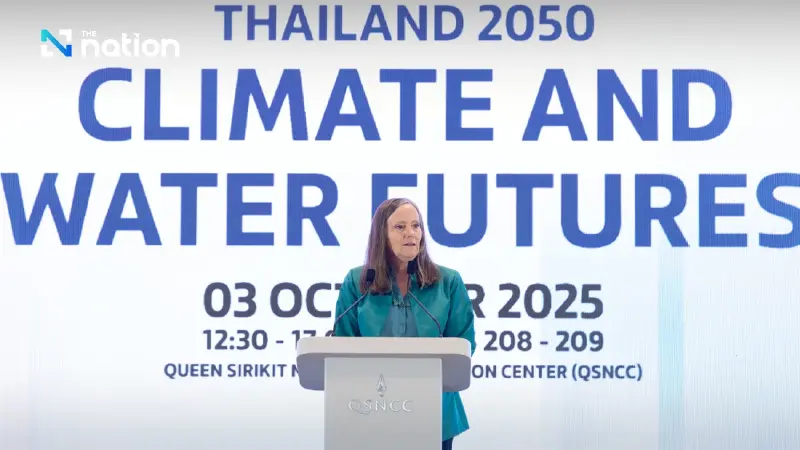
"Thailand's future competitiveness will hinge on reducing the emission intensity of its economy and shifting production towards greener goods and services—steps that can create new industries, generate high-quality jobs, and keep Thailand attractive to investors in a low-carbon world," said Melinda Good, World Bank Division Director for Thailand and Myanmar.

Mounting Physical Risks
Thailand ranks amongst the ten most flood-prone countries globally, with the Chao Phraya river basin—home to 40% of the population and generating 66% of GDP—particularly vulnerable.
The devastating 2011 floods, which caused damages equivalent to 12.6% of GDP, could be repeated with increasing frequency under climate change scenarios.
The report projects that by 2050, heat-related labour productivity losses will emerge as the most significant economic threat, affecting workers across all sectors nationwide.
In Bangkok, each 1°C temperature rise could generate costs of 85-123 billion baht related to heat deaths, productivity losses, and increased energy consumption—equivalent to 1.6-2% of the capital's GDP.
Coastal erosion already affects 30% of Thailand's coastline and could cost the tourism sector US$1 billion annually by the mid-2040s without intervention.
Meanwhile, water scarcity in key agricultural regions and industrial zones, including the Eastern Economic Corridor, will worsen significantly.

Substantial Returns on Climate Investment
Whilst the challenges are severe, the World Bank identifies considerable economic opportunities.
The report estimates that US$219 billion in climate-related investments will be needed over the next 25 years—equivalent to 2.4% of cumulative GDP—but the returns substantially exceed the costs.
Investments in flood mitigation, water security, coastal protection, and cooling infrastructure could raise annual GDP by 2-3% by 2040 and 4-5% by 2050 compared with business-as-usual scenarios.
The government's "Nine Plans" for Chao Phraya basin flood management, combined with nature-based coastal solutions and water infrastructure improvements, form the cornerstone of this adaptive strategy.

Green Transition Presents Economic Opportunity
Thailand also faces transition risks if it fails to match the decarbonisation efforts of trading partners.
The report notes that 78% of multinational corporations plan to exclude high-carbon suppliers from their supply chains from 2025 onwards, whilst initiatives such as the EU's Carbon Border Adjustment Mechanism could increasingly affect Thai exports.
However, accelerated decarbonisation could raise Thailand's GDP by 2.5% by 2050 compared with baseline projections.
The country already leads in eco-friendly air conditioner exports, supplies 4% of global solar photovoltaic exports, and is emerging as an electric vehicle production hub. With appropriate policy support, green exports could increase by 2-3% of GDP by 2030.
"Investments in flood mitigation, water security, coastal protection, climate-smart agriculture, and cooling could raise annual GDP by 2-3% by 2040 and by 4-5% by 2050 compared with a business-as-usual scenario, whilst protecting people and reducing the risks of extreme events," said Kim Alan Edwards, World Bank Senior Economist and lead author of the report.

Financing and Policy Reform
The report emphasises that carbon pricing will be crucial for mobilising resources. A carbon price starting at US$25 per tonne of CO2 equivalent in 2030 could generate revenues approaching 1% of GDP, helping to offset adaptation costs and fund social protection measures.
Public sector adaptation spending will need to average around 1% of GDP annually over the next 25 years—approximately US$7.5 billion per year—representing a substantial increase from current climate-related expenditure of 117-137 billion baht annually.
Power sector reform to promote renewable energy competition, grid modernisation, and regional integration are identified as critical priorities.
The transition to renewable energy could ultimately reduce electricity costs from 7 cents to 5.6 cents per kilowatt-hour whilst avoiding over 15,000 premature deaths annually by 2050 through improved air quality.

Social Protection Critical
The report stresses that Thailand's poorest and most vulnerable populations face the greatest climate risks. Water-scarce and flood-prone areas in the north and northeast are amongst the country's poorest regions, with high dependence on climate-sensitive rice agriculture and fisheries.
Following the 2023 floods, government assistance covered only approximately 20% of estimated income losses. The report recommends increasing regular and post-disaster benefits for State Welfare Card holders, requiring additional annual spending of around 0.6% of GDP to build resilience to climate shocks.
The report's release comes one year before Thailand hosts the IMF-World Bank Group Annual Meetings in October 2026, where "Building Thailand's Future Today" will be a central theme.
The World Bank is supporting several major infrastructure projects, including a US$346 million programme to upgrade flood management infrastructure in the Chao Phraya basin and a US$350 million water security project in the Eastern Economic Corridor.
