
JSCCIB urges PM to visit China to attract tourists and tackle corruption for investment boost
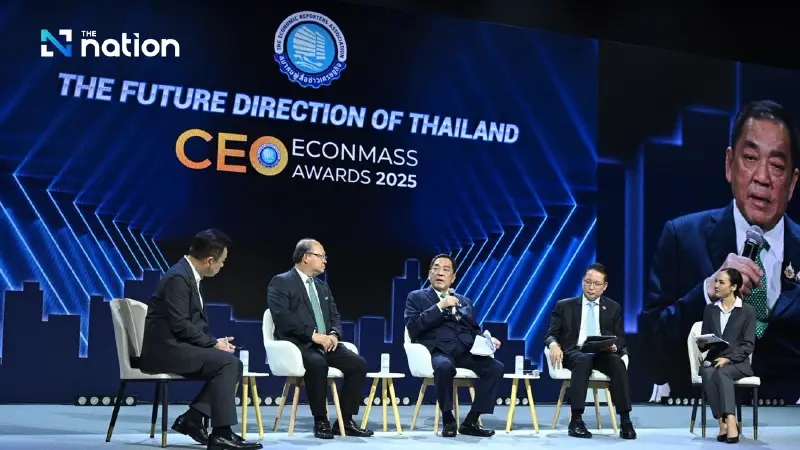


JSCCIB urges Thailand’s Prime Minister to visit China to boost tourism and tackle corruption to attract investment and stimulate the economy.
Poj Aramwattananont, Chairman of the Thai Chamber of Commerce, stated at the “Future Direction of Thailand” seminar that the government must act swiftly to unlock and transform the nation’s potential, especially by embracing artificial intelligence (AI), trade, and energy strategies to stay competitive globally. He highlighted that Thailand has not adapted sufficiently to the new world and is held back by outdated laws.
He emphasised that Prime Minister Anutin Charnvirakul is already aware of these issues, and the government must unlock the purchasing power of citizens, stimulate the grassroots economy, offer low-interest loans, and provide liquidity for SMEs to stay competitive in agriculture and trade.
In addition, the government should focus on unlocking free trade agreements (FTAs) with Europe, ASEAN, Canada, and others. A key area that needs unlocking is transparency in fighting corruption, which has been a major hindrance to the country's development. Poj expressed the private sector’s commitment to collaborating with key anti-corruption agencies, including the Anti-Corruption Organization of Thailand and the Office of the National Anti-Corruption Commission (NACC). He proposed that the government should declare a Zero Corruption policy, believing it would earn significant public support.

The Joint Standing Committee on Commerce, Industry, and Banking (JSCCIB) projects Thailand’s economy to grow between 1.8% and 2.2% this year, with exports expected to rise by 2-2.5% and inflation to stay low at 0-0.5%. The committee plans to revise these projections in November. Looking ahead to 2026, Poj sees hope from the new government, which includes a team of economic ministers from outside politics, offering a more dynamic approach than a caretaker government. Despite a short four-month tenure, the Prime Minister is actively listening to the private sector’s input and translating it into short-term policies.
The committee also stressed the importance of monitoring the progress of FTAs with the EU and trade negotiations with the US, particularly regarding Local Content rules, as these will impact exports and the economy in 2026. The tourism sector, which has underperformed this year, also needs urgent attention. Poj recommended that the Prime Minister urgently visit China or implement measures to attract Chinese tourists, thereby stimulating spending and supporting the economy.
Kriangkrai Thianukul, President of the Federation of Thai Industries (FTI), stated that the restructuring of Thailand’s economy and country should be driven by four key strategies: GO Digital and AI, which requires a focus on reskilling and upskilling over the next four months; GO Innovation, as Thailand is still trapped in the middle-income country trap, with an income of $7,500 per capita per year, still halfway to the goal of $13,000 per capita per year, meaning business models need to be adjusted; GO Global, seeking new markets; and GO Green, which focuses on the new global rules for the environment and reducing carbon emissions, with Thailand aiming to achieve Net Zero by 2050, ahead of the previous target of 2065.
However, Thailand has historically relied on exports (60%) and tourism (10%) as its main economic engines. Yet, these have been impacted by the trade war and currency fluctuations. The Thai baht, which was previously stronger, has now appreciated by 5% compared to the earlier 7%. The FTI has announced a shift towards future industries, with trends focusing on new products. The relocation of manufacturing from China to this region is seen as a new industry aimed at restructuring the traditional model to create higher value, along with upgrading the skills of the workforce and shifting from OEM production to ODM with its own branding, thus changing the way of thinking.
Regarding Thailand’s economic outlook, after expanding by 3% in the first half of the year (with Q1 at 3.2% and Q2 at 2.8%), growth slowed to 1.7% in Q3, and it is expected to be only 0.3% in Q4. The JSCCIB has forecast Thai GDP growth for the year at 1.8-2.2%, but in 2026, they believe growth will improve. This is in line with projections from the World Bank and the IMF, which expect Thailand’s GDP in 2026 to be around 2%, as it is anticipated that the trade war with the US may come to a resolution.
"What Thailand must be cautious of is the issue of income. Thailand depends on exports for 60% and tourism for 10%. When the baht strengthens, it negatively affects tourism. The Tourism Authority of Thailand (TAT) had set a target of 40 million visitors, the same as pre-COVID, with a revenue of 2 trillion baht. However, with only three months left, the JSCCIB is raising concerns about this. If the currency strengthens, products become more expensive, just as with tourism. For example, Japan’s weaker yen has supported tourism,” said Kriangkrai.

Payong Srivanich, President of the Thai Bankers' Association, stated that looking five years ahead, data from international organisations, such as the International Monetary Fund (IMF), forecast Thailand's economy to grow by 2.7%. However, the average growth in ASEAN is 4.5%, making Thailand’s growth rate lower than other countries due to three main issues: 1) structural problems, 2) productivity, and 3) government efficiency. No one wants to invest in the country, while many are keen on stimulating the economy through spending without considering long-term sustainability. This reflects a structure where investors are not interested in Thailand.
He referred to data from the Stock Exchange of Thailand (SET), where 65% of listed companies have a low Price to Book (P/B) ratio, which discourages investment. The liquidity in Thailand is flowing out into foreign markets through FIF Funds (Foreign Investment Funds), with billions of baht invested abroad, raising the question: why is there no investment in Thailand?
Currently, the commercial banking system has liquidity, with loans being extended through the Repo market with the Bank of Thailand (BOT), and short-term government bonds being bought, averaging 5 trillion baht. However, liquidity is not reaching the system, particularly affecting SMEs and smaller businesses, which are crucial to employment in the country, contributing to 70% of jobs. This comes amid high household debt and an aging population. To break free from the economic trap, two key factors are needed: technology and sustainability, which could provide the turning point, as Thailand is weak and unable to generate income at the household and small business levels.
At the same time, the JSCCIB sees the Quick Big Win policy as crucial and has recommended a partnership for national reform through Reinvent Thailand. This involves collaboration between JSCCIB and economic agencies such as the National Economic and Social Development Council (NESDC), the Fiscal Policy Office (FPO), the Bank of Thailand (BOT), and is currently seeking allies like the Stock Exchange of Thailand and the Thailand Institute of Justice (TIJ), as well as other relevant agencies.
He added, “We must focus on transparency and data-driven actions. The JSCCIB identifies three issues for discussion in public forums: the informal economy, informal debt, and corruption indices. These will be based on facts and serve as a foundation for public policy, aiming at legal reforms under the rule of law. The goal is to improve the skills of Thai people and provide incentives for them to enter the formal system, such as with the Let’s Go Halves Plus Programme, which motivates taxpayers. This could be a symbolic starting point.”
