
Asia remains resilient despite tariffs and global uncertainty, says IMF
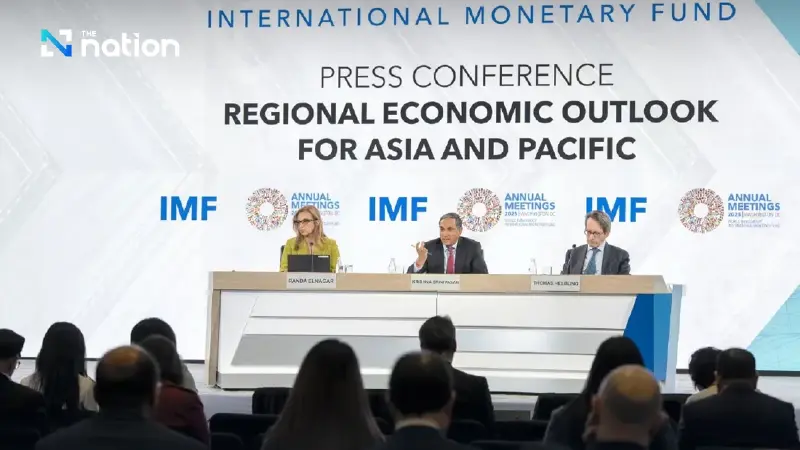


The IMF projects Asia will remain a key driver of global growth despite rising tariffs and geopolitical uncertainty.
- According to the IMF, Asia's economy remains a key driver of global growth, contributing about 60%, despite facing challenges from trade tariffs and global uncertainty.
- The region's resilience is attributed to factors like front-loading exports ahead of tariffs, strong investment in technology, reconfiguring supply chains within Asia, and supportive government policies.
- While regional growth is projected to slow slightly from 4.5% to 4.1% next year, this outlook is better than previously estimated, with major economies like India still expanding at a healthy pace.
- To sustain its strong growth, the IMF recommends that Asian economies rebalance towards domestic demand and deepen regional trade integration.
The International Monetary Fund (IMF) assesses that Asia’s economy remains strong and continues to serve as a key driver of global growth, according to its report “Asia’s Economic Growth Is Weathering Tariffs and Uncertainty.”
The region has proved unexpectedly resilient, aided by front-loading of exports, technology investment, and policy support. To sustain strong and durable growth, it must now rebalance more towards domestic demand and deepen regional integration.
Asia’s economic growth next year is poised to hold up better than previously estimated despite weaker external demand, elevated tariffs, and persistent policy uncertainty.
Growth in the Asia and Pacific region is likely to slow to 4.1% next year from 4.5% this year, our latest projections show. Inflation is likely to remain moderate.
China’s economic growth is forecast to slow from 4.8% this year to 4.2% next year, while Japan’s decelerates from 1.1% to 0.6%. India will still expand at a healthy pace of 6.6% this year, the most among major emerging economies, while slowing to 6.2% next year. Korea’s growth will accelerate from 0.9% this year to 1.8%. The Association of Southeast Asian Nations (ASEAN) economies will expand by 4.3% for a second straight year.
While Asia is at the centre of the global trade-policy reset, it will remain the biggest driver of global growth, contributing about 60% this year and next. The shock from trade tensions has been cushioned by front-loading of exports ahead of new levies, stronger-than-expected investment in artificial intelligence, ongoing supply-chain reconfiguration within the region, and policy easing in some countries.

Risks to Asia’s economic outlook
But several risks to the outlook underlie this resilience. These include renewed escalation of tariffs and stricter rules-of-origin restrictions to avoid transshipments, further supply-chain disruptions, and tighter global financial conditions.
Trade remains a key part of the resilience narrative. The United States in April raised effective tariff rates to multi-decade highs, and they remain elevated even after various pauses, agreements, and reinstatements. Exporters accelerated shipments ahead of implementation, contributing to a first-quarter surge that cooled in the following three months.
There is also more to the story than shifting trade and tariff policies. Drawing on lessons from the 2018 tariffs, production and sourcing are shifting within the region, with a larger share of intermediate goods flowing to—and through—Southeast Asia and other hubs. Parallel to this regional trade boost is a powerful AI-driven cycle that has bolstered exports of advanced technology from economies including Korea and Japan, deepening intra-Asian trade.
These dynamics are reinforced by monetary easing across many economies and targeted fiscal support in some, notably China, Korea, Indonesia, and Vietnam. This has helped support economic growth and cushion the external-demand shock. Financial conditions have also eased across much of Asia, reflecting the depreciation of the dollar, compressed credit spreads, higher stock-market valuations and, in emerging economies, lower government bond yields.
Beyond near-term resilience, a weakening in traditional growth engines is compounding the effects of the uncertain trade environment. Aging is diminishing the demographic dividend in some major economies. Productivity growth is slowing because investment is not always reaching the most dynamic firms. In addition, with post-pandemic scarring still weighing on domestic demand, especially in emerging Asia, external imbalances have widened. Moreover, recent unrest underscores how a lack of jobs and other opportunities is fuelling social strains, particularly where institutions are weaker and perceptions of corruption widespread.

Rebalancing growth
The task for policymakers is to convert today’s resilience into strong, durable, and inclusive growth that harnesses new drivers to better realise economic potential.
In coming months, policies should focus on absorbing recent shocks and lowering policy uncertainty. With inflation below target in many economies, measured monetary easing remains appropriate. Exchange-rate flexibility should help absorb shocks, with intervention reserved for disorderly conditions, in line with the IMF’s Integrated Policy Framework. Temporary, targeted fiscal measures can protect the most vulnerable and support viable businesses. In addition, horizontal reform policies, including a concerted streamlining of regulations and improving the business environment, will be essential to unleashing the role of the private sector.
In coming years, policies should prioritise securing durable growth and expanding the share of private consumption in the economy. Successful rebalancing can be achieved by strengthening social safety nets so that people do not feel obliged to save precautionarily. It will also be important to scale back industrial policies. And in China, where property markets remain strained, repairing balance sheets and completing pre-sold homes can help restore confidence in the housing market and ultimately boost private consumption.
Across the region, rebalancing also requires governments to repair their finances to protect against shocks and meet important needs without raising private sector borrowing costs.
Capital must flow to its most productive uses. Regulatory obstacles and high borrowing costs have weighed on investment and productivity in parts of the region, our analysis shows. Reforms to broaden market-based finance, deepen stock and bond markets, and help borrowers restructure debt will better allocate capital and help viable enterprises grow.

Although Asia’s economies are relatively open, that is not uniformly the case. South Asia’s services industries, for example, are relatively closed. Our analysis shows that deeper regional integration would increase competition and productivity, cut costs, and diversify markets. Lowering non-tariff barriers, expanding trade agreements to reflect the growing role of services and digital trade, and easing restrictions on foreign direct investment would attract more investment and complement the ongoing reconfiguration of supply chains.
In conclusion, resilience endures, but mounting headwinds are straining a growth engine already challenged by the trade-policy reset. Countries should rebalance toward domestic demand, fortify medium-term fiscal frameworks, and deepen regional trade and financial integration to keep growth durable and inclusive.
