
Thai Aromatic Coconut Industry in Crisis as Vietnamese Rivals Seize China Market
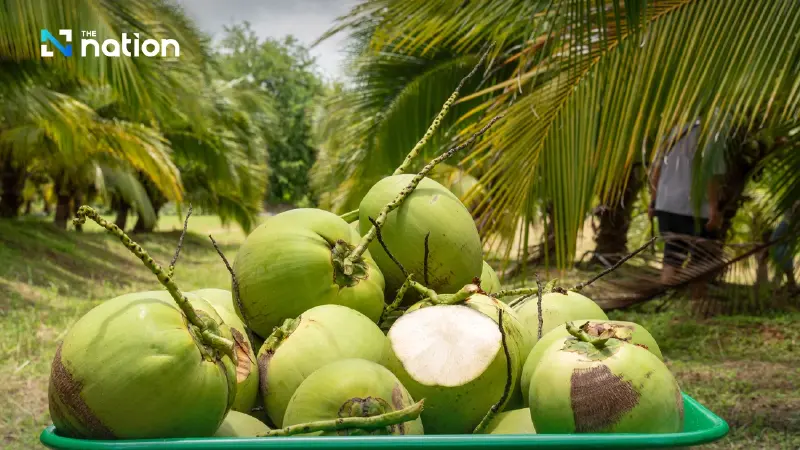


Farmers 'Abandoned' by Government: Plummeting prices below 3 Baht per fruit trigger $500M loss as Vietnamese volume and proximity win over key Chinese buyers.
- The Thai aromatic coconut industry is facing a severe crisis as prices have plummeted to less than half of production costs, causing massive financial losses for farmers.
- Vietnam has aggressively captured the crucial Chinese market, formerly Thailand's main buyer, after securing a formal export protocol with China in 2024.
- Vietnamese rivals hold a significant competitive edge due to strategic government support, large-scale production, and closer geographic proximity to China, which results in lower shipping costs.
Farmers 'Abandoned' by Government: Plummeting prices below 3 Baht per fruit trigger $500M loss as Vietnamese volume and proximity win over key Chinese buyers.
The Thai aromatic coconut industry is facing a severe crisis, with local farmers struggling to cope with prices that have dropped to less than half their production costs.
The dramatic price collapse is largely attributed to aggressive market capture by Vietnam, which now enjoys a competitive edge in shipping proximity and scale, while Thai quality remains inconsistent.
Tattawin Saruno, an independent academic and expert in agricultural management, revealed the extent of the disaster.
As of October 21, 2025, the farm-gate price for aromatic coconuts in Songkhla province stood at a mere 2–3 baht per fruit.
This is critically low, especially when farmers' production costs average 4–5 baht per fruit. In some areas, buyers are refusing to purchase the coconuts, leaving crops to rot on the tree.
With Thailand's annual production standing at 500 million fruits, every 1 baht drop in price equates to a staggering 500 million baht loss for the sector, threatening an industry with an annual export value in the tens of billions of baht.
The Rise of Vietnam and the China Protocol
The primary catalyst for the crisis is Vietnam's successful entry into the massive Chinese market.
While Thai small-scale farmers watched prices plummet, Vietnam secured a pivotal advantage in 2024 by signing the protocol with China.
This agreement formally permitted the export of fresh coconuts to the world's largest consumer. Major Vietnamese shipments and exponential growth began in late 2024 and early 2025, coinciding directly with the collapse of Thai prices.
"The Chinese market, which has very high demand and was previously Thailand’s main buyer, has rapidly shifted its imports toward Vietnam," Tattawin noted.
Vietnamese media reported that their exports of both fresh and processed coconuts to China expanded by several hundred per cent in 2025.

Global Market Drivers and Vietnamese Advantages
Global coconut demand is booming, driven by its status as a 'superfood' and innovations like coconut coffee in China. The overall market is projected to grow from $3.5 billion USD in 2023 to $8.2 billion USD by 2032.
Vietnam, the world's 7th largest producer, has capitalised on this growth through clear strategic planning:
Political Prioritisation: The Vietnamese government designated the coconut as one of its six key industrial crops.
Scale and Infrastructure: Production in the Mekong Delta (Ben Tre being the 'Coconut Capital') yields approximately 2 million tonnes annually, supported by an investment boom that saw processing plants increase from 8 in 2015 to 45 in 2024.
Logistical Edge: Vietnam’s geographic proximity to China provides a clear competitive advantage over Thailand, resulting in lower shipping costs and faster delivery times.
Vietnam's export revenue has rocketed from $180 million USD in 2010 to over $900 million USD in 2023, with expectations to surpass $1 billion USD in 2024.
The majority of this income now comes from high-value processed products, marking a strategic shift away from being a raw material producer.

Thai Weaknesses and Future Outlook
Despite the market's vast potential, Thai farmers are struggling with structural weaknesses, including an accusation that the government has 'abandoned' them to market forces.
While Vietnam has secured organic certifications for a third of its coconut area, Thailand suffers from inconsistent product quality and a lack of systematic planning across its farms. Meanwhile, the crisis is hitting provinces like Ratchaburi and Samut Sakhon—the largest growing regions—hardest.
