
Thailand Risks Sliding to Fifth-Largest ASEAN Economy Within Five Years, Warns Industry Federation


FTI sounds alarm as Q3 growth slumps to 1.2%, calling for urgent shift from traditional manufacturing to next-generation industries
- The Federation of Thai Industries (FTI) warns that Thailand could fall from being the second-largest economy in ASEAN to the fifth within five years if it fails to address structural weaknesses.
- This alert follows a significant slump in GDP growth to just 1.2% in the third quarter and an industrial confidence index that has remained low for 13 consecutive years.
- Key domestic issues dragging down the economy include crippling household debt, a struggling SME sector that employs 70-80% of the workforce, and a growing reliance on importing finished goods over domestic manufacturing.
- To counter this, the FTI proposes an urgent policy shift from traditional manufacturing to "Next Gen Industries" focusing on digitalization, AI, innovation, and green technology.
FTI sounds alarm as Q3 growth slumps to 1.2%, calling for urgent shift from traditional manufacturing to next-generation industries.
Thailand faces the stark prospect of falling from the second-largest economy in Southeast Asia to fifth place within five years unless it urgently addresses structural weaknesses and accelerates industrial transformation, the Federation of Thai Industries has warned.
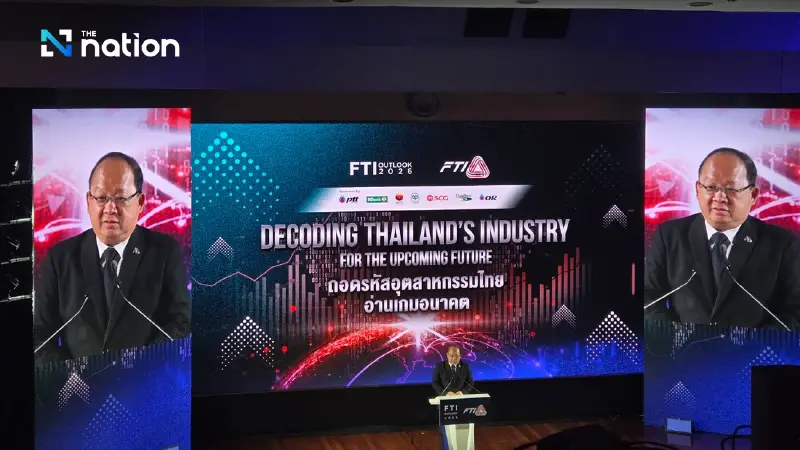
Speaking at the FTI Outlook 2026 forum on Wednesday, FTI chairman Kriengkrai Thiennukul revealed that the federation's industrial confidence index has remained below the median value of 100 for 13 consecutive years, reflecting persistent concerns amongst members about the country's economic trajectory.
The warning comes as Thailand's GDP growth plummeted to just 1.2 per cent in the third quarter, surprising private sector leaders and highlighting the severity of structural challenges facing the export-dependent economy.
"If current growth trends persist, Thailand risks falling from its position as the region's second-largest economy," Kriengkrai said, outlining the FTI's "1 FTI" policy to transition from "First Industries" to "Next Gen Industries" through four strategic pillars: Go Digital and AI, Go Innovation, Go Global, and Go Green.

Geopolitical Volatility and AI Disruption
To successfully transform Thailand's industries, Dr Surakiart Sathirathai, former deputy prime minister and chairman of Chulalongkorn University Council, urged stakeholders in both public and private sectors to develop a deeper understanding of Thailand's weaknesses as well as global dynamics, particularly the strategic movements of superpower nations.
He warned that volatility, fragmentation, and contradiction must be accepted as the "new normal" in global affairs.
Dr Surakiart identified key pressures including Trumpism and protectionism, geo-economic fragmentation involving global de-dollarisation efforts and the rise of the petro-yuan, and Chinese "involution"—a phenomenon where China shifts from outward expansion to intense internal competition, leading to overproduction and severe domestic economic stress.
On technological disruption, he noted that the current AI S-curve might conclude within five years, shifting towards applications or entirely new paradigms.
He stressed that Thailand must focus on developing proficient AI users whilst cultivating human traits that artificial intelligence cannot replicate, including critical thinking, determination, resilience, passion, and compassion.
Dr Surakiart argued that Thailand's rapid transition into an ageing society, whilst challenging, creates vast opportunities in the care and longevity economy, where the country holds distinct advantages in ASEAN regarding care and hospitality services.

Household Debt and SME Crisis
The event proceeded with a panel discussion titled "CEO's Vision: Leading Change for the Upcoming Future", which brought together Chanapun Juangroongruangkit of Thai Summit Group, Montri Rawanchaikul of PTTEP, and Piti Tantakasem of TMBThanachart Bank to outline strategic responses to these converging challenges.
Piti, chief executive of TMBThanachart Bank, identified crippling household debt as the "tip of the iceberg" dragging down economic performance.

He emphasised that whilst large corporations generate 70 per cent of GDP, the SME sector—which employs 70 to 80 per cent of the workforce—is lagging significantly, suppressing overall household income growth.
Piti warned that Thailand is increasingly becoming a "transshipment country", primarily importing finished goods from China rather than manufacturing domestically.
He called for a fundamental policy shift from a large corporate-centric focus to an SME-centric and "real people-centric" approach, advocating for policies based on Regional Value Content and local content to ensure Thai products—particularly those that are "greenly made by Thai companies"—receive competitive advantages.
To ensure long-term financial stability, he stressed that National Credit Bureau data must be mandatory to enable risk-based pricing and encourage responsible credit behaviour.
Automotive Sector at Crossroads
Chanapun, senior vice president of Thai Summit Group, warned that the automotive component manufacturing sector faces existential challenges as the market for hybrid electric vehicles currently grows faster than pure battery electric vehicles.
She highlighted critical risks including domestic suppliers lacking technology to compete with Chinese entrants, volume reduction per model due to market fragmentation across 20 original equipment manufacturers instead of 10, and the need to adapt to process disruption such as switching materials from steel to aluminium or magnesium.
"If Thai suppliers fail to adapt, they risk becoming the 'farmers in the industry'—doing the hard work but capturing minimal value, which accrues instead to OEMs and consumers," Chanapun warned.
She urged manufacturers to choose between becoming cost companies focused on production excellence or technology companies focused on research and development, whilst advocating for government policies that incentivise existing Thai manufacturers to upgrade facilities rather than focusing solely on attracting new foreign investment.

Energy Security Concerns
Montri, chief executive of PTTEP, emphasised that energy security remains fundamental to economic stability, noting that 60 per cent of Thailand's electricity is generated from natural gas, with 40 per cent of supply imported.
This reliance exposes the nation to extreme price volatility, as demonstrated during the 2022 global crisis when Thailand struggled to purchase high-priced liquefied natural gas.
Whilst confirming Thailand has robust infrastructure to prevent blackouts, Montri warned that long-term prices will remain high due to import dependence.
To support the "Go Green" objective, PTTEP is committed to carbon capture and storage, including the Arthit project, which aims to store one million tonnes of CO2 annually, despite the current lack of clear government regulation and incentives.
