
JSCCIB launches ‘Zero Corruption’ taskforce to drive systemic reform
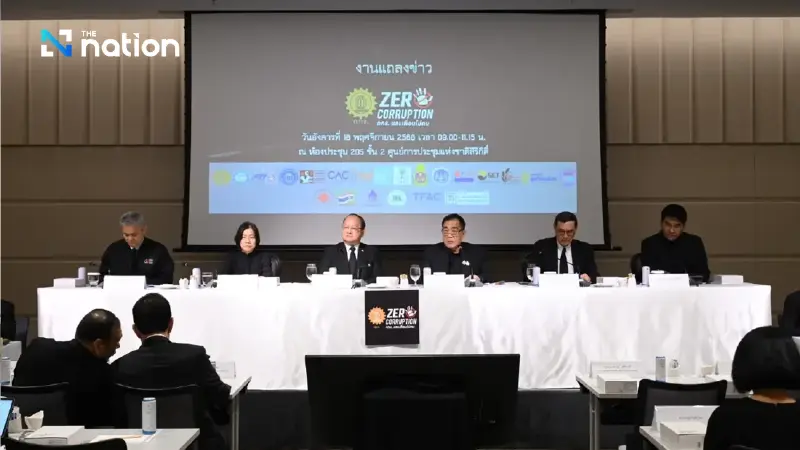


The Joint Standing Committee on Commerce, Industry and Banking sets up a dedicated task force to advance practical anti-corruption measures, rebuild investor confidence and strengthen Thailand’s transparency and competitiveness.
- The Joint Standing Committee on Commerce, Industry and Banking (JSCCIB) has launched a “Zero Corruption” taskforce to develop policy proposals for systemic anti-corruption reform.
- The taskforce will gather recommendations from the business sector and civil society, in collaboration with anti-corruption bodies and academic institutions, to restore investor confidence and create a transparent economy.
- Its action plan focuses on six key areas: building public awareness, strengthening corporate anti-corruption policies, implementing risk-management systems, increasing public-sector data disclosure, using technology for transparency, and protecting whistleblowers.
- The initiative is part of the wider "Reinvent Thailand" agenda, which identifies corruption as a major obstacle to public-sector efficiency, national competitiveness, and economic growth.
Poj Aramwattananont, Chairman of the Thai Chamber of Commerce and the Board of Trade of Thailand, and Chair of the Joint Standing Committee on Commerce, Industry and Banking (JSCCIB), announced that the committee has approved the establishment of a new Taskforce titled “Zero Corruption: JSCCIB and Allies Will Not Tolerate It.”
The decision was made at the JSCCIB meeting on October 3, 2025. The Taskforce will gather recommendations from the business sector and civil society and translate them into structured policy proposals for the government. It aims to ensure that anti-corruption measures can be implemented effectively, restore investor confidence and help build a transparent, fair and competitive economic and political system.
The initiative is part of the wider Reinvent Thailand agenda, which identifies corruption as a major obstacle to public-sector efficiency and national competitiveness.
The taskforce is supported by leading anti-corruption bodies, including the Anti-Corruption Organisation of Thailand (ACT), the Thai Private Sector Collective Action Against Corruption (CAC), the Thailand Institute of Justice (TIJ), as well as academic institutions such as the University of the Thai Chamber of Commerce and the Thailand Development Research Institute (TDRI). These partners will work together to design policy frameworks, oversight mechanisms and transparent systems, along with an action plan to be jointly driven by business and civil society.

Cooperation will also extend to state anti-corruption agencies such as the National Anti-Corruption Commission (NACC), the Public Sector Anti-Corruption Commission (PACC), relevant government bodies, and private-sector networks including the Stock Exchange of Thailand, the Thai National Shippers’ Council, the Tourism Council of Thailand, the Thai Capital Market Business Council and various industry associations, to support and publicise the initiative’s progress.
Poj said the Quick Impact Plan consists of six workstreams designed to help eliminate corruption from Thai society:
1. Building public awareness
This includes campaigns encouraging voters to support political parties with strong anti-corruption platforms: “Vote with integrity — reject corrupt candidates and refuse vote-buying.”
The JSCCIB also aims to promote effective communication of private-sector commitments to reject kickbacks, emphasising responsible business practices across all sectors in terms of customers, the environment and society.
Knowledge-sharing forums will be held on topics such as “Stopping scammers and grey capital before the nation collapses” and “The impacts and counter-measures against mule accounts and grey-capital nominees.” These will help map risks and develop clear guidelines to prevent nominee structures, supported by local business reporting mechanisms.
2. Strengthening corporate anti-corruption policies
The committee will encourage more companies to join the CAC to enforce internal controls and set clear codes of conduct prohibiting all forms of bribery.
The JSCCIB is calling for accelerated work by the “Urgent Legal Reform Committee” to advance the Regulatory Guillotine project and support passage of the Ease of Doing Business Act, which would help Thailand meet requirements for OECD membership.
The private sector also supports Thailand’s participation in the OECD and the Open Government Partnership (OGP), with proposals to be raised at upcoming World Bank and IMF meetings. It also seeks to drive legislation modernising public administration.
3. Risk-management systems
The committee will survey businesses and disclose findings on bribery related to licensing. It plans to issue a list of “10 bribes we will no longer tolerate” and propose measures for more transparent licensing procedures.
Network members will soon receive questionnaires on anti-corruption experiences. The JSCCIB will also track and publish results from indicators such as the CSI and CPI to continuously assess corruption trends.
4. Public-sector data disclosure
The taskforce will push for government data to be published according to international standards, including 25 key datasets required under the Open Data Charter, to strengthen transparency.
5. Technology for transparency
The JSCCIB and its partners will use ACT Ai, the Anti-Corruption Organisation of Thailand’s data platform, to help investigate and verify suspected corruption cases.
6. Whistleblower channels and protection
The campaign “When asked for a bribe… we report” will encourage Thai citizens, civil servants, and both Thai and foreign businesses to report bribery or misconduct through the “Corruption Watch” chat channel.
The JSCCIB emphasises that whistleblowers will be protected and not subject to retaliation or SLAPP-style lawsuits.
Poj said the initiative “Zero Corruption: JSCCIB and Allies Will Not Tolerate It” is not a campaign but a national reform effort. It brings together the business community, civil society and academia to permanently dismantle corruption chains, create a “level playing field,” and build a transparent, credible and sustainable Thai economy.
He noted that Thailand now stands at a critical crossroads between transparent competition and growth built on risk. The country must shift its mindset, he said, from viewing corruption as someone else’s problem to treating it as a shared national mission, essential for long-term stability.
“The damage caused by corruption is impossible to quantify because it occurs in secrecy between giver and receiver. But if you look at Thailand’s GDP, we grew only 2% when we should have grown 3–4%. The missing percentage points represent the economic cost of corruption,” Poj said.

Kriangkrai Thiennukul, Chairman of the Federation of Thai Industries (FTI), said that in the modern industrial era, businesses must “produce transparency” alongside goods, as corruption is an “invisible cost” that undermines investment, technology adoption and national growth potential. He stressed that robust anti-corruption action is essential if Thailand is to position itself as a trusted global production hub.
“Corruption is not only an economic problem but a social one. It erodes the foundations of the economy. Thailand should be growing at 4% GDP, but we are stuck at 2%. The missing 2% is corruption,” Kriangkrai said. “Beyond GDP, the real damage is the loss of trust. Thailand is ranked among the worst countries for corruption, undermining the nation’s credibility, and that becomes a cost the entire country must bear.”
Kobsak Duangdee, Secretary-General of the Thai Bankers’ Association, said Thailand is facing deep structural challenges, weakening competitiveness and more than 100,000 outdated government regulations, issues closely tied to corruption. He stressed the need to drive reform through transparent, data-driven processes aligned with the Reinvent Thailand agenda and Quick Big Win measures, both of which will help strengthen Thailand’s international standing and prepare the country for OECD accession.
Assoc Prof Saowanee Thairungroj outlined the organisational framework of the Zero Corruption Taskforce, which will operate across six key pillars:
- Cultivating civic consciousness and encouraging Thais to prioritise the public interest;
- Promoting internal anti-corruption policies and transparent corporate governance;
- Enhancing risk-management systems and corruption-risk assessments;
- Expanding public-sector data disclosure in line with Open Data standards;
- Deploying transparent technologies such as big data and AI to detect irregularities; and
- Strengthening whistleblower protection through secure reporting channels, including the “Corruption Watch” hotline.
University of the Thai Chamber of Commerce (UTCC) President, Assoc Prof Thanavath Phonvichai, said the latest Thai Corruption Situation Index (Thai CSI) for June showed the overall score had fallen to 36 from 37 in December 2024, indicating a deterioration in the national corruption climate.
All three sub-indices, severity, prevention and suppression, declined. Moreover, 87% of respondents said corruption had become “more severe.”
However, one positive signal emerged: Thailand’s tolerance of corruption score dropped to a historic low of 0.92 (on a scale of 0–10, where 0 means “strongly rejects corruption”), suggesting that Thai society is increasingly unwilling to accept corrupt behaviour.
Key perceived drivers of corruption included:
- Weak law enforcement (13.5%),
- Lack of transparency in political processes (11.6%), and
- Politically motivated benefits (11.3%).
The most common forms of corruption identified were:
- Non-disclosure or incomplete disclosure of public information (13.7%),
- Nepotism and cronyism (12.3%), and
- Abuse of political office for partisan benefit (10.9%).
Respondents said the most urgent actions required from the government were:
- Investigating corruption among politicians (11.5%), and
- Empowering networks, businesses and civil society to conduct scrutiny (11.5%).
The top policy priorities the government should tackle, according to the survey, were:
- Transparent, independently auditable public procurement processes (22.9%), and
- Economic policies that support fair and transparent competition (22.1%).
