
JSCCIB keeps 2025 GDP growth forecast at 2.2%, warns export growth deceptive
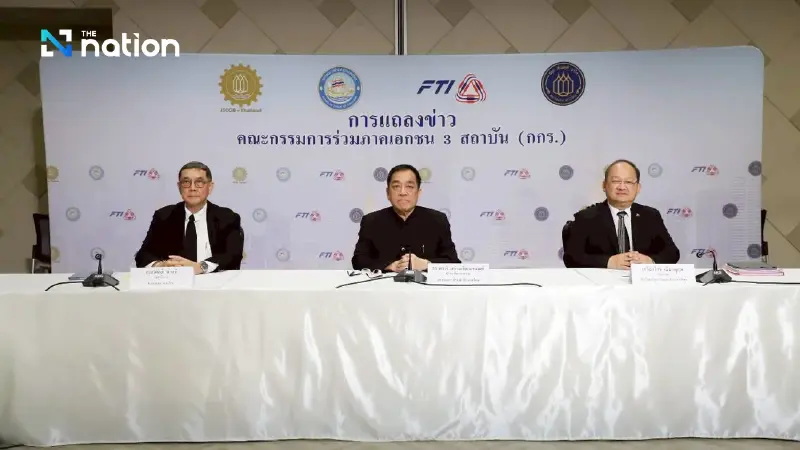


The JSCCIB keeps Thailand’s 2025 GDP outlook at 2.2%, highlighting that export growth of around 10% brings limited value‑added due to low local content.
Poj Aramwattananont, Chairman of the Thai Chamber of Commerce (TCC), chaired a meeting with Kriangkrai Thiennukul, Chairman of the Federation of Thai Industries (FTI), and Kobsak Duangdee, Secretary General of the Thai Bankers' Association (TBA), to assess the economic outlook and policy recommendations for the government.
The Joint Standing Committee on Commerce, Industry and Banking (JSCCIB) has maintained its forecast for Thailand’s 2025 GDP growth at 1.8% to 2.2%, despite expectations that exports could grow by 9.5% to 10.5%.
However, these figures are largely driven by products with low local content and gold exports, which do not add significant value to the economy. Meanwhile, imports are projected to rise by 10.2%, and inflation is expected to remain low at -0.1% to 0.1%, driven by lower energy prices.
If the government can expedite the disbursement of the 2026 budget alongside the Khon La Khrueng Plus (Let’s Go Halves Plus) economic stimulus measures, and provide support for SMEs and Made In Thailand initiatives under the Quick Big Win strategy, it will be a significant driver for Thailand's economy in 2025, allowing growth to approach the 2.5% growth seen in the previous year.

JSCCIB also noted that global economic growth is outperforming expectations, led by continued expansion in the US, with the International Monetary Fund (IMF) revising global GDP growth for 2025 upwards to 3.2%.
While the positive global outlook is expected to boost Thai exports, the benefits to Thailand's GDP are limited due to the low local content of exported goods.
The report highlights a fragile labour market as a key challenge for Thailand's economic adjustment. The unemployment rate in the social security system reached 2.1% in Q2 2025, the highest in two years.
Unemployment is also rising in the industrial sector and among new graduates, exacerbated by the ongoing trade war and foreign competition, alongside the lingering effects of the COVID-19 pandemic.
In terms of debt management, TBA, in collaboration with the government and the National Credit Bureau (NCB), is working to provide sustainable solutions for household debt, particularly focusing on small loans under 100,000 baht. These efforts aim to support 3.4 million households, with a total debt of 122 billion baht.

JSCCIB also reviewed the “Reinvent Thailand” initiative, which focuses on six priority sectors: agriculture and food, automotive, smart electronics, healthcare, tourism, and retail. The committee will drive the development of these industries, aiming to strengthen supply chains and support SMEs through various government measures.
Additionally, JSCCIB expressed concerns over proposed legislation, such as the Labour Protection Act, Clean Air Act, and the Factory Act, which may increase operational costs for SMEs and reduce foreign investment appeal.
The committee called for thorough regulatory impact assessments (RIA) before any major legal changes are made, ensuring laws balance protection with the long-term competitiveness of the Thai economy.
JSCCIB also supports government initiatives to modernise public administration and streamline regulations to enhance Thailand's business environment. It will continue to collaborate with Deputy Prime Minister Prof. Borwornsak Uwanno to ensure tangible progress on these reforms.
