
‘A Horse Running Through Fire’: Thai Corporates Warn of Severe Economic Risks in 2026 if Growth Fails to Reach 2%
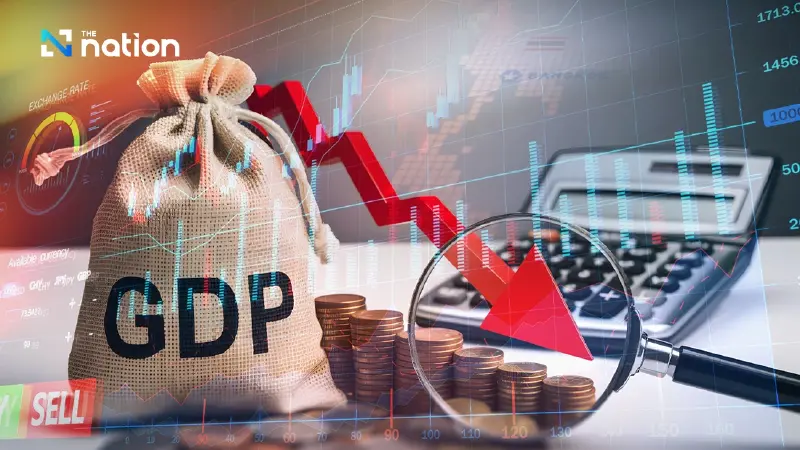


Private sector warns Thailand’s 2026 economy faces high risk if GDP stays below 2%, citing structural traps, debt burdens, and ASEAN competitiveness pressures
- The private sector warns that Thailand’s economy in 2026 faces significant risks if GDP growth falls below 2%, in line with forecasts of 1.6–2.0% from several institutions.
- Key structural weaknesses—such as the middle-income trap, ageing society, and high household debt—combined with a slowdown in the global economy, continue to weigh on growth.
- Persistently low growth could leave Thailand struggling and at risk of being overtaken economically by neighbouring ASEAN countries.
Entering the final month of 2025, the National Economic and Social Development Council (NESDC) expects Thailand’s 2025 GDP to grow by 2.0%, while 2026 growth is anticipated at around 1.7%.
Current growth is supported by recovering exports, domestic consumption, and tourism. However, downside risks include a global slowdown, U.S. trade tariffs, geopolitical uncertainty, climate volatility, and high household and business debt. Private-sector leaders shared their views below.
Kriangkrai Thiennukul, Chairman of the Federation of Thai Industries (FTI), told that the Joint Standing Committee on Commerce, Industry and Banking (JSCCIB) had forecast Q3 2025 GDP growth at 1.5–1.7%, but the actual figure came in at 1.2%. For the first three quarters, GDP grew 2.4%. The final quarter will determine whether full-year growth meets the JSCCIB projection of 2%.
For 2026, the JSCCIB forecasts GDP growth of 1.6–2.0%. The IMF projects 1.6%, while the World Bank expects 1.7%, close to the global projection of 2.6%—a low global baseline that could depress Thailand’s exports, which account for 60% of GDP.
“Next year still carries risks and many variables that could affect Thailand’s economy—geopolitical conflicts, delays in Thai-US trade negotiations following the imposition of 19% tariffs on Thai goods, and domestic political uncertainty ahead of next year’s general election. All factors matter,” Kriangkrai said.
He noted major challenges and opportunities ahead: Thailand must urgently revive its economy, which has slowed due to structural constraints.
The ageing society is now fully established, with 21% of the population (14 million people) aged 60+, and the birth rate falling.
Another obstacle is the middle-income trap: Thailand’s average income remains about US$7,500 per capita, far below the US$13,000 threshold for high-income status.
Furthermore, business and industrial models largely generate low value-added output. At current growth rates, Thailand may need 30–40 years to become a high-income nation and risks having its GDP overtaken by Vietnam, Malaysia, Singapore, and the Philippines in the coming years.
“Thailand must completely reshape its industry and business models to build innovation, value creation, and higher profits. If GDP growth remains below 2%, it will be extremely difficult,” he added.
Kriangkrai also commented on the “Let's Go Halves Plus” Phase 1 co-payment scheme, which saw all 20 million entitlements used quickly. He said the scheme successfully stimulated the economy and eased living costs and should continue into Phase 2 if fiscal space allows, as household consumption remains a key growth engine in 2026.
The 2026 Economy: ‘A Horse Running Through Fire’
Saengchai Teerakulvanich, Chief Strategy Officer of the Federation Thai SME, told that the Thai economy at the end of 2025 and into 2026 remains under pressure, particularly from the severe southern floods, which affected 9 provinces, 101 districts, and more than 280,000 SMEs.
External pressures include the “Trump 2.0” tariff regime, which further impacts exports, and tourism numbers that have yet to fully recover.
In 2026, Thailand must navigate multiple risks—global economic conditions, natural disasters, and technological competition. Saengchai highlighted “the debt trap”, particularly household and NPL debt, as a major challenge requiring urgent attention.
He emphasised the need to upskill the workforce—especially in digital, AI, innovation, and creativity—to enhance competitiveness. Thailand’s quarterly GDP growth remains the lowest in ASEAN at 1.2–3.3%, trailing Vietnam, Indonesia, the Philippines, Malaysia, and Singapore.
Another essential priority is disaster preparedness, including water-management strategies, storm and tsunami response, and protective infrastructure.
AI and innovation will become both opportunities and obstacles; without adaptation, they may hinder SME and labour competitiveness.
For 2026, Saengchai expects GDP to grow 2–2.2%, supported by government stimulus and clearer investment promotion measures despite flood damage.
He said 2026 will be a ‘A Horse Running Through Fire’ —full of opportunities and challenges. Thailand must focus on four essential pillars:
- Clear national strategy for integrated development
- Differentiated economic strategy to raise household income and reduce debt
- Leadership, from government, private sector, and citizens, to drive transformation
- Governance, including anti-corruption and state efficiency improvements
On political volatility, Saengchai said this is normal for Thailand—but as long as the country remains under a constitutional monarchy and private-sector voices are respected, he still sees positive opportunities in 2026.
Key Priorities for 2026
- Solve the systemic debt trap and ensure effective measures
- Upskill–reskill the workforce to stay competitive
- Accelerate access to technology and innovation to boost economic value
- Advance ESG seriously and help SMEs access global markets
- Address informal economy and grey capital to reduce long-term economic damage
“If Thailand establishes clear strategies on technology, leadership, and governance, the country can turn challenges into opportunities and achieve sustainable GDP growth,” Saengchai concluded.
