
Commerce warns Thai exports in 2026 face downside risk, worst case seen contracting 3.1%
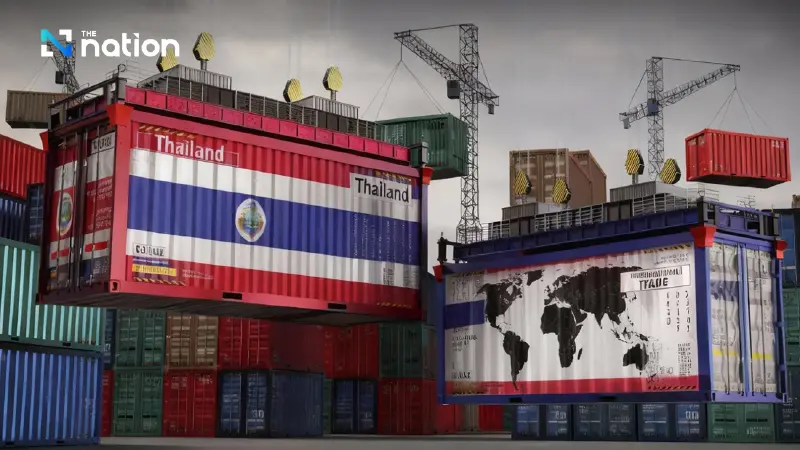


Commerce Ministry projects Thai exports in 2026 could range from 1.1% growth to a 3.1% contraction, with US trade barriers and strong baht key risks
Commerce Minister Suphajee Suthumpun has warned that Thailand’s exports in 2026 face significant downside risks, with the worst-case scenario pointing to a 3.1% contraction if global conditions deteriorate and trade tensions escalate.
She said the Commerce Ministry expects Thai exports in 2025 to exceed earlier targets, with two reference projections: US$332,982.1 million, representing 10.7% growth, and US$334,982.1 million, or 11.4% growth. For 2026, however, the ministry has prepared three scenarios:
Best-case scenario
Exports would grow by 1.1% to US$337,655 million if major trading partners such as the United States, China, ASEAN, Europe and Japan recover faster than expected, and if US trade measures do not increase significantly. This outlook assumes that global trade volumes continue to expand, US protectionist measures do not intensify or widen as feared, and investment relocation into Thailand begins to bear fruit in a tangible way, especially in electronics components, AI and EV-related industries.
Baseline scenario
Exports would contract by 1.0% to around US$330,642 million as shipments normalise after very strong growth in 2025. Suphajee noted that many trading partners accelerated imports this year in order to front-load purchases ahead of potential tariff increases, which means orders in 2026 are likely to ease as inventories remain high. At the same time, the global economy and key partners are expected to slow, in line with relatively weak growth in world trade.
Price factors and the exchange rate are also cited as major headwinds for competitiveness and exporters’ earnings in baht terms, while lower global crude oil prices would drag down the value of oil-related exports.
Worst-case scenario
Exports could shrink by 3.1% to about US$323,628 million if US trade barriers and tariff measures become more severe and broader in scope than currently anticipated, disrupting global supply chains and causing world trade volumes to contract. A sharper-than-expected slowdown in major economies, particularly the US and China, would add further pressure.
In this scenario, a stronger baht would squeeze exporters’ margins and competitiveness, while falling commodity prices would weigh on Thailand’s overall export value.
Suphajee said the ministry’s baseline forecast of around -1% for 2026 reflects the fact that exports in 2025 are expanding from a high base, at a time when the global economy is losing momentum, the baht is under appreciation pressure and crude oil prices are easing. The baseline outlook is broadly in line with assessments from the Bank of Thailand and the International Monetary Fund (IMF), she added.
Despite the challenges, she said exports are still expected to generate an additional 91.956 billion baht in economic value compared with the previous year, equivalent to about 0.46% of GDP.
