
Thailand-Cambodia Crisis: Economic War Paralyzes $5 Billion Trade and Threatens Vast Gas Reserves
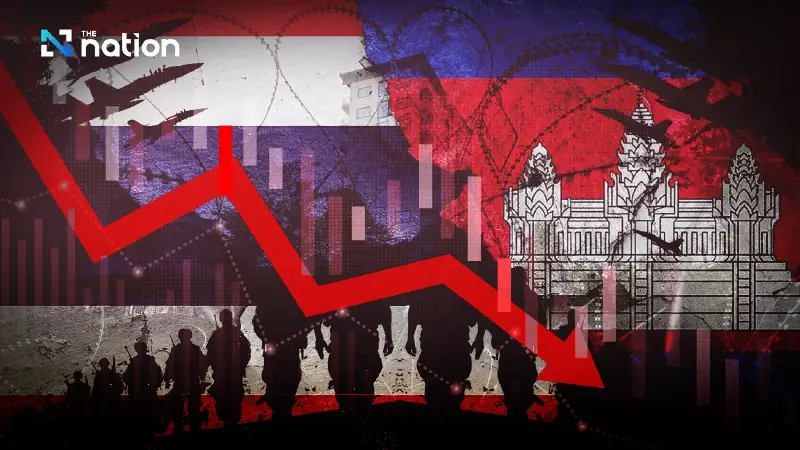


Border trade paralysis and the flight of 780,000 workers trigger economic shockwaves across Southeast Asia, indefinitely stalling a multi-trillion baht gas project
- The conflict has paralyzed border trade, particularly at the Klong Luek–Poipet crossing, halting commerce valued at approximately $4.7 billion (174.5 billion Baht) annually.
- A joint project to develop vast natural gas reserves in the Gulf of Thailand's Overlapping Claims Area, valued at over 10 trillion Baht, has been indefinitely suspended.
- The crisis has triggered a severe labor shortage in Thailand due to the exodus of 780,000 Cambodian workers and caused a catastrophic collapse in the border tourism sector.
Border trade paralysis and the flight of 780,000 workers trigger economic shockwaves across Southeast Asia, indefinitely stalling a multi-trillion baht gas project.
The escalating border conflict between Thailand and Cambodia in 2025 has transcended a mere territorial dispute, morphing into a full-scale "Economic, Political, and Geopolitical War."
The clashes have inflicted profound and deepening economic wounds on both nations, with the indefinite halt of cross-border trade and the dark prognosis for a multi-trillion-baht energy project threatening regional stability.
The conflict's immediate consequence was the paralysis of trade at the vital Klong Luek–Poipet crossing, generating immense economic damage and disrupting established regional supply chains.
The crisis has simultaneously resulted in a severe shortage of Cambodian labour in Thailand and a catastrophic collapse of the border tourism sector following its designation as a "Conflict Zone."
The Road to Breakdown
Tensions initially flared following skirmishes in the Emerald Triangle, quickly escalating into the "Five-Day War" between 24 and 28 July.
The fighting caused at least 48 fatalities and forced over 300,000 civilians to evacuate from the border areas—violence levels that immediately destabilised the economic structures of both states.
A brief respite was offered by the signing of the Kuala Lumpur Peace Agreement on 26 October.
However, the truce proved brittle, lasting less than two months before an insidious series of bombings and reciprocal accusations led the Thai government to declare, "Peace is over."
This paved the way for aerial bombardments on 8 December and sustained armed confrontations along the 800-kilometre frontier that continue to this day.
Trade and Investment Ground to a Halt
The indefinite closure of the Klong Luek–Poipet crossing, a crucial logistics hub, has completely stalled border commerce valued at approximately 174.5 billion baht per year (around $4.7 billion).
Thailand’s exports, particularly consumer goods, fuel, and construction materials—which are essential lifeblood for Cambodian production—have been cut off.
Conversely, Thailand’s manufacturing sector has suffered from the loss of crucial Cambodian raw materials, including cassava and scrap metal, creating a complex crisis for the starch, ethanol, and steel industries.
According to the Centre for Economic and Business Forecasting at the University of the Thai Chamber of Commerce (UTCC), the direct trade damage is staggering.
In a scenario where the border remains shut for a full year, Thailand faces a loss of approximately 66.61 billion baht in exports and 20.37 billion baht in necessary imports. The UTCC forecasts that Thai GDP could contract by 0.74% in 2026.
Cambodia, which relies almost entirely on Thai capital goods, is simultaneously facing a severe inflationary spiral.
The entire cross-border logistics system has stalled, forcing companies to reroute shipments through Vietnam and Laos, hiking transportation costs by an estimated 25 to 40 per cent and impacting the regional supply chain as a whole.
Labour and Tourism Collapse
The instability, combined with rumours of impending security sweeps, triggered a swift exodus of Cambodian migrant labour from Thailand.
Over 780,000 workers returned home almost overnight, causing an immediate, acute labour shortage across the Thai construction, fishing, and processed agriculture sectors, and subsequently driving up local wages.
For Cambodia, this represents the loss of over $3 billion USD in annual worker remittances, a critical source of income for household economies.
Tourism along the Trat, Chanthaburi, Sa Kaeo, and Ubon Ratchathani borders has been designated a "Conflict Zone," leading foreign insurers to revoke travel coverage.
This has resulted in a decisive slump for the final quarter, with cancellation rates during the peak high season approaching 100 per cent.
Geopolitical Friction and the Lost Gas Prize
The crisis has been significantly intensified by the involvement of global powers. The United States, under President Donald Trump, deployed "Tariff Diplomacy," threatening an initial 36 per cent tariff on Thai and Cambodian exports unless a ceasefire was implemented.
China, meanwhile, has been actively manoeuvring to preserve and extend its regional influence, framing the conflict as a flashpoint for geopolitical competition.
The greatest, yet least-discussed, casualty is the Overlapping Claims Area (OCA) in the Gulf of Thailand, which both nations had planned to develop jointly.
The indefinite suspension of the 2001 Memorandum of Understanding (MOU) has postponed any hope of tapping the immense natural gas resources, conservatively valued at over 10 trillion baht.
This project’s stagnation, alongside the uncertainty, risks a mass outflow of Foreign Direct Investment (FDI) from newer industrial sectors, such as Electric Vehicles (EVs) and digital technology, where Thailand is already competing fiercely with Vietnam.
Future Scenarios
Analysts have outlined two dominant future scenarios:
Protracted Conflict: Regardless of any short-term ceasefires, border crossings are likely to remain shut for a sustained period. This would permanently damage trade, downgrade bilateral relations, and risk the conflict becoming a chronic, low-level military confrontation.
Renewed US Pressure: A fresh wave of intervention by the US may see them use the indefinite suspension of trade negotiations and the application of new trade tariffs to compel both nations back to the negotiating table, leading to a new, yet inherently fragile, ceasefire agreement.
The war has unequivocally demonstrated that the economic fates of Thailand and Cambodia are more profoundly linked than previously acknowledged.
The border problem no longer stops at the frontier; it is fundamentally shaking the economic stability and security of both nations. The restoration of peace is therefore not a political option but an urgent economic necessity.
