
Anutin opens OECD Asian Senior Budget Officials Meeting, vows Thailand will pursue full OECD membership
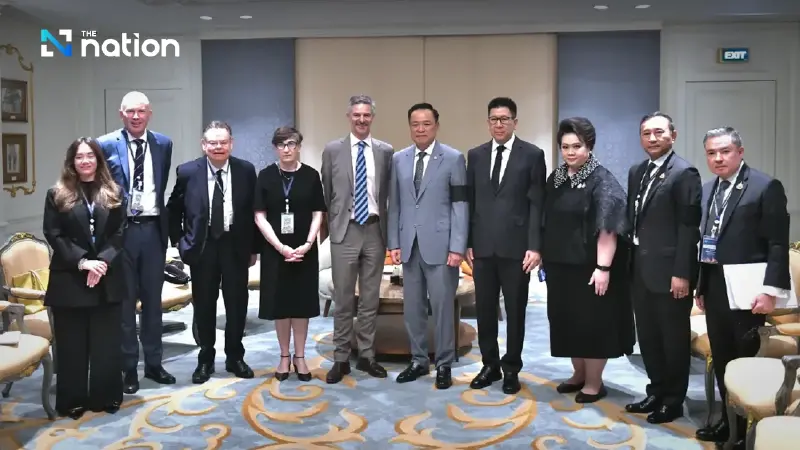


Prime Minister Anutin opens the 19th OECD Asian Senior Budget Officials Meeting in Bangkok and confirms Thailand is pressing ahead with full OECD membership.
Prime Minister and Interior Minister Anutin Charnvirakul on Thursday (December 11) presided over the opening of the 19th OECD Asian Senior Budget Officials Meeting, an academic workshop on public budgeting co-organised by the Budget Bureau and the Organisation for Economic Co-operation and Development (OECD).
Held at Mandarin Oriental, Bangkok, the meeting was co-chaired by Richard Windeyer, Deputy Secretary to the Treasury of Australia, and Koranin Kanchanomai, Deputy Director of the Budget Bureau. Deputy Prime Minister and Finance Minister Ekniti Nitithanprapas also took part, along with senior officials from OECD member countries and others including the European Union, Japan, South Korea, New Zealand, Indonesia, Bhutan, Brunei and Qatar.
International organisations such as the IMF and Germany’s international cooperation agency GIZ, as well as fiscal and financial experts from many countries – around 100 participants in total – are attending the meeting.

Anutin said that since Thailand first hosted an OECD meeting in 2002, this platform has reflected the longstanding cooperation between Thailand and the OECD and has evolved into an important forum for sharing experience, strengthening fiscal governance and improving public-sector management across the region.
He noted that this year’s gathering comes at a critical juncture, as governments worldwide face economic uncertainty, geopolitical tensions, rapid technological change and rising public expectations for transparency, efficiency and sustainability. In such a context, he said, careful budgeting and responsible fiscal management are not merely technical tasks, but the foundation of trust between governments and citizens – a trust that Thailand remains fully committed to upholding.
The prime minister outlined the government’s goals of boosting economic growth, increasing national income and ensuring that public spending is as efficient and cost-effective as possible, while at the same time driving the transition to a low-carbon society, undertaking comprehensive legal reforms and building sustainable digital governance to prepare for increasingly complex challenges.
He stressed that fiscal discipline, transparency and accountability are at the heart of Thailand’s governance, guided by the Sufficiency Economy philosophy, and that every baht of public money must deliver maximum benefit to the people while supporting the country’s long-term sustainability.
Anutin added that this year’s meeting theme – “Fiscal sustainability, digital transition and strengthening public-sector capacity” – aligns closely with the government’s policy direction, which focuses on reinforcing the fiscal policy framework to preserve stability while supporting economic growth.
The Thai government is also working to modernise public financial management through digital platforms and to explore the responsible use of AI to increase efficiency and transparency in the civil service. At the same time, it is promoting financial literacy and public participation to foster a culture of sustainability across Thai society.
On Thailand’s path towards OECD membership, the prime minister revealed that the country has reached an important milestone. Last week, the government submitted its Initial Memorandum to the OECD Deputy Secretary-General, formally launching the next stage of technical reviews. He reaffirmed the government’s firm commitment to the accession process.
He said cooperation between Thailand and the Asian Senior Budget Officials forum will play a key role in achieving this goal. Personnel exchanges between the Budget Bureau and the OECD over more than two decades have deepened understanding and forged close relations based on shared objectives, for which Thailand is deeply grateful.
Anutin concluded by saying that the two days of discussions would be an important opportunity to exchange views on how fiscal systems should adapt to future challenges – from more effective public spending and smarter management to transparent communication with citizens. These aims, he said, are shared by all countries seeking to build stronger and more inclusive societies.
He also praised the co-chairs and the OECD Secretariat for their continued support in organising the event, and wished the meeting every success in achieving its objectives.
