
Industrial Confidence Edges Up as Thailand's Manufacturing Sector Rebounds


FTI calls on government to extend BOI incentives and tighten PM2.5 controls amid lingering economic headwinds
- Thailand's Industrial Confidence Index rose to 88.7 in January, up from 88.2 in December, as manufacturing returned to full capacity after the New Year holiday.
- The rebound was driven by increased demand ahead of the Lunar New Year, a surge in tourism, pre-election spending, and government-approved investments in data centres.
- Despite the modest improvement, the sector faces challenges including slow government budget disbursement, rising labor costs, severe PM2.5 pollution, and a strong baht impacting exporters.
- The three-month forecast for the index is also positive, anticipating a boost from the upcoming Songkran festival and the formation of a new government.
FTI calls on government to extend BOI incentives and tighten PM2.5 controls amid lingering economic headwinds.
Thailand's Industrial Confidence Index rose marginally to 88.7 in January 2026, up from 88.2 in December 2025, as the manufacturing sector returned to full swing following the New Year holiday and demand picked up ahead of the Lunar New Year, according to the Federation of Thai Industries (FTI).
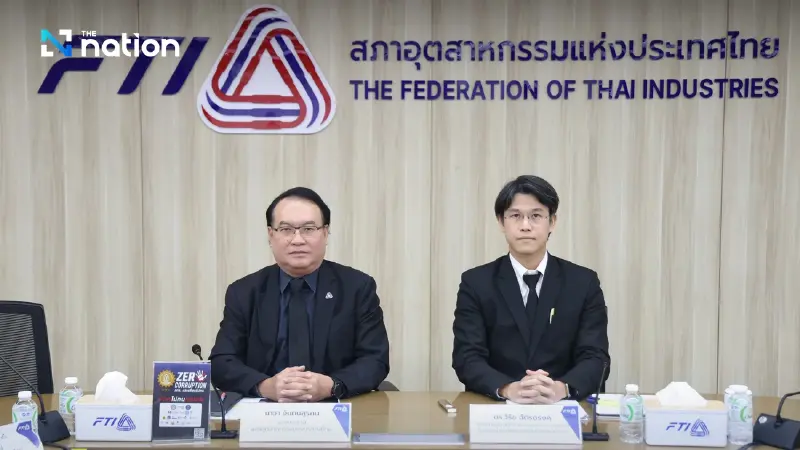
During the monthly press conference on Wednesday, FTI's vice chairman Nava Chantanasurakon and board director Dr Virat Chatdarong attributed the modest improvement to a confluence of positive developments.
Factories ramped up production to fulfil Lunar New Year orders, particularly in the processed food, apparel and packaging industries, whilst a surge in tourist arrivals — bolstered by government initiatives including direct flight routes and promotional events — helped channel spending into regional economies and local businesses.
Further tailwinds came from the Board of Investment's approval of incentives for seven data centre projects in the Eastern Economic Corridor (EEC), collectively valued at over 96 billion baht.
The move is expected to accelerate the expansion of high-technology industries and drive demand for electronic equipment. Pre-election activity also provided a short-term boost, with spending on campaign materials, ballot printing and party operations injecting additional money into circulation.
Meanwhile, a ceasefire agreement between Thailand and Cambodia helped ease tensions along the border, allowing displaced residents to return home and economic activity in the area to normalise.

Despite these encouraging signs, several challenges clouded the outlook.
Capital expenditure disbursement has lagged behind schedule since the start of the fiscal year; as of 23 January 2026, the disbursement rate stood at just 21 per cent against a target of 26 per cent, threatening to delay the flow of public funds into the broader economy.
A rise in Social Security contributions — from 750 to 875 baht per month — has pushed up labour costs for businesses, whilst delays in unemployment benefit payments have affected more than 208,000 individuals.

Air quality has also emerged as a pressing concern. PM2.5 pollution levels have surged, driven largely by open burning in the Central and Northeastern regions, with knock-on effects for public health and the tourism economy.
The expiry of government consumption stimulus measures has further dampened domestic purchasing power, and exporters — particularly in processed food, agriculture and low-margin manufacturing — have faced a squeeze on revenues and competitiveness as the Thai baht continues to appreciate.
A survey of 1,300 entrepreneurs across 48 industry clubs under the FTI found that concerns eased in several areas, including the domestic economy, government policy, energy prices and access to credit.
However, anxiety over the global economic outlook and exchange rate volatility — especially among exporters — increased notably.

The three-month forecast for the index stands at 95.9, a slight improvement on the 95.7 recorded in December. The FTI cited the upcoming Songkran festival as a key driver, expecting the high tourism season to stimulate spending on food, beverages and souvenirs.
The anticipated formation of a new government was also seen as a positive factor, with hopes that fresh economic policies would accelerate budget disbursement and bolster investor confidence. Risks remain, however, particularly around geopolitical tensions and the threat of escalating trade wars, which could disrupt global supply chains.
The FTI put forward three policy recommendations: extending the BOI's Competitiveness Enhancement Fund support programmes through to the end of 2026; strengthening enforcement of PM2.5 regulations and deepening cooperation with neighbouring countries on transboundary haze; and expediting budget allocations for artificial intelligence training, particularly for small and medium-sized enterprises.

Speaking at a subsequent question-and-answer session, Nava expressed confidence in the government's Kon Ka Krueng Plus co-payment stimulus scheme, describing it as a meaningful tool for reviving consumer spending.
He stressed, however, that sound governance would be essential to its success.
"If there is no corruption, I believe that the government's GDP target of 3 per cent this year can be achieved," he said.
