
TPSO flags six Trump trade levers after reciprocal tariff ruling
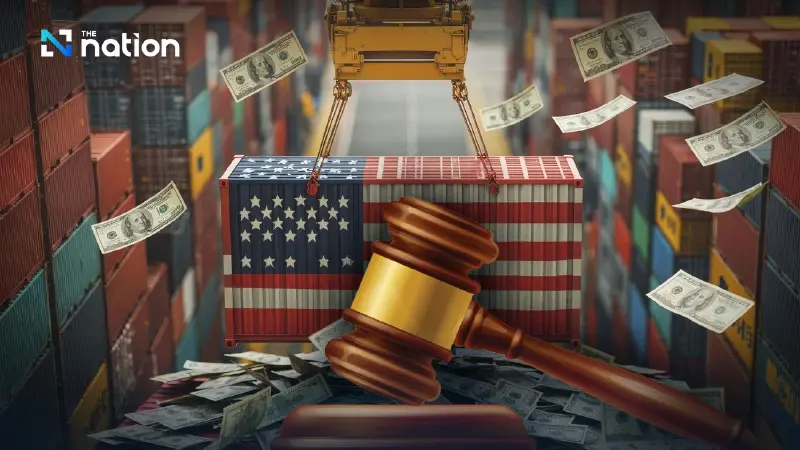


TPSO says Trump still has six trade levers even after US Supreme Court voids reciprocal tariffs; NESDC expects faster product-by-product duty hikes.
The Trade Policy and Strategy Office (TPSO) has published an article titled “Six Trump trade weapons after the US Supreme Court voids reciprocal tariffs”, outlining key US laws that can be used to enforce trade measures against foreign countries.
They include:
Section 232 of the Trade Expansion Act of 1962
This gives the US President authority to impose trade measures when the Department of Commerce reports that imports threaten national security. Measures can include tariff increases, quotas, or import bans, and there is no specified time limit for enforcement.
The Trade Act of 1974
- Section 122 allows the US President to impose a blanket import surcharge (up to 15%) without congressional approval. It may be enforced for up to 150 days; beyond that, congressional approval is required. However, no US President has ever used Section 122 because of the time limit.
- Section 203 authorises the US President to impose safeguard measures to protect domestic industries from a surge in imports. The measure may be applied for up to four years and extended for another four years if the US International Trade Commission (USITC) finds it still necessary.
- Section 301 empowers the United States Trade Representative (USTR) to investigate unfair trade practices by trading partners that burden US commerce, and to impose remedies, including higher tariffs and other trade restrictions. The USTR may initiate a Section 301 investigation on its own, or in response to petitions from stakeholders, but must do so under specific authority from the US President.
Section 338 of the Tariff Act of 1930
This allows the US President to impose new tariffs of up to 50% on countries that discriminate in trade, based on US International Trade Commission (USITC) investigations and reports. To date, it has never been used in practice.
The International Emergency Economic Powers Act (IEEPA)
This authorises the US President to address external threats affecting national security, foreign policy, or the economy, including through sanctions, export controls, import bans, and restrictions on purchases by foreign nationals.
The IEEPA does not clearly define key terms, giving the US President broad discretion without needing prior approval from Congress. However, it requires the President to consult and report to Congress periodically.
While Congress retains the power to terminate a declared national emergency by passing a joint resolution, the President can still veto that resolution.
TPSO noted that if the Supreme Court continues to uphold rulings consistent with the views of the Court of International Trade (CIT) and the Court of Appeals for the Federal Circuit (CAFC), the US President would still have options to pivot to Section 232, Section 301, Section 203, Section 338, or Section 122, which fall within executive authority for determining foreign trade measures.

NESDC expects Trump to accelerate product-by-product tariffs
Danucha Pichayanan, Secretary-General of the National Economic and Social Development Council (NESDC), commented on the US Supreme Court’s ruling that President Donald Trump’s use of presidential authority to impose reciprocal tariffs on countries was unlawful, saying the NESDC has been closely monitoring developments.
Initially, he said global trade conditions should ease, benefiting trade and exports worldwide. He added that the tariff the US announced at this level is 10% across the world, which does not in itself create advantages or disadvantages for particular countries—except for countries facing additional duties under other provisions that are more focused on specific products.
He said the next step Trump is expected to take, after the ruling made it impossible to impose reciprocal tariffs in the same way, is to shift towards more product-specific tariffs. Thailand will need to watch which goods face higher duties in order to track potential impacts.
Thailand must also monitor whether enforcement will intensify on checks related to local content and regional value content (RVC), which could be applied more frequently to goods shipped to the US.
As for Thailand’s negotiations with the US—after earlier tariff talks—whether they should continue and how binding they are will depend on clarification from the Ministry of Commerce, he said.
Danucha added that the effects on the US economy should be assessed in both the short and long term. In the short term, US import prices should fall in line with the reduced tariff rate, easing inflationary pressure domestically. That could in turn weaken the US dollar—an approach Trump supports to help boost exports.
Conversely, a weaker dollar would strengthen other currencies, including the baht, which could hurt Thailand’s export sector and tourism.
Looking ahead, he said the ruling that reciprocal tariffs were unlawful could worsen US fiscal risks, because the US government may have to refund tariffs collected from private companies in countries that faced the additional duties. No one yet knows the exact figure, but estimates put it at around US$175 billion.
“If refunds are made to companies in countries affected by the tariff increases, it will have fiscal implications for the US, which already has high public debt and a large budget deficit,” Danucha said.
“If US public finances face problems, it will affect spending and may also impact the global economy. This is something we must keep monitoring in the period ahead,” he added.
