
Vietnam overhauls rice industry for high-value, low-carbon global markets
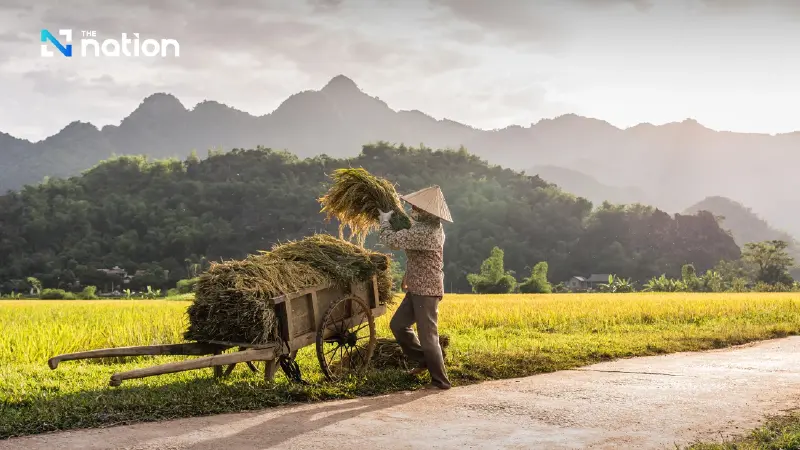


Vietnam is undertaking a major restructuring of its rice industry, shifting towards low-carbon production and higher value-added output while expanding into African and Asean markets, DITP says.
The Thai Trade Centre in Ho Chi Minh City, under the Department of International Trade Promotion (DITP), reports that Asia’s rice production sector, including Vietnam, is undergoing a major structural shift.
The focus is moving away from expanding cultivation areas and increasing output towards raising the economic value generated per unit of land, amid a broadly balanced global rice supply.
In the 2025–2026 production year, global rice output is forecast at around 556.4 million tonnes, while many countries have already achieved food security at a self-sufficient level.
The key drivers in the next phase are no longer higher production volumes, but pressure from climate change, greenhouse gas reduction requirements, and stricter import standards in world markets. As a result, the traditional quantity-driven growth model is no longer aligned with today’s international trade and economic environment.
Vietnam is therefore accelerating the transformation of its rice sector towards a “rice economy” model, in which rice sits at the centre of the value chain. This approach places emphasis on production processes, product quality, and value creation.
Although Vietnam records an average rice yield of as much as six tonnes per hectare and produces more than 43 million tonnes annually, its capacity to raise output further is beginning to reach its limits.
Future development will therefore focus on improving quality and promoting low-emission production.
Vietnam’s Ministry of Agriculture and Environment has rolled out several key initiatives, notably a project to develop one million hectares of high-quality, low-emission rice cultivation in the Mekong Delta, alongside a plan to reduce greenhouse gas emissions in crop production from 2025 to 2035.
Participating farmers are required to comply with standards including alternate wetting and drying (AWD) water management, reduced use of fertilisers and chemicals, and proper straw management. Pilot results show methane emissions can be cut by around 20–40%, while farmers’ net profits can rise by more than 30%.
In addition, Vietnam is developing a measurement, reporting and verification (MRV) system to certify carbon credits in the agricultural sector. It is also promoting the use of drones for seeding and fertiliser application, as well as digital production data-recording systems, to meet international import market requirements.
Institutionally, agricultural cooperatives serve as the central mechanism for organising cultivation, linking farmers with the business sector, and strengthening bargaining power across the value chain.
On the export front, in January 2026 the Philippines remained Vietnam’s leading market, importing more than 331,000 tonnes worth US$147.4 million, accounting for about 51% of total export volume.
At the same time, market diversification is becoming clearer. In 2025, Ghana increased rice imports from Vietnam by 21.3%, Côte d’Ivoire by 67.5%, and Bangladesh by as much as 125 times, reflecting the potential of emerging markets to reduce reliance on a single major buyer.

At the regional level, Vietnam has proposed cooperation on the development of climate-resilient seed varieties, joint alignment of low-carbon production standards, and has called on international financial institutions to provide support through climate finance mechanisms and results-based payment schemes in order to back the restructuring of the regional rice value chain.
For Thai businesses, these changes bring both pressure and opportunity. On one hand, Vietnam may become more competitive in the mid- to lower-end rice market segments in Asean and Africa.
On the other, rising demand generated by this large-scale programme for agricultural technology, machinery, digital systems, and sustainability certification services is opening up new business opportunities for Thai companies.
Businesses should therefore accelerate efforts to raise production standards in line with environmental requirements, develop products with differentiated quality and greater value-added, and closely monitor carbon market policies and international trade standards in order to preserve long-term competitiveness.
